
For many people considering breast reduction surgery,
one of their greatest concerns is
the “scars left after surgery.”
Because the procedure involves directly excising and suturing skin and tissue,
it is impossible to guarantee that no scars will remain at all.
However, the goal of modern plastic surgery is to ensure that, over time,
scars heal into a thin, soft, and inconspicuous state.
In today’s post, rather than simply reducing the length of the incision,
we will discuss the key principles of “skin-tension distribution” and
“three-dimensional structural design,” which are far more important.
The Key Factor Determining Scar Size
Not the Incision Length, but “Skin Tension”

The course of breast reduction scars is influenced far more by the tension—the pulling force exerted on the incision after surgery—and by gravity than by the incision length alone.
Our bodies are constantly affected by gravity,
and the weight of the breast tissue remaining after surgery
continuously exerts tensile force in a downward direction.
When strong tension becomes concentrated around the wound,
the risk of the scar widening or becoming raised increases.
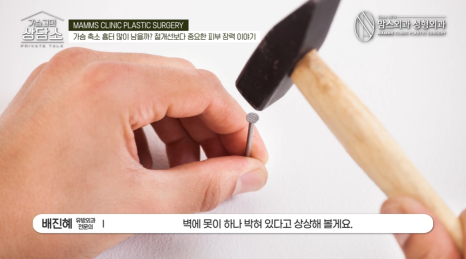
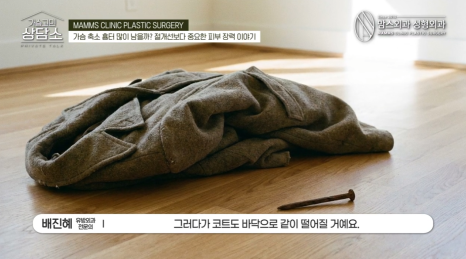
Even a small, lightweight nail set into a wall
can become loose and eventually fall to the floor
if a thick, heavy coat is hung on it for a long time.
Likewise, unless the weight and tension of the tissue placed on the suture line in a breast surgery incision are fundamentally reduced,
the suture line will inevitably stretch over time.

Therefore, successful breast reduction surgery requires
three-dimensional planning that firmly distributes tension
from the inner tissues outward,
rather than forcibly shortening the visible incision.

① Tension-Calculation Planning That Considers Various Dynamic Positions
The direction and intensity of skin tension differ completely
when the body is standing still, lying down,
or moving.
Therefore, during the preoperative design stage,
it is necessary to precisely calculate in advance the areas where tension will be most concentrated in various positions—not only while standing upright—and determine the extent of tissue excision accordingly.

② Three-Dimensional Tension Distribution Through Multi-Layer Suturing
Simply applying suture tape to the skin surface for an extended period
is only a two-dimensional approach.
Starting from the deep surgical layers close to the chest wall,
structural support must first be established
so that the inner tissues can be stably supported.
Then, by distributing tension step by step across multiple layers,
including the dermal layer,
the burden placed on the outermost skin surface is reduced.

③ Repositioning the Center of Gravity and Preventing Excessive Creasing During Suturing
The heavy tissue in the lower breast is precisely excised,
and the center of gravity is lifted upward
so that gravity does not pull strongly on one particular area.
If the skin is excessively gathered and sutured
in an effort to shorten the incision,
strong restrictive forces can develop around the areola or along the vertical incision.
As a result, the areola may enlarge later,
or the incision may lengthen as though it were pulling apart,
so caution is needed.
Scar-Healing Environment and Individual Factors
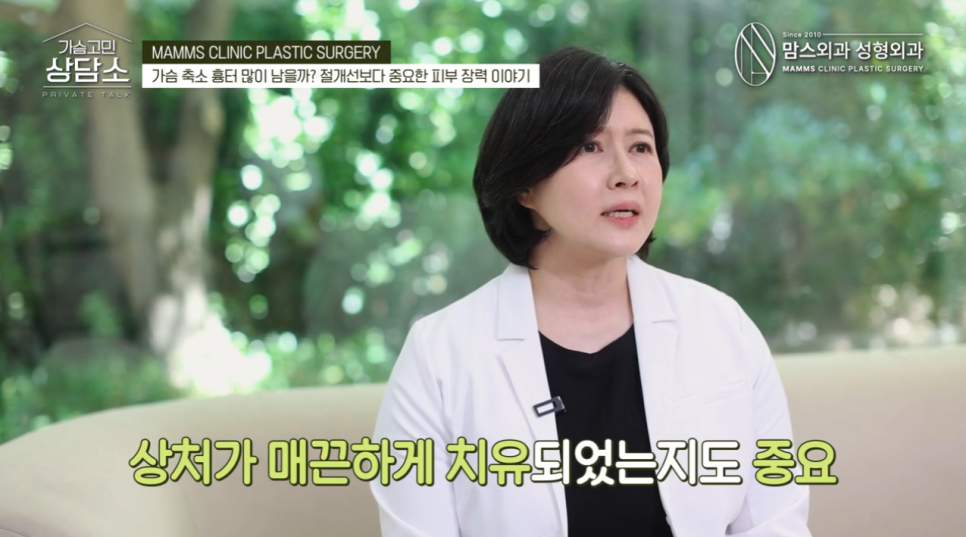
In addition to the surgical technique,
the final appearance of a scar varies depending on whether the wound has an environment in which it can heal smoothly and stably.
✅ Surgical factors
Preventing inflammation or infection at the surgical site and maintaining a smooth healing process
✅ Individual factors
Smoking status, body mass index, and a predisposition to hypertrophic scars or keloids
A Systematic Postoperative Care System

Scar care after breast reduction surgery
does not end in the operating room.
Personalized aftercare according to skin type
helps improve the overall quality of the surgical outcome.
✅ Daily care
Adequate use of moisturizer, along with compression and protection using silicone-based gels or sheets
✅ Professional medical care
Scar laser treatments appropriate to the stage of healing may be performed alongside follow-up monitoring.

The key to reducing scars after breast reduction surgery
is not “forcibly making the incision shorter,”
but “creating an environment in which the skin can heal comfortably
through three-dimensional tension distribution.”
Careful surgical planning that firmly supports the inner structures
and appropriately distributes the effects of gravity
provides the foundation for achieving a natural and satisfactory
breast shape and scars even after many years.