

Lower Eyelid Surgery for Middle-Aged Adults Is Not Necessary for Everyone
Hello.
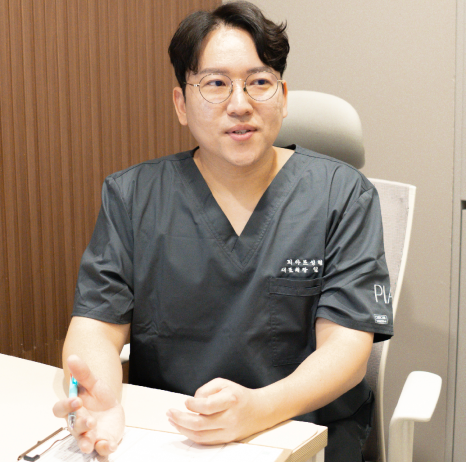
I’m Jin-Young Lim, the chief director of Piap Clinic.
There is a saying,
"No one can win against time."
When you look at eyes that have become saggy and puffy under the weight of time,
you really feel the truth of that saying.
Even comments from acquaintances like,
"You seem much more tired lately,"
are not easy to brush off.
Even if you finally make the difficult decision
to undergo lower eyelid surgery because of such concerns,
you may still have anxiety in your heart.
Will recovery after surgery be delayed?
Will it look too artificial?
..
The considerable cost may also feel like a burden.

So today, I have prepared this post for those of you who have these concerns.
I’d like to talk about
"When middle-aged lower eyelid surgery is needed and what to watch out for."
It’s not a difficult topic.
Take your time reading it,
and I hope you make the choice
that is truly helpful for you.
Middle-aged lower eyelid surgery:
When is it needed?
Changes around the eyes that occur with age
are a concern for many people.
In particular, sagging under the eyes
or the appearance of protruding fat
can make the face look darker.
This goes beyond a simple cosmetic issue,
and can lead to various inconveniences in daily life.
One method used to improve these problems around the eyes
is lower eyelid surgery.

If you have the following symptoms,
you may want to consider middle-aged lower eyelid surgery.
First,
"when the lower eyelid sags."
This happens as skin elasticity decreases.
It can make you look tired,
or make you appear older than your actual age.
Also, like trying to write on wrinkled paper...
deep wrinkles may make makeup apply poorly,
which can be inconvenient.
Second,
"under-eye swelling caused by protruding orbital fat."
The fat around our eyes is originally
covered by a strong membrane.

Lower Eyelid Surgery for Middle-Aged Adults Is Not Necessary for Everyone
As we age, this membrane gradually weakens.
It is similar to the stitching on a cushion cover that has been used for a long time, with the threads slowly coming apart one by one.
Just as cotton comes out through broken stitches, fat pushes outward through the weakened membrane.
At first, it may only look slightly puffy...
but over time, the under-eye area can become uneven, like a cushion with stuffing popping out in several places.
This can also lower confidence in social situations.
Third,
"frequent tear pooling due to a sagging tear trough."
This is one of the issues that can cause significant inconvenience in daily life.


When the tear trough becomes looser,
tears do not drain properly.
It is like a clogged drain.
As a result, the eyes may become bloodshot easily,
or you may feel a foreign-body sensation.
In particular, symptoms may worsen when cold wind blows
or in dry weather.
The severity of these symptoms can vary from person to person.
However, a common feature is that they tend to worsen gradually with age.
Therefore, it is important to consult with medical professionals
to find the appropriate way to improve them.

What should you keep in mind for middle-aged lower eyelid surgery?
Before talking about precautions,
I think it is important to understand the surgical methods in detail.
Lower eyelid surgery can be broadly divided into
"skin incision method" and "conjunctival incision method."
First, the skin incision method
is a method that makes an incision in the skin directly below the eyelashes.
Through the incision,
a sagging skin, muscle, and fat are repositioned or removed.
For this reason, it is suitable for people with more severe skin sagging.
On the other hand, the conjunctival incision method
is a surgical method performed through the inside of the eye.
Because there is no external incision,
it has the advantage of leaving no scar.
It is mainly considered when skin sagging is not severe,
but fat protrusion is present.
Both methods are effective
for improving the under-eye area.
For more satisfactory results,
it is important to choose the method that is truly right for you.
This is because skin elasticity,
the condition of the fat layer,
and muscle tension vary greatly from person to person.
For example, let’s assume a patient has both skin sagging
and protruding fat.


What would happen if the conjunctival incision method
were applied to such a person?
Because the conjunctival incision method does not address the skin or muscles,
there would be limits to improving skin sagging.
As a result, additional incisions or procedures may be necessary.
Therefore, for such people,
it is better to choose the skin incision method from the beginning.
to reduce unnecessary repeat surgery
and additional costs.
In particular, in middle age,
the skin is thinner and more sensitive.
That is why a more careful approach is needed.


If too much fat is removed when the skin is thin,
the eyes may instead appear sunken.
This can also make the eyeballs look more prominent.
In the end, rather than looking younger,
the person may end up appearing more tired.
So I hope you do not choose a method simply because
"others had it" or "this method leaves fewer scars."
The most important thing is to accurately understand your own condition.
And please remember that you should choose the optimal method
that matches it.



Previous image
Next image
Lower Eyelid Surgery for Middle-Aged Adults Is Not Necessary for Everyone
Today, I wrote this post for those who need middle-aged lower eyelid surgery.
To summarize the main points,
| 1. Cases with severe sagging under the eyes or discomfort caused by fat |
|---|
| 2. It is important to proceed with the method best suited to you |
I hope this information helps you regain a brighter daily life.
This has been Jin-Young Lim,
the chief director of Piap Clinic.
Thank you.

| Piap Clinic |
|---|
| Main number: 02-420-8883 |

| This post complies with Article 56 of the Medical Service Act and was written directly by Piap Clinic to provide accurate medical information. All treatments may cause side effects depending on the individual, so please proceed only after sufficient consultation. |