
Lower Eyelid Surgery in Your 40s,
There Is Another Reason It Fails
I’m in my 40s and considering lower eyelid surgery.
But I’m worried because I’ve heard that the area under the eyes can sag again, or that the results may not be satisfying.
Hello.
I’m Lim Jin-young, CEO doctor of Piap Clinic.
As we age, if the area under the eyes sags or becomes puffy,
it can make us look tired.
For this reason, many people consider lower eyelid surgery.
However, if you search for information online,
reviews about side effects or revision surgery will likely catch your eye.
These points make it even harder to make a decision and increase worry.
So today, for those of you with these concerns,
I’ve prepared an explanation of:
| - Various methods of lower eyelid surgery in your 40s |
|---|
| - Causes of reduced satisfaction |
| - Things to watch out for |
Please read to the end,
and I hope it helps ease your concerns.
| Lower eyelid surgery in your 40s, |
|---|
| What exactly is it? |
Simply put, it is a surgery that improves the unnecessary fat and loose skin that have accumulated under the eyes.
Usually, once you enter your 40s and 50s,
skin elasticity declines, and the fat under the eyes starts to protrude.
As a result, dark circles or wrinkles may appear more pronounced.
These changes have a big impact on the overall impression of the face.
At this stage, lower eyelid surgery in your 40s can create a more youthful and lively eye area.
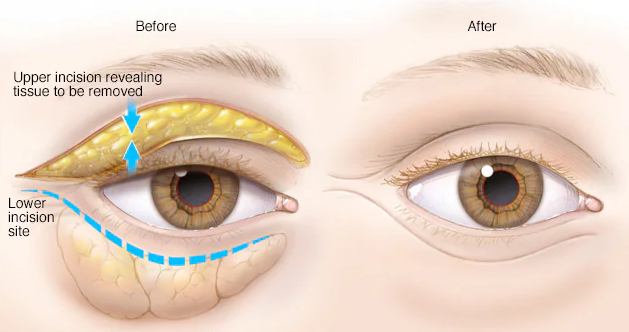
The surgical methods are broadly divided into two types: the “skin incision method” and the “conjunctival incision method.”
Let’s look at the advantages and disadvantages of each, and who they are suitable for.
- Skin incision method
This is a method in which an incision is made just below the lower eyelashes.
Through the incision,
fat is removed or repositioned,
and the loose skin is trimmed away to tighten the area.
Because of this, it is suitable for cases with many wrinkles or reduced elasticity.
It can be especially effective for middle-aged patients with significant sagging.
However, because it involves an incision,
there may be a scar.
 Lower eyelid surgery in your 40s,
There Is Another Reason It Fails
In most cases, it overlaps with the wrinkle lines under the eyes,
so it is naturally concealed.
There is no need to worry too much.
Instead, after surgery,
it is best to get enough rest
and take care of bruising and swelling.
- Conjunctival incision method
This method removes or repositions fat by making an incision inside the eye, that is, through the conjunctiva.
Its advantage is that it does not leave a scar.
Recovery is also relatively quick.
However, a drawback is that it is difficult to correct loose skin.
So for middle-aged patients with significantly reduced elasticity, it may have limitations.

This method can be considered when the sagging is not severe,
and when bulging fat is the main cause.
It can also be a good option for those who want a natural improvement without worrying about scars.
As you can see, the appropriate method can differ depending on the patient’s condition and concerns.
To achieve a satisfying result,
it is best to receive an accurate diagnosis.
| Lower eyelid surgery in your 40s, |
|---|
| Why does satisfaction decrease? |
After lower eyelid surgery,
most people expect the eye area to become firmer and look younger.
However, unfortunately, the desired effect may not appear,
or the result may end up being unsatisfying.
Usually, the condition of the skin may be the cause.
Today, let’s take a closer look at cases where “the skin is thin” and “elasticity around the eyelashes is reduced.”
- When the skin is thin,
it may look uneven or recur.
People with thin skin may not have a smooth area under the eyes even after surgery.
Wrinkles may form, or blood vessels may become visible.
Over time, you may also feel that the area sags again.
This is because thin skin lacks elasticity and has weaker support for the fat.
As a result, the skin often does not settle smoothly after surgery.
It is similar to putting something into a thin paper bag.
In particular, if the orbital septum (the membrane that surrounds the fat under the eyes) is weak,
the fat may push out again and make the area under the eyes look puffy.
In such cases, it is a good idea to combine the procedure with “orbital septum reinforcement.”
This is a method that makes the orbital septum more secure.
Then it can help prevent the fat from pushing out again.
By using this method, even people with thin skin can maintain stable results after surgery.
 Lower eyelid surgery in your 40s,
There Is Another Reason It Fails
- When the elasticity around the eyelashes is reduced,
the lower eyelid may feel pulled or turn outward.
When searching for side effects after lower eyelid surgery,
you will often come across the term “ectropion.”
This refers to a symptom in which the eyelid turns outward.
Why does this happen?
As we age, the elasticity around the eyelashes and the support of the outer corner of the eye (the lateral canthus) weaken.
If tissue is removed in this state, the shape of the eye may change.
In severe cases, the eyelid may be pulled downward and may not close properly.
To help you understand, let me give an example.
A new bird net has all its threads tightly connected.
But if some of the threads break, the whole structure begins to sag from that point.

What happens if you simply cut out only the problematic part at that time?
More force will be placed on the remaining parts, causing them to sag even faster.
The eyelid is the same.
Because of this, simply removing skin alone may not solve the problem.
In such cases, “lateral canthopexy” may help.
This surgery firmly connects the lower eyelid to the bone near the outer corner of the eye.
It helps prevent the lower eyelid from being pulled downward.
Through this, you may be able to achieve more satisfying results without worrying about side effects.
So far, we have looked at the methods of lower eyelid surgery in your 40s
and the causes of reduced satisfaction.
In conclusion, lower eyelid surgery is not simply a matter of removing skin and trimming fat.

If the skin is thin or the elasticity is reduced,
additional reinforcement may be necessary.
Therefore, it is important to make the best decision through sufficient consultation with the medical staff.
I hope this helps you maintain natural-looking results for a long time.
This has been Lim Jin-young, CEO doctor of Piap Clinic.
Thank you.

| Piap Clinic |
|---|
| Main number: 02-420-8883 |

| This post complies with Article 56 of the Medical Service Act and was written directly by Piap Clinic to provide proper medical information. All treatments may cause side effects depending on the individual, so please proceed after sufficient consultation. |