Hello.
I’m Lim Jin-young,
Chief Director of Piap Clinic.
Are you worried about
upper eyelid drooping?
Every time you look in the mirror,
your sagging eyelids
are probably bothering you,
and your field of vision
may feel obstructed,
causing various inconveniences.
That may be why you
are looking for a place
that does upper eyelid surgery well.
But did you know
there is something
that must be checked first?
That is,
what is causing
the changes that are appearing now,
and whether surgery
is truly necessary
for you.
You need to know this accurately.
Depending on whether it is simply due to aging
or whether there is another cause,
the solution can differ.
So today, I’ll explain this
in detail.
I’ll also tell you
important criteria to consider
when looking for a good clinic.
If you read through to the end,
you will be able to find the answer.

Upper eyelid surgery,
start by looking at the cause
Some of you may even be unfamiliar
with the term “upper eyelid.”
Simply put,
it refers to the upper eyelid.
In fact, this area has thin,
delicate skin,
so it is one of the first places
where changes appear as we age.
That is why when the eyelids
start to droop, many people
simply think,
“I guess it’s because I’m getting older.”
But that is not entirely true.
It is too complex a matter
to say it is only due to age.
Genetic factors and lifestyle habits
also play a major role.
For example, exposure to ultraviolet rays,
the habit of squinting frequently,
even the gravity we live with every day
affect the upper eyelids.
Over time, this causes the eyelids
to droop more and more.
It is like a rubber band that,
after being used for a long time,
stretches out
and loses its elasticity.
The upper eyelids are similar.
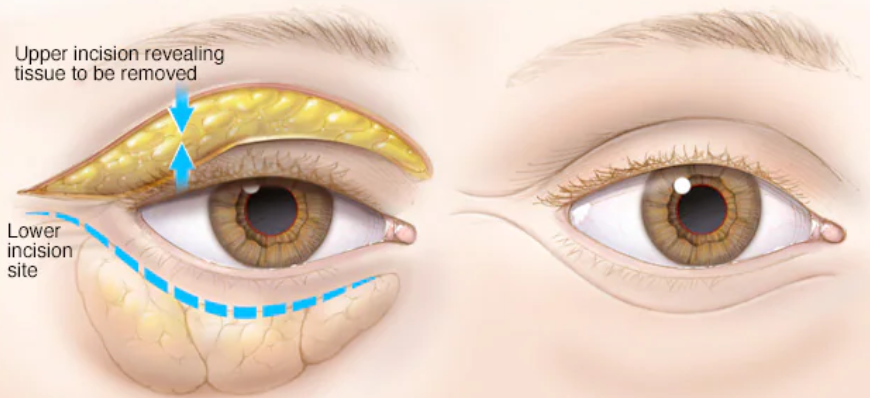
The thin skin and the tissues
supporting it underneath gradually weaken
or become disorganized,
changing their shape.
As this happens,
the fat in the eyelids also changes.
Fat may push forward,
making the eyelids look puffy,
or it may decrease,
causing deeper wrinkles to form.
So at first, people may only think,
“Have my eyes just gotten a bit droopy?”
But as these changes build up,
the eyelids can begin to feel heavier,
and opening the eyes may become difficult.
The problem is that these symptoms
can affect other areas as well.
For example, to open the eyes wider,
people end up repeatedly using
the forehead muscles.
Over time, fatigue accumulates,
which can also cause headaches.
Upper eyelid surgery is often needed
not simply to look better,
but to relieve these inconveniences.
The surgery usually involves
removing sagging skin and fat,
and restoring weakened muscles.
It is like tightening
a worn, uneven tent.
Then the eyelids become lighter,
opening the eyes feels easier,
and you may feel that a blocked field of vision
has become much wider.
So if you are wondering,
“Do I need surgery?”
because of the symptoms above,
I recommend first consulting with a medical professional.
If discomfort can be improved
and you can live better,
considering surgery can also be a wise choice.
Upper eyelid surgery,
useless without ‘this’?
The most important thing
when planning upper eyelid surgery
is an accurate diagnosis.
That is because the approach changes
depending on what caused the eyelid to droop.
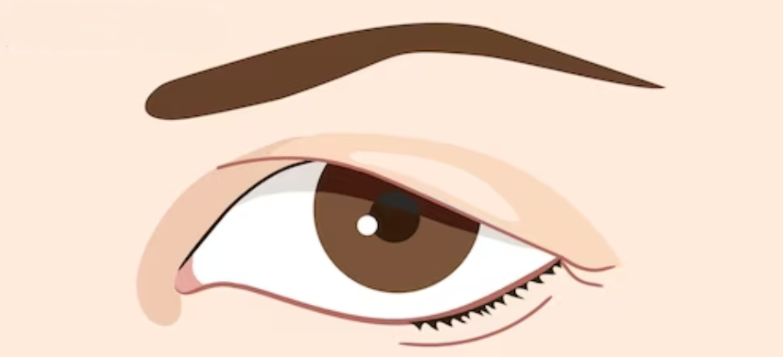
For example, if you had upper eyelid surgery
because your eyelids looked heavy,
but it turned out that the muscle
that lifts the eyes was weakened?
In that case, simply removing skin
will not solve the problem.
In fact, over time,
you may feel that the eyelids have drooped again.
In severe cases, your eyes may feel even more tired,
or you may even experience side effects
such as difficulty opening them properly.
To explain it more simply,
it is like changing only the wallpaper
when a house has a leaking pipe.
You need to find where the water is leaking from
and reinforce the structure,
or the same problem will keep happening.
Upper eyelid surgery is the same.
If you only look at the problem
that is visible on the surface and operate,
the symptoms may improve temporarily,
but the functional issues will be missed.
In the end, satisfaction will inevitably decrease.
So when looking for a place
that does upper eyelid surgery well,
you should check whether they carefully examine
even these details.
= Thickness of the eyelid skin
= Muscle tension and amount of fat
= Habits of using the forehead and eyebrows
Some people unconsciously use their forehead
to help open their eyes.
In such cases, upper eyelid surgery alone
may not be enough.
Additional procedures such as forehead or eyebrow lift
may be necessary.
Also, the eyes blink thousands of times a day,
constantly moving without rest.
So if the structural cause is not properly identified
before treatment,
an unnatural appearance may actually result.
In the end, upper eyelid surgery is a process
of delicately balancing the harmony of skin,
muscle, and fat within the small space of the eyelid.
And that process begins with an accurate diagnosis.
Only by understanding the cause properly
can you know what method is truly right for you,
and I hope you remember that
you can maintain a comfortable, natural-looking eye shape
for a long time.
Today, I gave advice for those
looking for a place that does upper eyelid surgery well.
In the end, the most important thing is
“accurately identifying the cause
and finding the right method for it.”

Thank you for reading this long post.
This was Lim Jin-young,
Chief Director of Piap Clinic.

| Piap Clinic |
|---|
| Main number: 02-420-8883 |