
Hello.
This is Lim Jin-young,
Chief Director of Piaf Clinic.
Among the names that come to mind when you think of “lifting,”
Ulthera is definitely one of them.
However,
many people do not really know
exactly what Ulthera is,
or how it differs from other lifting treatments.
But it can be hard to choose
simply because it is famous,
or because people around you say it is good,
without a clear understanding.
So today,
I’m going to systematically explain
what the principles behind Sinnae-dong Ulthera are,
what effects you can actually expect,
and what you should know
in order to get proper results.

If you read this article to the end,
your questions about Ulthera
will be clearly answered.
Let’s begin.
Sinnae-dong Ulthera,
shall we start with the principles?
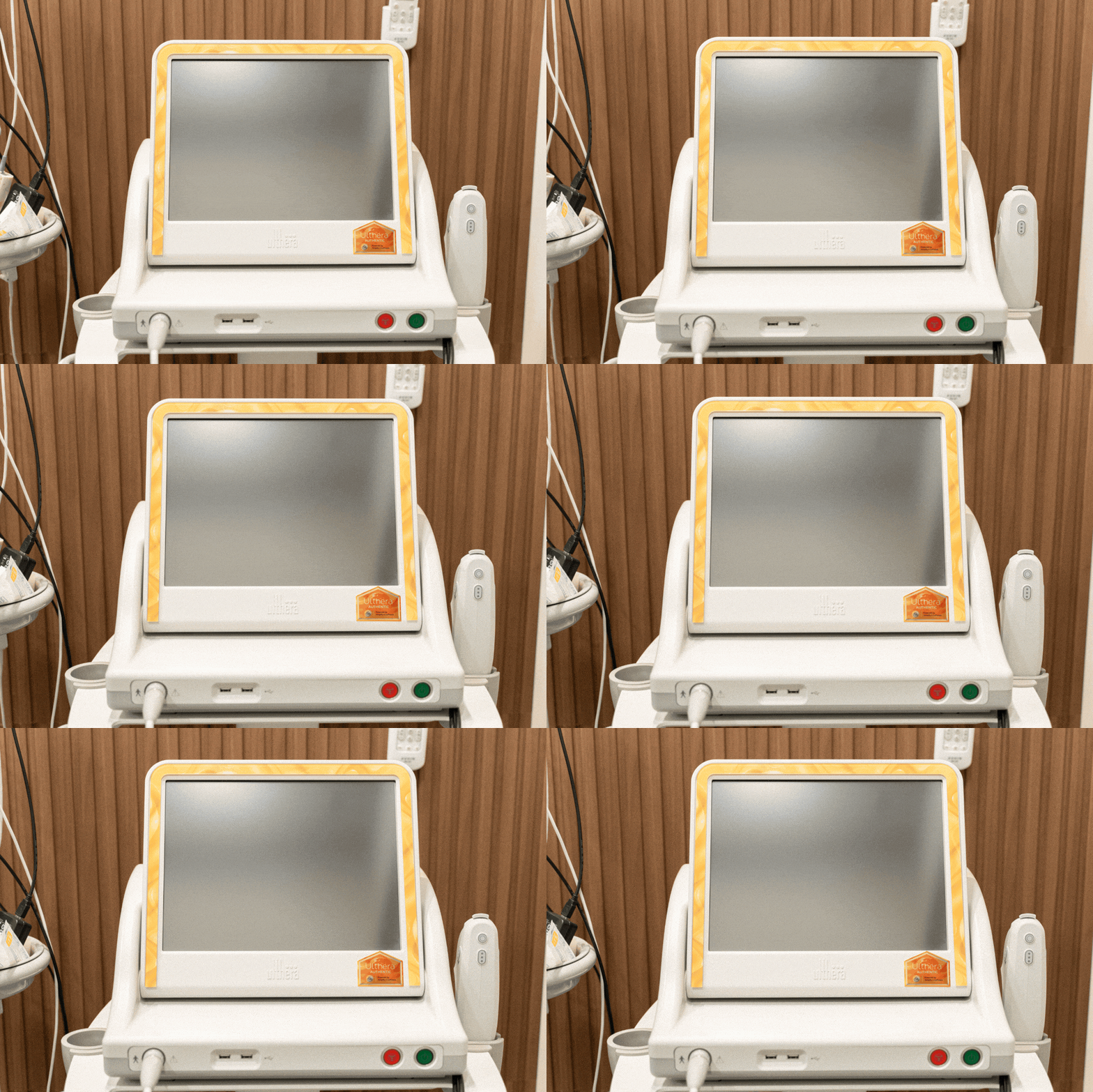
Ulthera is a lifting device that
uses ultrasound energy.
It delivers energy not to the skin surface,
but deep within the skin,
and works by tightening tissue
that has lost elasticity.
The key layer here is the
“SMAS layer.”
The SMAS layer is a thin membrane-like structure
located between the skin and the muscles,
and it acts as a kind of support base
that holds up the entire face.
As we age, when this layer
becomes loose and starts to sag downward,
the cheeks lose their shape,
the jawline becomes blurred,
and the face as a whole can look tired.

Sinnae-dong Ulthera reaches
this SMAS layer directly,
applies thermal stimulation
with ultrasound energy,
and contracts loosened tissue,
while inducing a collagen
regeneration response in the process.
This is how elasticity is restored
from deep within the skin.
Another strength of Ulthera is that
it is equipped with an ultrasound imaging device.
The practitioner can check the skin’s internal structure
in real time and adjust the location and depth
where the energy is delivered.
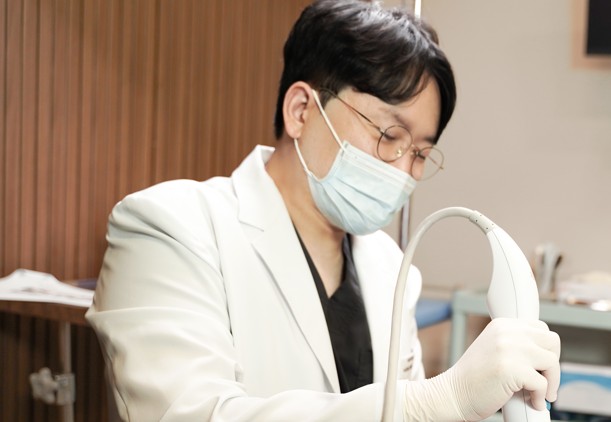
Thanks to this, more precise
and stable treatment is possible.
The required depth differs
depending on the degree of sagging,
and skin thickness varies greatly
by area, so this kind of customized adjustment
is extremely important.
In the end, Ulthera is not just about pulling
the skin that is visible on the outside,
but about correcting the structure
that supports the face itself,
and creating a natural, defined lifting effect.
Sinnae-dong Ulthera,
is the effect really good?
So then, what kind of changes
can you actually feel?
The first thing you’ll notice is
a more defined jawline.
The facial contour that had looked vague and sagging
will begin to gradually become more distinct
from right after the procedure.

The skin that had been sagging under the cheeks
is also lifted upward,
making the entire face look
a little more tightened and refined.
In many cases, the double chin
and the line around the neck
also improve.
In particular, people whose skin itself is thin
or has lost a lot of elasticity
may notice these changes more quickly.
However, Ulthera’s effects
do not appear all at once;
they tend to emerge gradually over time.
You may feel a slight immediate lifting effect
right after the procedure,
but the real changes are completed gradually
over the course of 2 to 3 months.
That is because the processes of
collagen regeneration and tissue reorganization
take time.
So when you look in the mirror a month later,
then two months later,
you may think,
“Hmm? Something looks different.”
The duration of the effect varies from person to person,
but it is generally known to last about
1 year to 1.5 years.
After that, depending on your skin condition,
additional treatments can be considered.
However, please remember that all of these effects
can only be expected when the right amount of energy
is delivered to the correct location.
Not for everyone
“Ulthera is good, so can’t I just get it done?”
It’s easy to think that way,
but in fact, lifting is an area that requires
far more of a personalized approach
than you might expect.
Everyone’s skin thickness,
elasticity, direction of sagging,
fat distribution, and muscle mass are different.
Even at the same age,
some people may have severe cheek sagging,
while others may only have
a weakened jawline.
Some people may have reduced elasticity
throughout the entire face,
while others may need focused care
only in specific areas.
In addition, lifestyle patterns
are also important.
Whether you can secure enough recovery time
after the procedure, how sensitive you are to pain,
whether you have had previous procedures,
and so on.
All of these conditions must be considered
in order to choose the lifting method
that is truly right for you.
So Sinnae-dong Ulthera
may not be the best choice for everyone.
In some cases, a radiofrequency method
may be more suitable,
and in others, combining two methods
may produce better results.
For example, if the skin is thin and sensitive,
the energy intensity must be adjusted delicately,
and if the fat layer is thick,
a setting that can stimulate deeper layers is needed.
Such judgments are impossible
without an accurate understanding of the skin condition.
So rather than simply thinking,
“It’s a famous procedure,”
it is much wiser to approach it by asking,
“Is this a procedure that suits my skin?”
So far,
I have explained the principles and expected effects
of Sinnae-dong Ulthera,
and why a personalized approach
is important for each individual.
To summarize the key points:
First, Ulthera uses ultrasound energy
to reach the SMAS layer,
contracting loosened tissue and inducing
collagen regeneration.
Second, you can expect gradual and natural changes
across the overall facial contour,
including jawline definition,
cheek lifting, and improvement of a double chin.
Third, since skin condition and lifestyle
are all different,
you should carefully judge whether
it is the right method for you.
Lifting is not something to decide
based only on the name of the device.
Understanding your skin properly
and finding the method that suits it
is the surest path to satisfying results.
Thank you for reading all the way to the end
of this long article.
This has been Lim Jin-young,
Chief Director of Piaf Clinic.
Related columns you may also like


| Contact information |
|---|
| Main number: 02-420-8883 |
