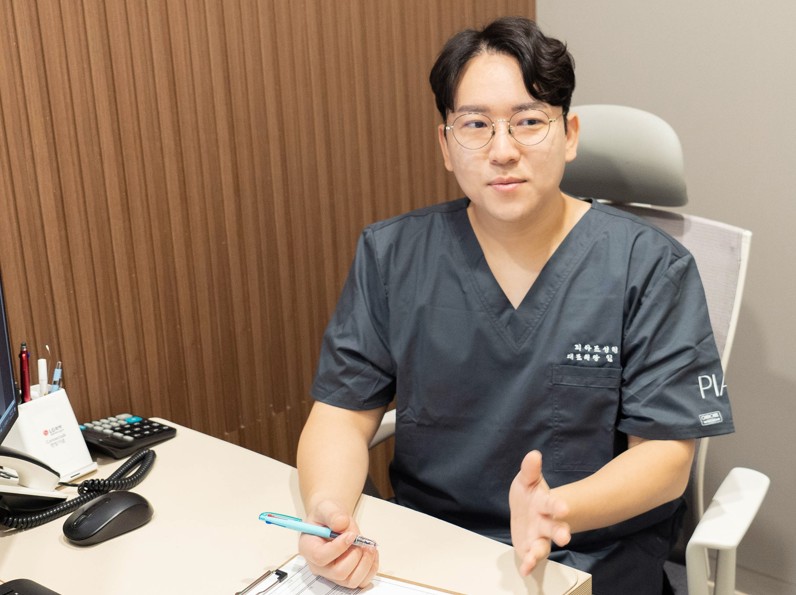
Nice to meet you.
I’m Jin-young Lim, CEO and chief doctor of Piap Clinic.
While looking into lifting procedures
and searching for Thermage,
you probably came across this post.
You may have been struggling
with jawline or skin laxity concerns.
“Thermage is supposed to be good,
but what exactly is the mechanism?”
“Could there be side effects?”
These thoughts may have been
running through your mind.
Today, I’ll organize everything
from how Thermage works
and when side effects can occur,
and also what changes appear
after the procedure.
If you read this post to the end,
your vague expectations or concerns
about Thermage will turn into a clear understanding.
Thermage:
The effect starts with “OOO contraction”
To understand Thermage’s effect,
you first need to know
what radiofrequency is.
Radiofrequency delivers thermal energy
deep into the dermis,
rather than to the skin’s surface.
When this heat reaches
the collagen tissue in the dermis,
an immediate contraction response occurs.
The stretched collagen fibers shorten
because of the heat,
which tightens the skin.
This “collagen contraction” process is
what creates the initial lifting effect
felt right after the procedure.
But that is not the end.
The dermis that received the heat stimulus
begins a natural response
to repair the damaged tissue.
In this process, new collagen
begins to form slowly.
It is usually produced gradually
over 2 to 3 months,
so elasticity improves little by little.
Therefore, Thermage can be seen as
a procedure with both immediate effects
and delayed effects.
The reason the jawline seems to lift immediately
is because of contraction,
and the reason skin texture improves over time
is because of regeneration.
These two processes work together
to complete the lifting effect.
That is why it is important not to judge
based only on the result right after the procedure,
but to observe the progress for at least 2 months.
Most side effects come from “OOO adjustment failure”
Among Sungnae-dong Thermage side effects,
the most commonly reported are hollow cheeks and asymmetry.
These problems occur because
energy was delivered too much
to the wrong location.
For example,
if excessive heat is applied
to someone with little cheek fat,
the fat layer may melt away,
which can cause the cheeks to look sunken.
On the other hand,
if the energy needed for the jawline
is concentrated in the front of the cheeks,
the jawline may remain unchanged
while the cheeks become more prominent,
resulting in a duller appearance.
Another side effect is
burns and pigmentation.
If too much radiofrequency heat accumulates,
damage can occur on the skin’s surface,
leaving red marks or dark spots.
These cases usually happen when
the cooling system does not work properly
or when the energy intensity
is adjusted incorrectly.
In the end, the key issue behind side effects is
“where the energy is delivered,
and how much is delivered.”
Even with the same device,
if shots are fired without analyzing the facial structure,
the risk of side effects
is bound to increase.
That is why, before the procedure,
it is necessary to accurately assess
skin thickness, fat distribution,
and the degree of sagging.
Sungnae-dong Thermage effect:
You also need to understand “individual differences”
Even with the same procedure,
some people see a dramatic lift in the jawline,
while others feel little change.
This difference comes from
each person’s skin condition.
First, skin thickness
has a major impact on the effect.
If the skin is relatively thick,
radiofrequency heat may not reach
the dermis sufficiently,
so the effect may be less noticeable.
Conversely, if the skin is thin,
the heat stimulus may be delivered too strongly,
which increases the risk of damage.
Next, the distribution of the fat layer
is also an important variable.
People with more fat need energy to be delivered
to deeper layers,
so a relatively higher intensity is required,
while those with less fat
can achieve sufficient results
with lower intensity.
Age also matters.
After the age of 40,
collagen regeneration slows down,
so even with the same stimulus,
the effect may appear more slowly
than in people in their 20s or 30s.
Therefore, Sungnae-dong Thermage
is not a procedure that guarantees
the same result for everyone.
Because the degree and speed of effect vary
depending on your skin condition, age,
and fat distribution,
it is important to make the decision
based on realistic expectations
rather than blind hopes.
So far, I’ve organized the mechanism,
side effects, and individual differences
of Sungnae-dong Thermage.
To summarize the key points once more:
Thermage is a procedure that uses radiofrequency heat
to contract and regenerate collagen,
side effects mostly arise from
energy adjustment failures,
and the results vary depending on skin thickness,
fat distribution, and age.
A lifting procedure does not guarantee results
simply by choosing a device that is said to be good.
Only when your facial condition is accurately assessed
and the energy is designed accordingly
can you expect safe and effective results.
So rather than vague expectations,
the first priority is to understand
what condition your skin is in now
and which method is suitable.
Thank you for reading all the way through
this long post.
This has been Jin-young Lim,
CEO and chief doctor of Piap Clinic.
Columns you may also like


| Contact information |
|---|
| Main number: 02-420-8883 |
