
Hello.
I’m Lim Jin-young, the chief director of Piap Clinic.
"My under-eyes are bulging,
and I also have dark circles...
I don’t know
which surgery is right for me..."
"When I went in for a consultation,
every hospital said something different...
I’m even more confused about what to trust..."
If you clicked on this post,
you may be having similar concerns.
The more information you look for,
the more confusing it can feel.
I completely understand that feeling.
In fact, there is a reason
for that confusion.
Under-eye surgery
may look similar on the surface,
but the right method
depends entirely on your condition.
If you are currently looking into
Samsung Station under-eye repositioning,
please check the following information first.
Samsung Station under-eye repositioning
Everyone says they had it done
and changed dramatically.
Half true,
half false.
If you look on Instagram
or YouTube,
there are actually many
successful cases.
When you see reviews saying the under-eye area
was smoothed out and the dark circles became lighter,
it’s hard not to feel tempted.
But on the other hand,
it’s not uncommon to see cases
where side effects occurred.
There are stories saying it actually
made the area look more sunken,
or that the bulging was not resolved.
Why do results differ so much
even with the same surgery?
Because the method changes depending on
what problem is being addressed
and how far the correction needs to go.
Understanding that difference
comes first.
Under the eyes, there is a membrane called the
"orbital septum," which holds the inner tissue
in place.
As we age,
this membrane loosens,
allowing tissue to shift forward,
which makes the under-eye area
appear bulged and protruding.
Under-eye repositioning
is a surgery that corrects this stage.
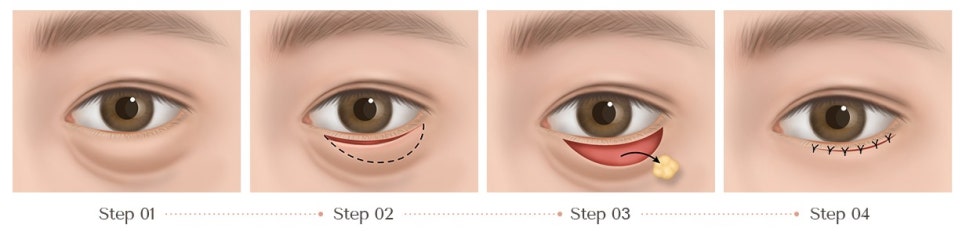
The protruding tissue is moved
to the sunken area,
and the orbital septum is
firmly secured again.
There are two main approaches.
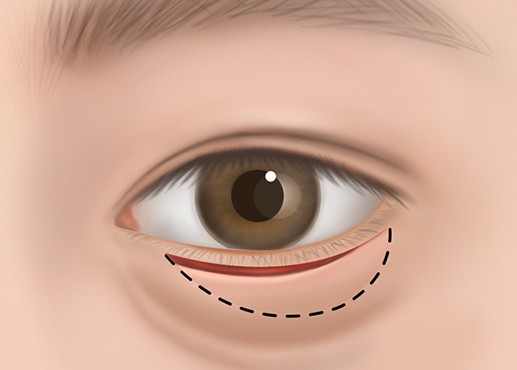
One method is to make a direct incision
in the under-eye skin,
and the other is the
"transconjunctival incision" approach,
which accesses the area through
the inner lining of the eyelid.
Because the transconjunctival approach
does not involve cutting the outer skin,
it has the advantages of no visible scar,
less swelling and bruising,
and a relatively faster recovery period.
That is why it tends to be especially satisfying
for people with relatively good skin elasticity,
particularly those in their 20s and 30s.
However, there is an important point here.

Which method is appropriate depends on
the condition of each person’s under-eye area,
and it is not the right answer for everyone.
So in what cases does under-eye fat repositioning
not solve the problem?
Samsung Station under-eye repositioning
When is it useless?
As mentioned earlier,
under-eye fat repositioning is a surgery that
secures the orbital septum and
repositions the protruding tissue.
Here is something to note.
The orbital septum only addresses the cause
of the tissue shifting forward;
it does not reverse aging
in the skin or muscles.
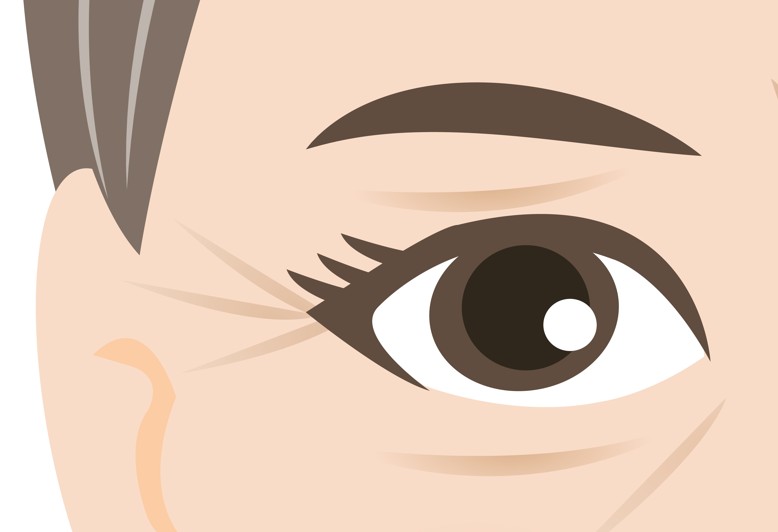
As we age,
the skin under the eyes loses elasticity
and starts to sag,
and the muscles also weaken
and begin to droop downward.
In other words, under-eye concerns often involve
a combination of fat bulging, skin sagging,
and muscle drooping.
Even if the tissue is repositioned
and the orbital septum is secured through fat repositioning,
the already loosened skin
and sagging muscles remain.
This is why some reviews say the bulging was reduced
but the under-eye area still looked saggy,
or that the face looked even more awkward.
To summarize:
If elasticity is still good
and protruding fat is the main concern →
Samsung Station under-eye repositioning may be enough.
If sagging accompanies the fat protrusion →
repositioning alone may be insufficient,
and lower blepharoplasty may be needed.
Samsung Station under-eye repositioning
Then what kind of surgery is lower blepharoplasty?
Lower blepharoplasty is a more comprehensive procedure
than under-eye fat repositioning.
The tissue repositioning and orbital septum fixation
are performed in the same way,
but the key difference is that it also includes
removal of excess skin and reinforcement
of sagging muscles.
The surgical method is divided according to
the degree of sagging.
If skin sagging is pronounced,
a direct incision made just below the eyelashes
is chosen,
and if the sagging is not severe,
a no-incision approach through the conjunctiva
is also possible.
Which method is appropriate is determined after
a precise diagnosis based on skin elasticity,
fat volume, and muscle condition.
However, when looking into lower blepharoplasty,
there is one thing you must check.
That is a design intended to prevent
"ectropion."
Ectropion is a condition in which the eyelid
turns outward,
and it occurs when too much skin has been removed
or the lower-eye muscles are not properly supported.
It can lead to chronic eye irritation
and dryness.
To prevent this,
skin should be removed conservatively,
a suturing process that firmly supports the
sagging muscles should be performed,
and in some cases, canthopexy,
which reinforces the outer corner of the eye,
should also be considered.
In the end, determining which surgery is right for you
requires a precise evaluation of the under-eye area.
Today, we looked at when under-eye fat repositioning
is appropriate, when it is not,
and why.
To summarize the key points briefly:
◇ Under-eye fat repositioning
Orbital septum fixation + repositioning of protruding tissue
Transconjunctival approach — no visible outer scar
Suitable when protruding fat is the main concern and sagging is not present
◇ Cases where repositioning is not effective
A stage where skin and muscle sagging are also progressing
Loose skin and muscles cannot be corrected by repositioning alone
In such cases, lower blepharoplasty may be needed
◇ Lower blepharoplasty
A combined correction involving repositioning + excision + muscle reinforcement
Incision vs. no incision — determined by individual condition
Structural design to prevent ectropion is key

Lastly,
I would like to say this.
When choosing a hospital,
don’t decide based only on places with many reviews
or the lowest prices.
Speaking as a practicing physician,
I recommend visiting at least three hospitals
and getting a detailed examination,
rather than making a decision based only on online information.
If you visit several places,
you will be able to find the hospital
that is right for you.
The more effort you put in,
the more you can prevent regret later.
I hope today’s information was helpful
for those looking into
Samsung Station under-eye repositioning.
This has been Lim Jin-young,
Chief Director of Piap Clinic.
Thank you for reading this long post. 😊
Related articles you may also like

| Contact information |
|---|
| Main number: 02-420-8883 |
