
If you are reading this, you may be looking into under-eye fat repositioning because you often hear things like, “Have you not been sleeping well lately? You look tired.”
Although it is a frequently discussed procedure, under-eye fat repositioning is by no means a simple procedure.
Because the structures around the eyes vary completely from person to person, it is a technically demanding surgery that requires a careful approach.
Since it is a procedure that should be approached cautiously—some even say it should only be performed once or twice in a lifetime—you need to choose a dermatology clinic or hospital based on clear criteria.
In this article, I will explain the three essential criteria you must check when choosing a dermatology clinic in Songpa-gu.
Please read to the end, as this may help you avoid revision surgery costing several million won or more.
Songpa-gu Dermatology Clinic
Does it only reposition the fat?
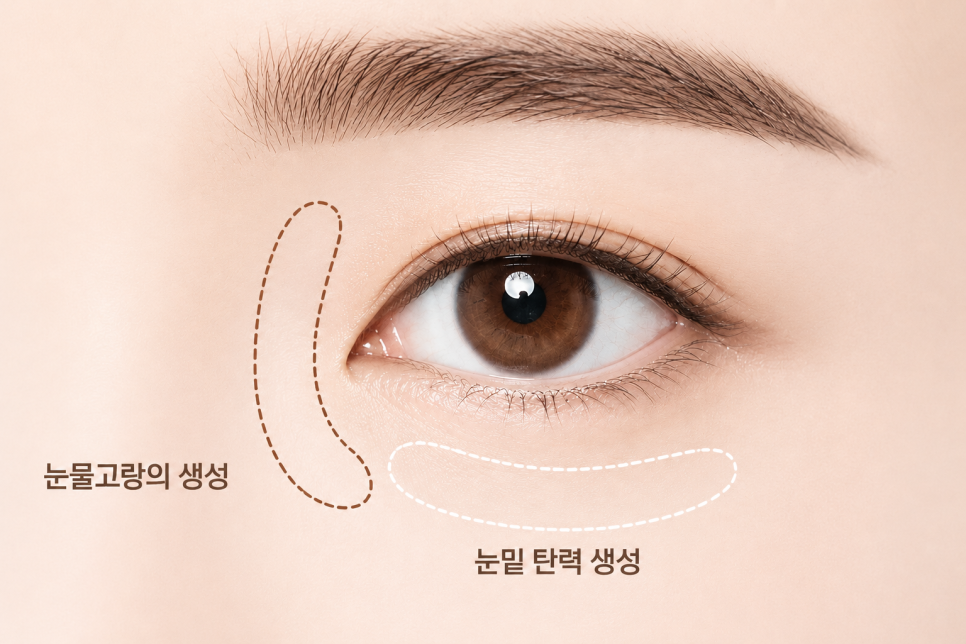
The fundamental reason the area under the eyes becomes puffy is not that the fat suddenly increases.
It is because the wall called the “orbital septum,” which surrounds the tissue and prevents it from protruding, has weakened and lost its strength.
What would happen if the weakened wall were left as it is, while only the protruding fat were roughly flattened downward and sutured?
Over time, the weakened septum would become loose again, causing the tissue to protrude once more.

This is what is known as “early recurrence.”
Therefore, when undergoing surgery at a dermatology clinic in Songpa-gu, the procedure must include pulling the loosened orbital septum tight and firmly fixing it to the periosteum covering the bone.
If this step is omitted, the likelihood of recurrence soon after surgery increases, and you may end up needing revision surgery, which can be several times more complicated and expensive than the initial procedure.
To avoid this situation, be sure to ask during your dermatology consultation whether “septum fixation is performed as well.”
Is it recommended only for people who are likely to see real results?

Many people think, “Under-eye fat repositioning will make everything look smooth and clear.” This is only partly true.
Repositioning, as the name suggests, is a surgery that changes the location of the fat through the inner conjunctiva.
Therefore, if the skin has become loose where the tissue has been displaced, or if significant sagging is already present, fine lines may appear even more crinkled.
To prevent this, the patient’s skin elasticity should be assessed first.
If the skin has good elasticity, the procedure may be sufficient. However, if skin laxity is also present, lower eyelid surgery or micro-grafting may be necessary in some cases.
Alternatively, if elasticity has decreased, laser lifting may need to be performed in combination with the procedure to create a synergistic effect.
Check whether the dermatology clinic objectively assesses your skin condition, and whether it avoids recommending repositioning unconditionally.
The more honestly a dermatology clinic suggests the solutions you actually need, the more satisfactory the results may be.
Is it a 1:1 “custom design”?

You may have seen advertisements online offering the procedure in the 300,000–400,000 won range.
Factory-style dermatology clinics do not have the time to deeply analyze and study each individual patient.
Just as every face is different, the structure under the eyes also varies completely from patient to patient.
-
The degree of flatness of the under-eye bone (infraorbital rim)
-
The depth of the tear trough and the strength of the ligament
-
The volume of the anterior cheek (the area below the under-eye fullness)
The location and amount of fat repositioned should vary completely according to these three factors. Let’s look at some examples.
What if the anterior cheek lacks volume and the tear trough is deeply indented?
Simply repositioning the fat is not enough. To fill the hollow area, micro-fat grafting should be performed together with repositioning. Restoring volume in the anterior cheek as well is a key point in creating a softer appearance.
What if the under-eye bone is flat and only the fat is protruding noticeably?
If the tissue is moved too far downward in this situation, the area beneath it may appear excessively hollow. Therefore, only a precisely calculated amount should be appropriately moved to the upper surface of the bone, while some of the excess may be removed to achieve the proper volume.

What would happen if the bone structure and volume were ignored, and the same amount were mechanically repositioned for everyone without this process?
After surgery, the area could become hollowed out as if it had been sucked in by a suction cup, making the appearance look more tired or unattractive.
This is also why I examine each patient by palpation and take measurements from multiple angles.
In particular, the position of under-eye fat changes due to gravity when a person is standing versus lying down.
A 1:1 custom design is possible only by analyzing each person’s unique facial structure from multiple angles.
This concludes our discussion of the criteria for choosing a dermatology clinic for under-eye fat repositioning.
Even if you choose a dermatology clinic using only these three criteria, you may be able to avoid a situation in which revision surgery is necessary.
If you have any questions, please leave an inquiry.

| Contact Information |
|---|
| Main number: 02-420-8883 |
