
The nose plays an important role in maintaining bodily functions such as breathing,
and because it is located at the center of the face,
it is one of the areas that has a major impact on appearance.
For this reason, interest in nose surgery
has long been exceptional.
In particular, many people want to improve their appearance through nose surgery
and boost their confidence.
However, because cosmetic surgery inevitably carries surgical risks,
careful judgment and enough information gathering are essential.
In today's post,
I will focus on answering common questions about nose surgery.

✓ For those who are about to undergo nose surgery
✓ For those considering nose surgery
I hope this post helps resolve your questions
and leads to satisfying results.
Can donor rib cartilage or your own rib cartilage be used from the first surgery?


-
Donor rib cartilage: short for donor costal cartilage. It is harvested from another person’s rib cartilage and processed through steps such as radiation to prevent transplant rejection.
-
Autologous rib cartilage: cartilage harvested from your own body.
First, a CT scan is used to check the condition of the septum.
If the septum is severely deviated, very thin, or there is not much of it,
ear cartilage is usually used.
However, because it can be difficult to create a high, defined shape with ear cartilage,
if you want a more prominent nose shape,
autologous rib cartilage may be used from the beginning.
Is it okay to fly after nose surgery?


To answer first: yes, it is okay.
The pressure difference that occurs during air travel mainly affects the ears.
However, since pressure is not applied to the nose,
it is unrelated to pressure differences.
When major surgery such as abdominal surgery is performed,
pressure differences can cause stitches to rupture,
so flying is not recommended,
but this does not apply to nose surgery.
Why does bleeding sometimes occur?


Occasional bleeding from the nose can happen for various reasons.
For example, the nose may be dry,
or the blood vessels inside the nose may be sensitive.
In many cases, it is not related to nose surgery.
Usually, during nose surgery, many blood vessels are cut, so a hemostasis process is necessary.
Hemostasis can be described not as closing the blood vessels,
but as blocking the openings of the vessels.
Therefore, even after two weeks have passed since surgery,
the blood vessels have not fully recovered,
so if external pressure is applied, such as straining or seawater entering the nose,
the vessels may rupture and cause bleeding.
If bleeding continues or is excessive,
you should consult the doctor in charge immediately and take appropriate measures.
When can I return to daily life?


It can vary depending on the type of surgery you had
and how quickly you recover,
but generally, our clinic advises being careful for up to 3 months.
This means you should be especially careful during the first 3 months after surgery.
During this period, recovery and healing are taking place,
so it is important to follow the appropriate treatment guidelines given by the hospital.
Can recurrence happen after functional nasal surgery?

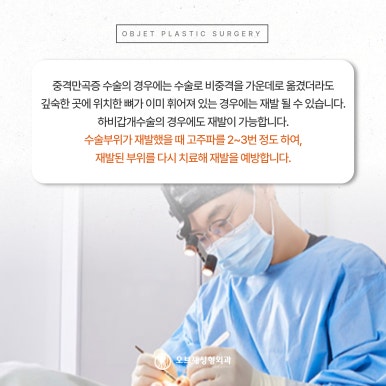
After surgery for a deviated septum or inferior turbinate surgery, recurrence may be possible.
It can vary depending on the individual’s condition and the surgical method,
but
✓ In the case of deviated septum surgery, even if the septum is moved to the center through surgery,
recurrence can happen if the bone located deeper inside is already bent.
The reason is that the bone may not be bent only near the airway opening,
but may already be bent and continue inward into deeper areas.
Cosmetic nose surgery also needs to consider function.
✓ Recurrence is also possible in the case of the inferior turbinate.
The size of the inferior turbinate changes every 4 hours, and if the CT scan shows that the inferior turbinate is small, the medical team may decide that reduction is unnecessary.
However, if it suddenly enlarges after surgery, recurrence may occur.
To prevent this, resection can be performed, but because too much tissue may be removed,
the risk of empty nose syndrome later can increase,
so in recent years, most cases have been treated with radiofrequency instead.
When the surgical area recurs, radiofrequency is performed about 2 to 3 times to treat the recurrent area again and help prevent recurrence.
Nose surgery should take into account
the individual’s nose shape and proportions,
as well as overall harmony,
and find the surgical method that fits best.
As mentioned earlier, because the nose is at the center of the face,
the shape of the nose
and the height of the nose
can affect the overall image.
The nose can help balance the center of the face for people of any age or gender,
and depending on its shape,
the face can become more aesthetically harmonious.
On the other hand, if the nose stands out too much,
it can disrupt harmony.
So when choosing nose surgery,
rather than considering only the shape of the nose,
it is better to choose a place that designs the nose with facial harmony in mind
and tailors it to the individual.
At our clinic,
we comprehensively consider each patient’s nose shape and facial proportions
and help find the ideal shape.
If you are 고민 about nose surgery, come to Obje Plastic Surgery Clinic.