Don’t get surgery without knowing the lower blepharoplasty method!
Plastic surgery knowledge from Objet Plastic Surgery
Hello, this is Objet Plastic Surgery.
So far, we’ve introduced under-eye fat repositioning several times, but I don’t think we’ve explained lower blepharoplasty in detail.
For people with a certain amount of skin elasticity, we recommend under-eye fat repositioning, and for cases where under-eye fat repositioning is somewhat difficult to apply, we’ve said that getting lower blepharoplasty is a good option.
Each time, many people asked whether under-eye fat repositioning and lower blepharoplasty are different procedures. Since both are surgeries that deal with the under-eye area, it’s natural to think of them as similar concepts.

Because so many people kept asking, we prepared a post introducing the lower blepharoplasty method.^^
In today’s post, we’ll explain in detail what lower blepharoplasty is, who it is recommended for, and what should be considered for satisfaction after surgery!
Under-eye fat repositioning vs. lower blepharoplasty
Which surgery is right for me?
Regardless of gender or age, when ‘this area’ changes, people feel like they are getting older. That area is the under-eye area.
Even if the under-eye area becomes only slightly darker, people often hear that they look dull or tired. Small changes around the under-eye area have a big impact on your impression.
As we age, the under-eye area also loses elasticity, making under-eye sagging, fine lines, and hollowness more noticeable.

The reason changes such as under-eye sagging, fine lines, and hollowness occur is that collagen production decreases.
Collagen is the component responsible for skin elasticity. Up to the early 20s, the skin is densely filled with collagen, maintaining smooth elasticity.
However, from the mid-20s onward, the amount of collagen in the skin gradually decreases, and the composition ratio of collagen changes, weakening the support of the skin tissue and reducing elasticity.

In particular, since the skin tissue under the eyes is thinner than in other areas, changes caused by reduced elasticity become more noticeable more quickly.
In addition, when the under-eye skin has lost elasticity, the strength of the orbital septum that holds the under-eye fat is also weakened, causing under-eye puffiness and shadowing in sunken areas.
To improve these under-eye changes, people consider under-eye fat repositioning and lower blepharoplasty. Both procedures fundamentally aim to improve under-eye aging.
However, there are differences between the two procedures. This is an important point, so please pay close attention from here on.

Under-eye fat repositioning literally means repositioning only the under-eye fat. Lower blepharoplasty, on the other hand, is an anti-aging procedure that repositions the under-eye fat while also removing loosened muscle and skin. Conceptually, under-eye fat repositioning can be seen as included within lower blepharoplasty.
The reason under-eye fat repositioning is mainly applied to people in their 20s and 30s whose skin elasticity is still somewhat maintained is that if the under-eye area is puffy, repositioning only the under-eye fat can smooth it out when the under-eye skin, muscle, and tissue are not sagging.

However, for patients in their 40s and older, even if under-eye fat repositioning is performed, the results may differ from those in their 20s and 30s because skin elasticity is weaker. In such cases, the appropriate lower blepharoplasty method is one that improves the loosened skin and muscle together, smoothing the sagging under-eye area.
Depending on the patient’s skin condition, Objet Plastic Surgery can perform step-by-step lower blepharoplasty, including standard lower blepharoplasty and dual lower blepharoplasty. (In the next post, we’ll explain dual lower blepharoplasty in more detail!)
Lower blepharoplasty method?
I’ll explain the key points simply!

Lower blepharoplasty refers to surgery that removes and lifts the loosened skin, muscle, and fat under the eyes to make the under-eye area firmer.
It may sound simple when described in words, but in fact the lower blepharoplasty method is very complex. That’s because the under-eye structure is more complicated than people think, and there are many things that need careful attention during surgery to improve the aging-related changes.
That is why at Objet, we perform lower blepharoplasty carefully and thoroughly over sufficient time so that patients can achieve satisfying results.
Let me explain in more detail how the lower blepharoplasty method is performed.^^
The most important first step in the lower blepharoplasty method is a detailed diagnosis. That’s because everyone has a different natural eye shape and a different current condition of the skin and tissues.
So first, Objet carefully assesses the degree of under-eye sagging and the amount of under-eye fat, and based on both the skin that needs to be removed and the amount of fat that needs to be reduced, we establish a detailed surgical plan.

Lower blepharoplasty begins with an incision. An incision is made along the lash line, starting from the inner side of the eye and moving outward, about 2 mm below the under-eye mucosa.
The incision is not made casually, either. At Objet, we keep the incision area as small as possible to prevent scarring. (This is also one of the representative differences between lower blepharoplasty and dual lower blepharoplasty.)
After that, the skin is dissected and part of the muscle layer is removed to reposition the loosened fat that had been enclosed within the muscle. Rather than simply finishing by repositioning the under-eye fat, we also carefully reinforce the septum, which is the pocket surrounding the under-eye fat.

If the surgery is completed without reinforcing the septum during the under-eye fat repositioning process, recurrence can happen at any time afterward. That is why at Objet, under-eye fat repositioning and septum reinforcement are always performed together.
After septum reinforcement, the loosened muscle that causes under-eye sagging is removed and lifted only as much as needed. Lifting and securing the sagging muscle is the core of Objet’s lower blepharoplasty method.
At Objet, the muscle is fixed at a total of three points. By pulling the muscle tightly and securing it on the outer side around the eye, we strengthen the support under the eye.
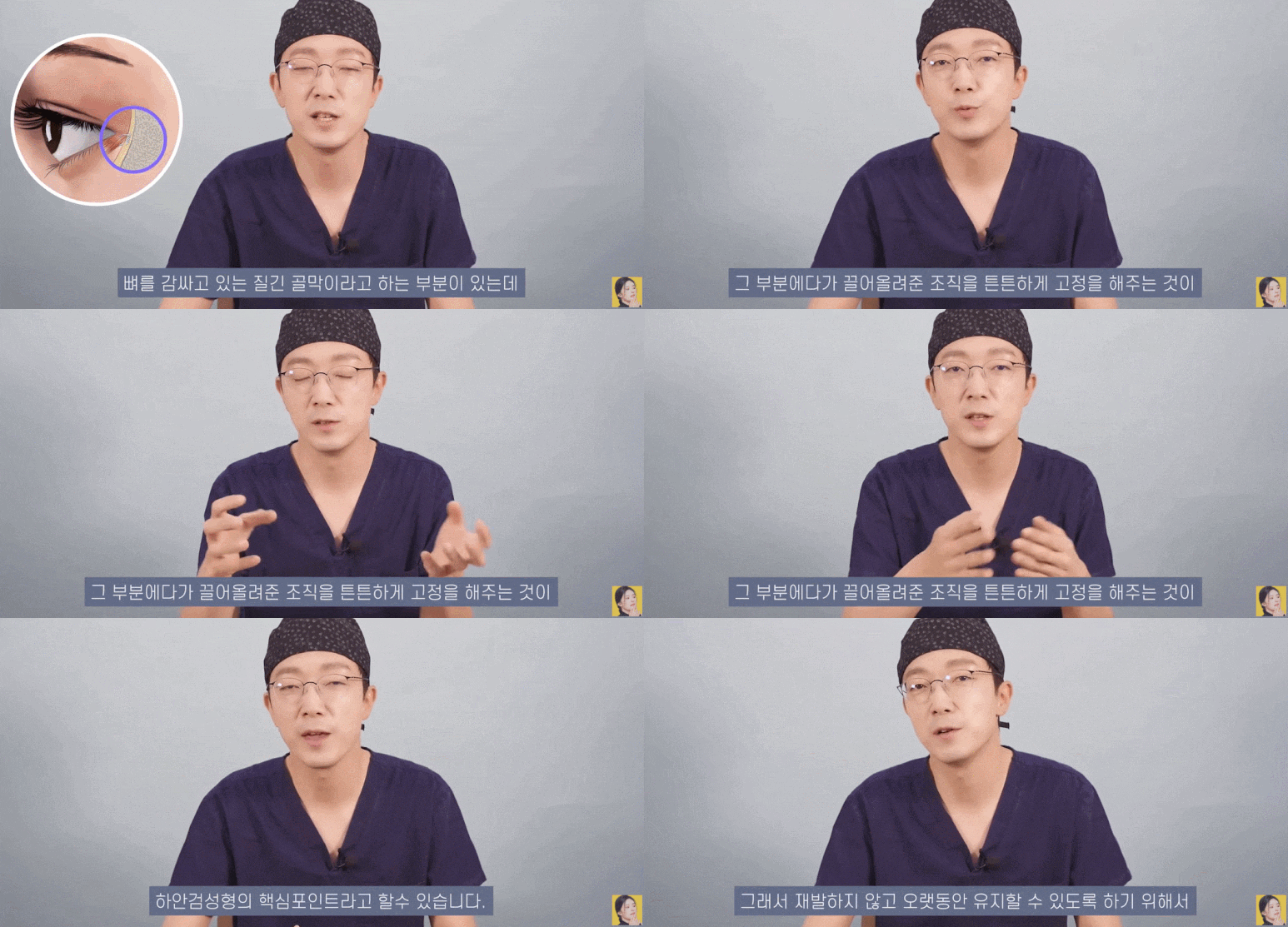
At this point, the area used for fixation is the periosteum, not the muscle. The periosteum is a fibrous membrane that covers the bone and is a very tough layer closely attached to the bone. If the loosened muscle is firmly fixed to the periosteum during lower blepharoplasty, it is not easily sagged or loosened.
To prevent recurrence after lower blepharoplasty and also reduce the possibility of ectropion, Objet firmly secures the muscle to the periosteum.

After the muscle removal and periosteal fixation are complete, the unnecessarily loosened skin is removed. At this stage, the important thing is not to remove more skin than necessary.
If too much skin is removed, ectropion can also occur. Therefore, lower blepharoplasty is performed with a conservative approach to skin removal.
Because ectropion is the representative complication of lower blepharoplasty, Objet takes extra care during surgery. I’ll explain it in more detail below.
We also spend a lot of time on suturing after skin removal. No matter how well the surgery is performed, if suturing is not handled carefully, there is a risk of scarring and inflammation, so we complete the surgery with meticulous stitch-by-stitch closure.
Four major concerns after lower blepharoplasty?
At ‘Objet,’ you don’t need to worry.
During lower blepharoplasty consultations, there are concerns patients often raise. These are due to the side effects that naturally come up when searching for the lower blepharoplasty method.
The representative concerns after lower blepharoplasty are ectropion, scarring, recurrence of under-eye puffiness, and preservation of the aegyo-sal.
I’ll explain in detail how Objet helps prevent the four major concerns that may arise after lower blepharoplasty.
- Ectropion

“Doctor, could ectropion happen after surgery?” is a question we hear often.
| What is ectropion? | A condition where the lower eyelid turns outward |
|---|
| The eye does not close properly, exposing the eyeball | |
| Exposure of the eyeball dries the inner surface and causes pain | |
| Various eye diseases can occur more easily | |
Ectropion can occur when the muscle lifted during surgery is not properly fixed and sags, creating a downward pulling force on the eyelid. To prevent this, it is important to firmly secure the muscle after removal and lifting.
At Objet, to prevent ectropion, we reinforce support by firmly fixing the muscle at three points on the outer side of the eye. In particular, because the muscle is fixed to the periosteum so that it does not sag, the likelihood of ectropion is significantly reduced.

There is one more important point for preventing ectropion: skin must be removed conservatively.
If too much skin is removed, there may not be enough skin left and the eyelid can turn outward, so conservative removal is used to prevent the situation that could lead to ectropion.

However, in older patients or those with weak skin tissue, ectropion can still occur even when support is reinforced and conservative removal is performed. In that case, lateral canthopexy is needed.
Lateral canthopexy is a procedure that lifts and fixes the lower eyelid upward. Because it secures the outer corner of the eye by pulling it upward so the eyelid does not turn outward, if you also receive lateral canthopexy during lower blepharoplasty, you do not need to worry too much about ectropion.
You may be wondering whether so many steps are really necessary for just one lower blepharoplasty surgery. The parts I mentioned are supplementary measures needed to prevent the possibility of ectropion, so you do not need to feel too burdened by lower blepharoplasty.
Lateral canthopexy is needed in about 1 out of every 10 patients who undergo the lower blepharoplasty method, so it is not necessary for everyone. We recommend it only for patients who truly need it, based on their condition.
- Scarring
Although lower blepharoplasty is performed not only to improve aging but also, above all, to smooth the unsightly under-eye area, it is true that many people worry about scarring. Since lower blepharoplasty requires skin incision, there is also a possibility of scars remaining.
Fortunately, the under-eye skin incised for lower blepharoplasty is one of the areas on the body where scars are less likely to remain. Therefore, it may help to keep in mind that the expected benefits of lower blepharoplasty are greater than the possibility of scarring.

Even though scars are less likely to remain compared to other parts of the body, it would still be best if scars were not visible at all. That is why at Objet we finish surgery with careful stitch-by-stitch suturing so that scars are as inconspicuous as possible.
Based on nearly 20 years of experience performing a wide variety of under-eye plastic surgery cases, the skin incision and suturing are done with great care, so you can feel a little less worried about scarring.
- Recurrence of under-eye puffiness

Many patients undergoing lower blepharoplasty naturally worry, “Will it recur over time?” In fact, some people do experience recurrence after lower blepharoplasty and look into revision surgery. That is why the technique of lower blepharoplasty is so important in preventing recurrence.
There are two major reasons for recurrence.
-
When periosteal fixation is weak during surgery
-
When only the under-eye fat is removed during surgery and septum reinforcement is not performed

Both causes clearly show that no step in the lower blepharoplasty process should be done carelessly.
The reason I explained periosteal fixation and septum reinforcement in detail earlier is precisely because these are part of Objet Plastic Surgery’s efforts to prevent recurrence.
- Preservation of aegyo-sal

Some patients say that after lower blepharoplasty, the under-eye area looks too flat and unnatural.
They say it seems like the aegyo-sal they originally had has disappeared.
To conclude first: aegyo-sal does not necessarily disappear after lower blepharoplasty.

However, to improve the loosened under-eye area, the orbicularis oculi muscle, which is called aegyo-sal, also needs to be improved together. Usually, the feeling that the eye is sagging downward appears when the outer part of the aegyo-sal (orbicularis oculi muscle) is overly loosened. Therefore, to improve the appearance of the eye sagging diagonally downward, lower blepharoplasty requires a process in which part of the orbicularis oculi muscle is removed and the sagging muscle is lifted.

You may misunderstand this as removing all of the aegyo-sal, but the part that is removed is only a very small portion, so there is no need to worry at all. In fact, by leaving an appropriate width of aegyo-sal, the eye shape becomes more youthful and the aegyo-sal is restored.
Right after surgery, the under-eye area may feel puffy at first and then settle down, so the overall appearance may feel somewhat unnatural. But the aegyo-sal itself has not disappeared, so there is no need to worry.

Because lower blepharoplasty involves skin incision, it takes several months before the scar disappears and the change in the eye area feels natural. During this period, patients may worry whether something went wrong or whether there are side effects.
As introduced today, if you undergo lower blepharoplasty with a focus on structural reinforcement, you can return to a smooth and elastic eye area without worry.
Although the area may look a little awkward right after surgery, it becomes more natural over time, giving you a face that looks 10 years younger. ^^
At Objet, we fully understand how patients feel when they come to us and why they decide to undergo surgery. That is why we do not simply end with solving the concern itself; we perform surgery through a careful lower blepharoplasty method to prevent side effects and help you enjoy the results for a long time.
In fact, the director who performs lower blepharoplasty at Objet also chose to have lower blepharoplasty at Objet, which shows the very high level of surgical completion and satisfaction with the results.
Director Jang Wook’s Pick
View the daily progress of dual lower blepharoplasty
All medical staff at Objet Plastic Surgery always perform with the same dedication as if they were operating on their own family. If you would like to know more about the lower blepharoplasty method explained today, please feel free to visit for a consultation.
This has been Objet Plastic Surgery. Thank you.
| Lower blepharoplasty consultation and inquiries |
| --- | --- |
| Quick phone consultation | 02-3447-7576 |
| Convenient Kakao consultation | @Objet Plastic Surgery |
-
This post is medical information written by Objet Plastic Surgery Clinic in compliance with the Medical Advertisement Act.
-
The effects of the procedure may vary depending on the individual, and side effects may occur.
We strongly recommend that you have a thorough consultation with medical staff in advance before deciding on the procedure.