Hello, this is Objet Plastic Surgery.
Do you find yourself worrying about deep forehead wrinkles that catch your eye every time you look in the mirror,
and eyelids that keep sagging more and more?
Every time you hear that you look tired without meaning to,
or that you look older,
your heart can feel heavy.
Perhaps that is why many people have recently searched for a procedure called “endoscopic forehead lift.”
The idea of minimizing scars and recovering quickly with the help of an endoscope is hard to resist. But when you look into reviews, you may become confused again.
“ The wrinkles were smoothed out, but I lost hair.”
“ It hasn’t even been a year, and it’s already sagging again.”
If you paid the cost and the results disappear quickly while side effects appear as well,
how upsetting would that be?
You may have started with high expectations, but after hearing stories like these,
you might wonder whether it would be better not to do it at all and hesitate.
In particular, when you see that some people say the surgery went well while others regret it not long after,
you naturally start wondering what the real key is.
So today, for those considering an endoscopic forehead lift,
I will explain the two things you absolutely need to know:
“the key fixation” and “side effects.”
If you want results that last a long time
and a safe procedure without worrying about side effects,
please pay attention from here on.
Endoscopic forehead lift,
If you want it to last, this is the key
An endoscopic forehead lift is, as the name suggests,
a surgery that uses an endoscope
to lift the forehead upward.
In this process, the eyebrows are naturally raised,
and forehead wrinkles are smoothed out,
so you can expect a clear rejuvenating effect.
But if that good effect
does not last and starts fading again,
the reason is fixation.
If fixation is weak, the effect cannot be maintained.
Many people think of a forehead lift simply as a surgery that pulls the skin and stitches it,
but in reality, a much more delicate process is required.
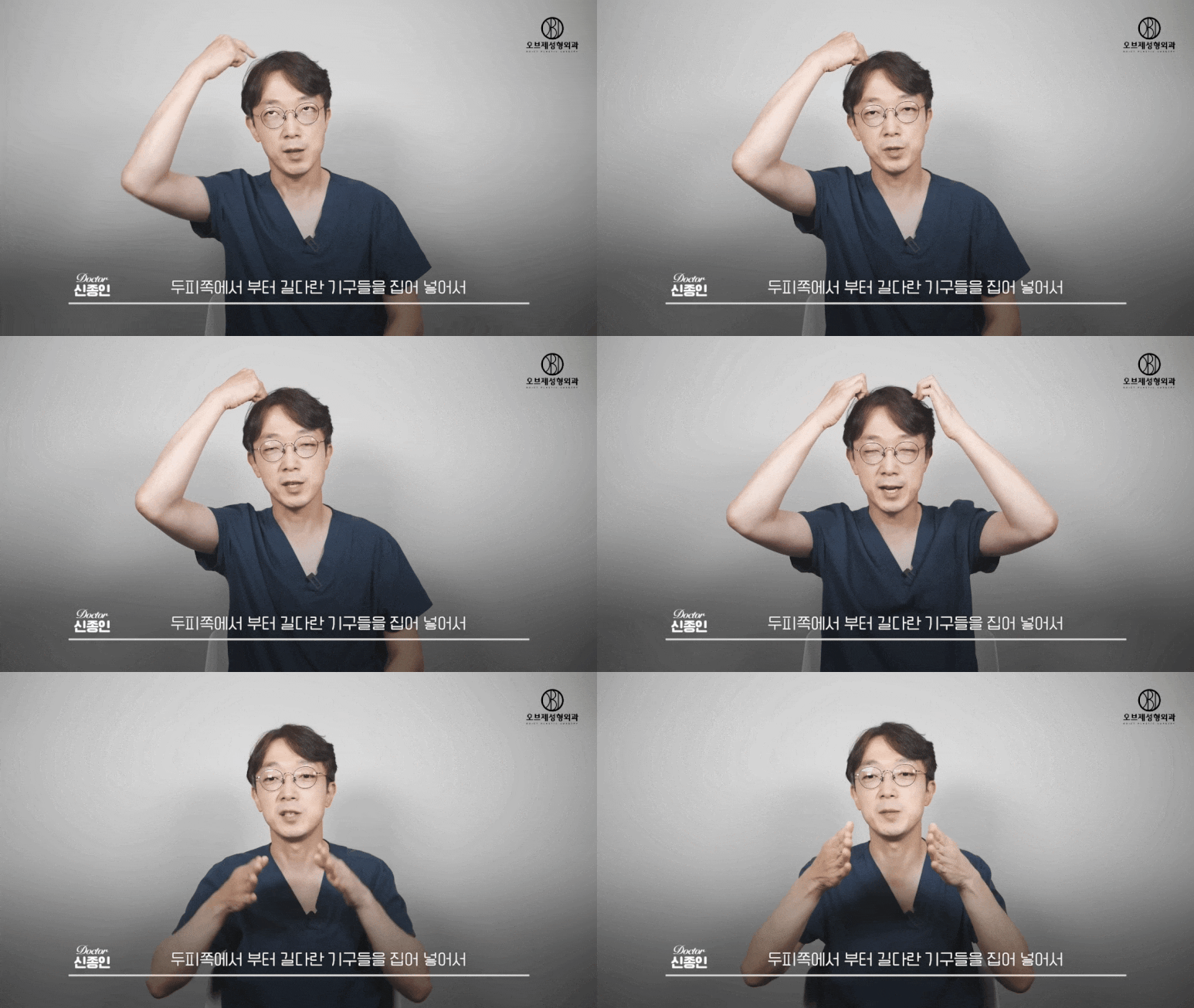
Using an endoscope, the ligaments and muscles inside the scalp are released,
and then the entire sagging tissue is repositioned upward.

At this point, fixation is what firmly holds the lifted tissue in place so that it does not fall back down.
Because facial tissues are constantly pulled downward by gravity,
a strong fixation device is needed to withstand that force.
If this fixation is not done properly,
the result is not just the forehead sagging again.

It can lead to various side effects, including hair loss.
What does weak fixation have to do with side effects?
If the tissue sinks back down after surgery,
the force that had been pulling it upward is borne directly by the sutures and the incision site.
When this puts strain on the incision site,
the skin can separate, and scar tissue forms to repair it.
This scar tissue does not have as rich a blood supply as normal skin,
so it is harder to provide nourishment.
And as scar tissue spreads,
that supply becomes even more difficult.
In other words, if fixation is weak,
not only can wrinkles return,
but hair loss may also occur around the incision site.
Therefore, to prevent side effects,
strong fixation is the key to the surgery.
Endotine vs. bone tunnel: Which is right for my face?
So how is fixation done?
The two fixation methods mainly used in forehead lifts today are Endotine and the bone tunnel method.
① Endotine method
Endotine is a fixation device placed inside the skin,
and it is a plastic form with small projections.

Because it fixes tissue over a broad area,
it is effective for people with thicker skin and stronger muscle force.
Just as a heavy garment is more stably supported when hung on a wide hanger,
the lifted tissue is distributed and held in place.
② Bone tunnel method
On the other hand, for people with thin skin,
Endotine may show through or feel like a foreign body.

In such cases, the bone tunnel method, in which a small hole is made in the forehead bone and medical thread is passed through to secure fixation, may be appropriate.
Because it allows natural fixation without visible devices on the outside,
it is advantageous for thin skin.
However, the bone tunnel method requires a very high level of surgical skill.
This is because the surgeon must precisely control the placement and tension based on their own sense and technique.
In the end, what matters most is not “what is used,”
but which method is suitable for my skin.
If my forehead skin is thick and firm,
but it is fixed with a weak method,
the effect may disappear quickly.
Conversely, if the skin is thin
and an overly forceful device is used,
a foreign-body sensation or an uneven result may occur.
To summarize what we discussed today:
The most important thing in a forehead lift is fixation,
and if fixation is weak,
it can lead not only to revision surgery but also to side effects.
And the fixation method must be different for each person,
so it should be analyzed precisely
and proposed in a customized way.
Rather than a clinic that simply insists that “this is better,”
it is important to find a clinic that carefully checks skin condition,
the structure of the forehead bone, and scalp thickness,
and chooses the method that fits those factors.
The reason we at Objet Plastic Surgery spend a lot of time on consultations
is also because of this.
We do not make decisions based only on the surface.
After analyzing the structure inside the forehead with an endoscope,
we design the safest and most effective fixation method.
If you are currently considering an endoscopic forehead lift,
please compare several clinics carefully
based on the criteria shared today.
We sincerely hope you will enjoy satisfying results for a long time after surgery.
This has been Objet Plastic Surgery.
Thank you.
<🔽🔽A video you may find helpful to watch together🔽🔽>
| Consultation and inquiries for middle-aged eye surgery |
|---|
| Quick phone consultation |
| Kakao simple consultation |
-
This post is medical information written by Objet Plastic Surgery Clinic in compliance with the Medical Advertising Act.
-
Results may vary depending on the individual, and side effects may occur.
We recommend that you thoroughly consult with the medical staff in advance before deciding on the procedure.