Why Are Some Under-Eye Fat Repositioning Surgery Reviews Different?
Dr. Shin Jong-in Explains!

Hello.
This is Objet Plastic Surgery.
When you look at reviews of under-eye fat repositioning,
you may feel a little confused.
Some people say,
"I’m really satisfied.
It was a life-changing surgery!"
while others express disappointment like this:
"It’s different from what I expected.
It feels like it went back to how it was before."
Why does this difference happen
for the same surgery?
In fact, when you analyze reviews,
the factor that determines satisfaction is
whether there was a specific design point in mind.
Today, through the satisfaction points and dissatisfaction points that often appear in real reviews,
Objet Plastic Surgery will talk about
how we design under-eye fat repositioning
to improve satisfaction.
If you read to the end,
you will clearly understand whether under-eye fat repositioning is suitable for you,
and what you should check in advance.
The difference in how long it lasts
was too extreme, though?
Among under-eye fat repositioning surgery reviews,
cases with high satisfaction often include comments like this:
"It’s been over a year since the surgery,
and it’s still smooth."
On the other hand, in dissatisfied reviews,
"It was good for the first few months,
but as time passed,
the area under my eyes started to bulge again."
Why does this difference happen?
The key is the treatment of the orbital septum.
The fat under the eyes is enclosed by a membrane called the orbital septum.
When you’re young, this membrane is firm,
so it holds the fat in place well.
But as we age, repeated blinking, facial expressions, and skin aging
cause the membrane to gradually stretch.
Then, unable to resist gravity,
the fat gets pushed forward.
Under-eye fat repositioning is the process of moving this protruding area
to the hollow under the eyes to make it smooth and flat.
Here is an important question.
Is changing only the position of the fat enough?
No.
The stretched orbital septum is still in a loose state,
so over time the fat can protrude again for the same reason.
That is why, in reviews with high satisfaction,
it is often not just the fat that was moved,
but the weakened orbital septum was also strengthened by tightening it with appropriate tension.
This process involves making an incision in the conjunctiva, pulling the stretched membrane, and firmly fixing it to the surrounding tissue.
There is something to be careful about here.
Pulling harder is not always better.
If it is tightened too much, the natural curve under the eyes can collapse,
making it look artificial.
Therefore, it is important to finely adjust the procedure while considering each person's bone structure and the anatomical shape of the eyes.
When this part is done properly,
that is when you get satisfying reviews like this:
"It’s been a long time since the surgery,
and it’s still holding up well!"
They said tears keep coming out?
Among under-eye fat repositioning surgery reviews,
you may also often see comments like this:
"My eyes keep watering after the surgery"
"It feels like my eyelashes are poking my eyes"
People who experience these symptoms often think it is part of the recovery process and endure it.
But this is not a normal recovery process.
This is a symptom called entropion, where the eyelid turns inward.
After surgery, our body creates scar tissue while healing the incision site.
This scar tissue tends to gradually shorten over time.
When the surgery is done through the conjunctiva,
the scar that forms on the back side of the eyelid contracts and pulls the back side inward.
Then the entire eyelid turns inward,
and the eyelashes that should face outward
end up facing inward, continuously irritating the eye.
To solve this problem,
a process that releases the hard, contracted scar tissue is needed.
First, the adhered areas are separated to reduce the pulling force,
and then the space that has become insufficient due to contraction is filled with artificial dermis or autologous fat so that the eyelid can return to its original position.
So rather than simply dismissing postoperative discomfort as part of recovery,
it is most important to accurately distinguish whether the current symptoms are within the normal range,
or whether they are a problem such as entropion that needs correction.
Some people say it makes them look older?
One of the complaints often seen in under-eye fat repositioning surgery reviews is,
"I look older than before the surgery."
In such cases, the cause can largely be divided into two types.
First, the area under the eyes may look hollow.
If someone who originally has a small amount of fat undergoes repositioning only,
the puffiness disappears,
but at the same time the overall volume also decreases,
which can make the area feel sunken instead.
To prevent this situation,
you need to receive a precise diagnosis before surgery regarding skin thickness and the degree of hollowing in the surrounding bone structure.
If it is determined that there is not enough fat,
fat supplementation should be performed at the same time as repositioning.
The problem is that the tissue under the eyes is the thinnest area in the body.
If a standard fat grafting method is used,
the limited space can cause unevenness,
or the layer may become more noticeable.
At Objet Plastic Surgery,
to solve this problem, single-cell fat grafting is performed.
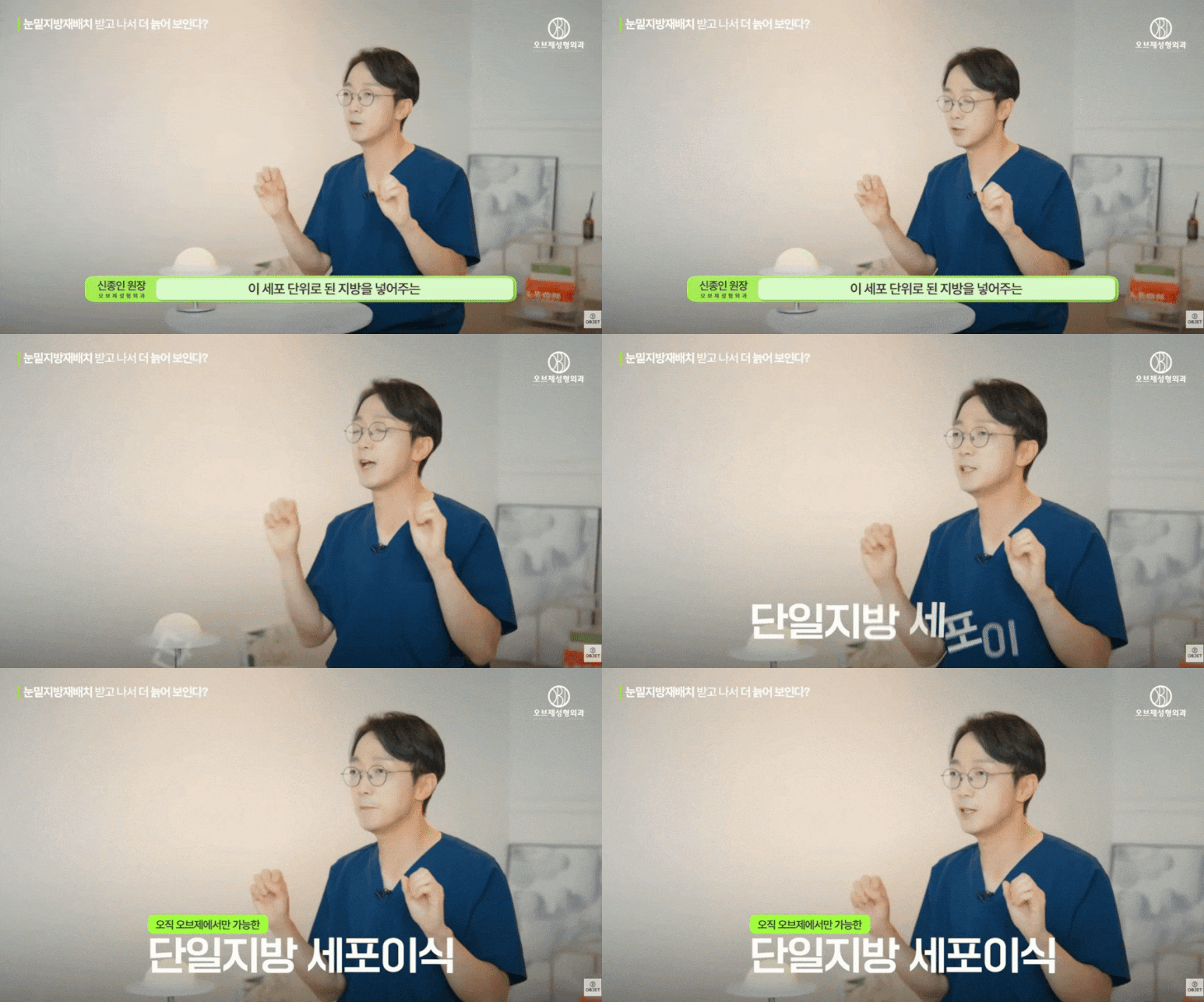
This method treats the harvested fat with enzymes to separate the mass into individual cells,
and then delicately places it into a thin layer just beneath the skin.
This makes it possible to naturally fill the height difference between the cheekbone and the eyelid.
The second case is when wrinkles become worse.
People whose skin elasticity has already decreased and who had wrinkles before surgery
may find that as the fat decreases,
the wrinkles become more prominent, like a deflated balloon.
In such cases,
the procedure has limits if it is only repositioning,
and skin excision for wrinkle improvement is also necessary.

In particular, if you are in your mid-to-late 40s or older,
it is better to have a consultation with the possibility of skin excision in mind.
Satisfying under-eye fat repositioning surgery reviews appear when these points are fully considered before surgery.
Accurately understanding your own condition and making a plan that fits it—
that is the most important factor that determines satisfaction.
The reason under-eye fat repositioning surgery reviews are so polarizing
is not the surgical method itself,
but rather the difference in how much was planned in advance.
Even with the same surgery,
the necessary treatment or approach changes depending on the individual's eye structure, fat volume, and skin condition.
Dr. Shin Jong-in of Objet Plastic Surgery,
a board-certified plastic surgeon who standardized under-eye fat repositioning surgery in Korea,
has studied and developed conjunctival under-eye fat repositioning surgery for a long time.

From issues that may arise during surgery, such as scars, adhesions, and eyelid turning inward,
he analyzes the cause based on anatomical structure and, when necessary, designs the procedure so that the under-eye area returns to its original stable position through repositioning, grafting,
and corrective procedures.
Under-eye fat repositioning is not simply a surgery that moves fat,
but a procedure where precise planning that also considers recovery is important,
and this is emphasized during the consultation process.

That is all from Objet Plastic Surgery.
Thank you.
<🔽🔽Helpful video to watch together🔽🔽>
| Consultation and inquiries for under-eye fat repositioning |
|---|
| Phone quick consultation |
| Kakao easy consultation |
-
This post is medical information written by Objet Plastic Surgery Clinic in compliance with the Medical Advertising Act.
-
Depending on the individual, treatment effects may vary, and side effects may occur.
We recommend that you have sufficient consultation with medical staff in advance before deciding on the procedure.