Upper Eyelid Surgery Meaning?
Director Shin Jong-in explains only the <key points>!

Hello.
This is Obje Plastic Surgery.
If you are concerned about drooping eyes,
while searching here and there,
you must have come across the term
'upper eyelid surgery.'
Many people have heard the term
somewhere before,
but do not really know
what kind of surgery it is.
When you look it up,
it seems similar to
a regular double eyelid surgery,
but many people are confused about
what exactly is different
and whether it is the right surgery for them.
Today, we’re going to clear up
that confusion for you.
What exactly does upper eyelid surgery mean,
who we recommend it for,
and how upper eyelid surgery
is performed at Obje Plastic Surgery
—we’ll go through it one by one.
By the time you finish reading,
the vague term will become clear,
and you’ll be able to understand
why upper eyelid surgery
is being recommended for your eyes.
Upper eyelid surgery meaning,
it’s different from double eyelid surgery!
First, let’s clarify the meaning
of upper eyelid surgery.
The "upper" in "upper eyelid"
means above, and "eyelid"
refers to the eyelid.
So upper eyelid surgery means
surgery for the "upper eyelid."
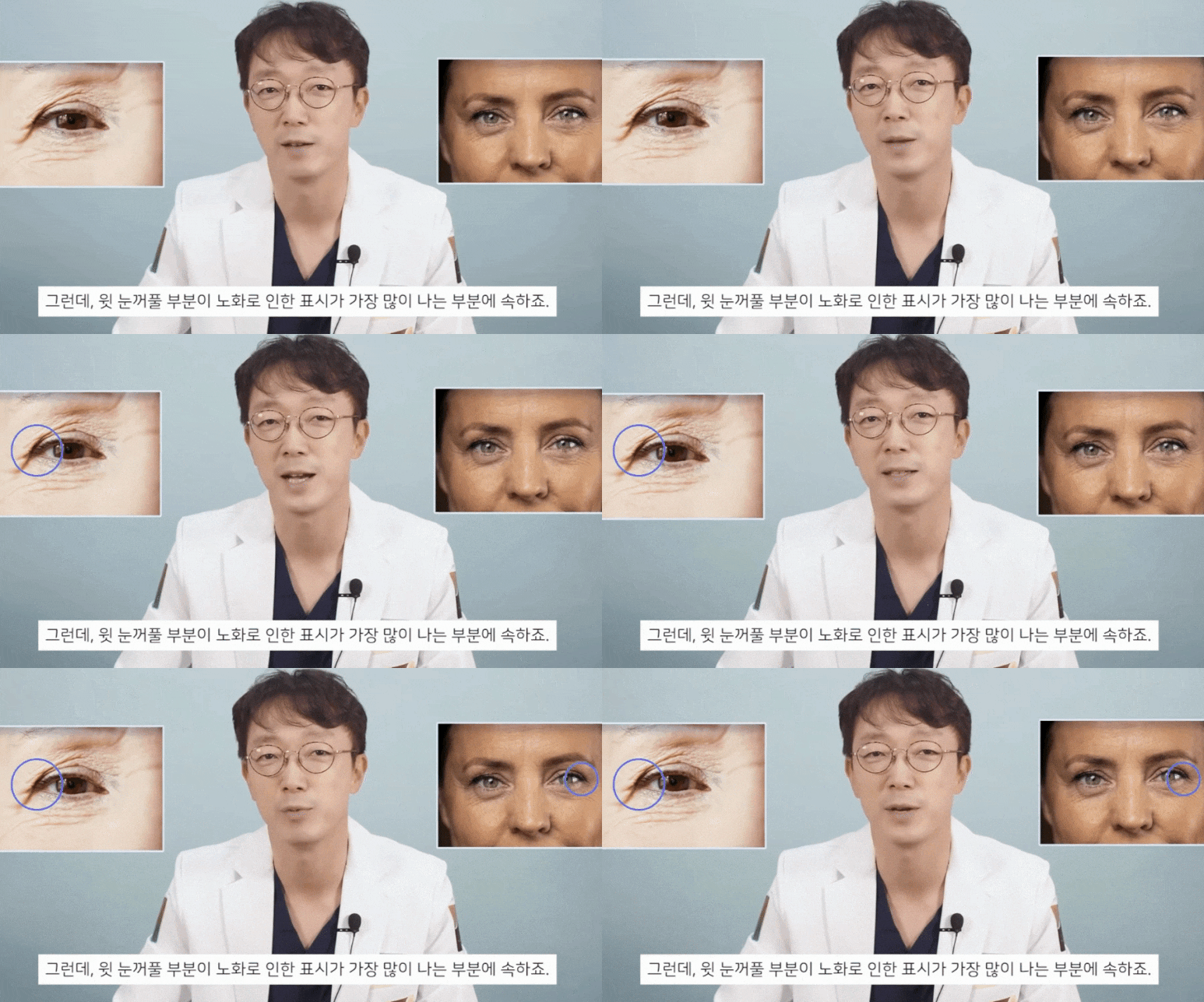
Upper eyelid surgery is
a procedure that improves changes
caused by aging of the upper eyelid.
Then how is it different from
incisional double eyelid surgery,
which younger people often get?
Incisional double eyelid surgery,
usually chosen by people in their 20s and 30s,
mainly aims to create
a double eyelid line.
It is a procedure for people who
do not naturally have a double eyelid
or who have a very thin inner double eyelid
and want a more defined crease.
In this case, because the skin
is not sagging,
there is no need to remove skin.
By contrast, upper eyelid surgery
aims to address the loosened skin
that develops with age.

After the age of 40,
the skin of the eyelids loses elasticity
and sags downward,
causing various problems.
The field of vision may become narrower,
the eyelashes may poke the eye,
or the outer corners of the eyes may become irritated.
That is why upper eyelid surgery
removes the excess skin,
and if necessary,
also improves weakened eyelid-opening strength.
In other words, double eyelid surgery
aims to "create a line,"
while upper eyelid surgery aims to
"remove excess skin and restore function."

Upper eyelid surgery,
needed for these people!
So, in what cases
should you get upper eyelid surgery?
The first is for people
whose outer eye corners
frequently become irritated.
When the eyelid skin sags,
the skin at the outer corner overlaps,
causing friction between the skin surfaces.
This friction can make
the outer eye corner turn red
or cause irritation.
If you wake up in the morning
with unusually heavy eye discharge,
or if the outer corner of your eye
feels stinging and itchy,
this may apply to you.
The second is for people
whose eyelashes poke their eyes.
When the eyelid sags downward,
the direction of the eyelashes changes too.
Eyelashes that originally pointed outward
gradually begin to point toward the eyeball.
So every time you blink,
the eyelashes rub against the cornea,
causing stinging eyes, redness,
and constant tearing.
If this condition continues for a long time,
it can damage the cornea,
so prompt improvement is needed.
The third is for people
whose eyelids cover the eyeball,
narrowing their field of vision.
When the eyelid skin sags severely,
even when your eyes are open,
it can feel as if your upper field of view
is blocked.
If you have to lean your head back
when reading to see the text,
or if you have trouble seeing traffic lights
while driving,
then it is already affecting
your daily life.
In this case, surgery is needed
not for cosmetic reasons,
but because of a functional problem.
Upper eyelid surgery,
this is how Obje performs it
Upper eyelid surgery
requires checking the line
while opening and closing the eyes,
so it is performed under local sedation anesthesia.
The surgery is done while the patient
is conscious and can open and close the eyes,
with the crease checked in real time.

First, an incision is made along
the double eyelid line,
then the excess skin
is removed in the exact amount needed.
If too much skin is removed,
the eyes may not close properly
or the appearance may become unnatural,
and if too little is removed,
the surgery will not be effective,
so adjusting the exact amount is
the most important part.
If eyelid-opening strength is weak,
the levator muscle of the eyelid
is adjusted as well.
That way, when the eyes are open,
enough of the black pupil is visible,
creating a refreshed eye shape.
The surgery takes about
1 to 2 hours on average.
Swelling occurs after surgery,
but after at least one month,
the swelling subsides and
a natural shape appears.
It typically takes about
2 to 3 months for everything
to fully settle.
Today, we looked at the meaning
of upper eyelid surgery,
which cases require it,
and how it is performed
at Obje Plastic Surgery.
Since it is a term you may be hearing
for the first time,
it may have felt vague and intimidating,
but I hope it is a little clearer now.
If your outer eye corners are irritated,
your eyelashes poke your eyes,
or your field of vision feels narrowed,
it may not simply be
a cosmetic issue,
but a functional problem
that affects your daily life.
Director Shin Jong-in of Obje Plastic Surgery
has many years of experience
in middle-aged eye surgery.
For upper eyelid surgery as well,
rather than simply removing skin,
he focuses on creating natural results
by considering the balance of the entire eye.

The result is characterized by being
not overdone, while improving both
function and appearance at the same time.
This has been Obje Plastic Surgery.
Thank you.
<🔽🔽A helpful video to watch together🔽🔽>
| Consultation and inquiry for middle-aged eye surgery |
|---|
| Quick phone consultation |
| Kakao simple consultation |
-
This post is medical information written by Obje Plastic Surgery Clinic in compliance with the Medical Advertising Act.
-
Treatment effects may vary by individual, and side effects may occur.
We recommend that you fully consult with medical professionals in advance before deciding on a procedure.