Hello.
This is Objet Plastic Surgery.
If you have been looking into lower eyelid fat repositioning because the area under your eyes looks dark and dull,
you may have heard the claim that "lower eyelid fat repositioning makes aegyosal disappear."
This can be especially concerning for people who already have aegyosal
and like how it looks.
Aegyosal is an important feature that makes the face look softer
and more lively,
so it is only natural to worry about whether improving the under-eye area might also take away that advantage.
If you even see reviews online or hear from people around you saying,
"I got lower eyelid surgery and my aegyosal disappeared,"
you may end up giving up on the surgery altogether.
But to get straight to the point,
there is no need to worry or give up.
The under-eye fat and aegyosal are in different layers,
so having lower eyelid fat repositioning does not make aegyosal disappear.

Today, while explaining the difference between under-eye fat and aegyosal,
we will go over why this misunderstanding arises,
and how aegyosal actually changes after surgery,
step by step.
If you read until the end,
you will be able to consider improving your under-eye area without worry.
Aegyosal,
is it really a "fat"?
First, we need to understand exactly what aegyosal is.
Because of the word "fat," many people assume it is body fat.
In fact, aegyosal is a muscle under the eyes.
More precisely, it refers to the fuller part formed by the lower portion of the orbicularis oculi muscle.
The muscle that moves when you blink is the orbicularis oculi muscle.
You can think of the reason aegyosal looks more prominent when you smile as being due to the muscle moving.
So what kind of surgery is lower eyelid fat repositioning?

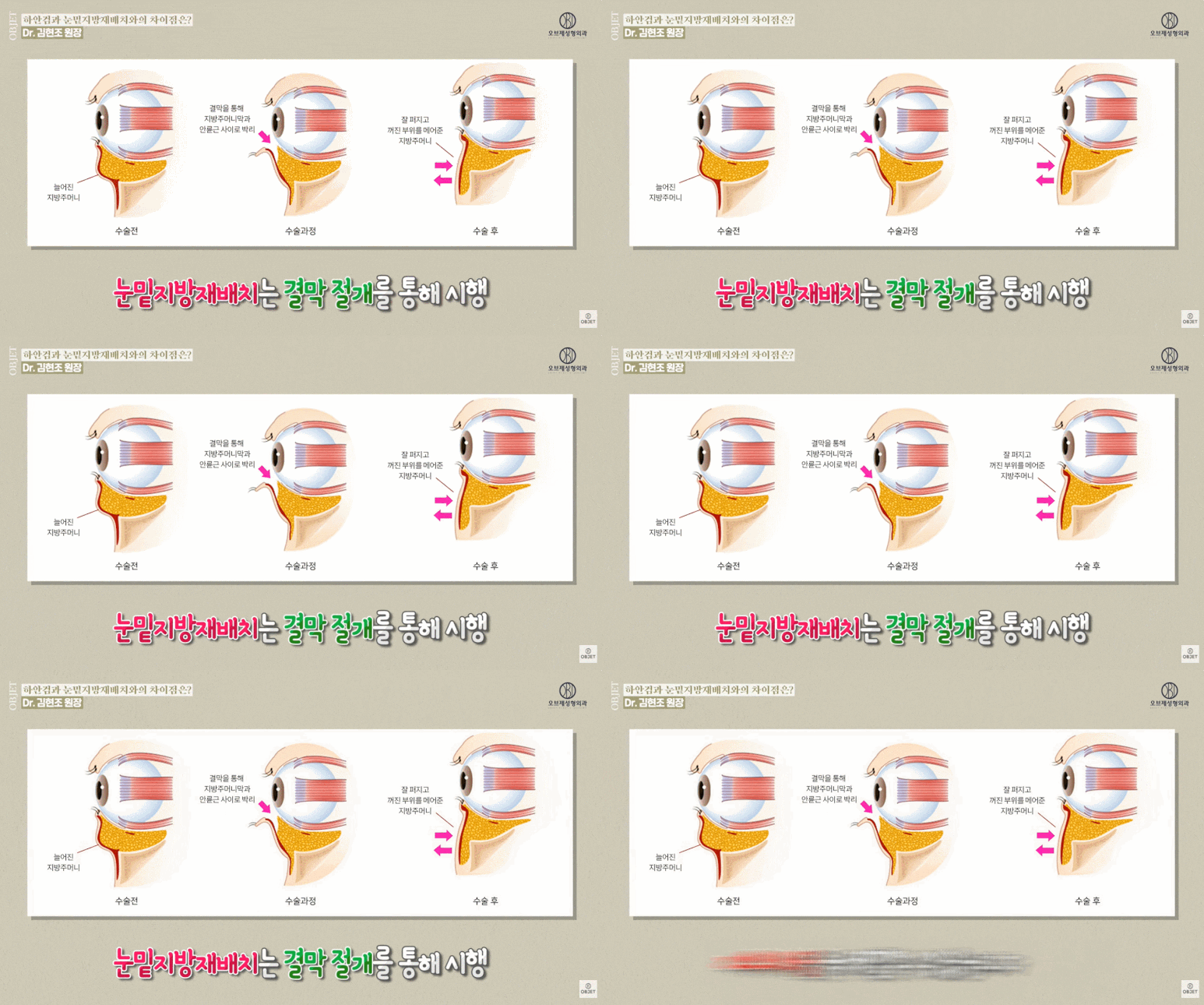
As the name suggests, it is a surgery that moves the "fat" that bulges under the eyes to an area that lacks volume,
making the area look smoother.
The important point here is that aegyosal, which is muscle, and under-eye fat are in completely different layers.
Inside our eyes, there is a tough structure called the tarsal plate that helps define the shape of the eyelid.
The orbicularis oculi muscle, which forms the aegyosal, is located just in front of this tarsal plate,
while the under-eye fat is located in a deeper layer.
Simply put,
aegyosal is in the "upper layer"
and under-eye fat is in the "lower layer."
During lower eyelid fat repositioning, the muscle is not touched at all,
and only the fat underneath it is repositioned.
In the end, lower eyelid fat repositioning is a surgery that deals with a completely different layer from the muscle,
so aegyosal remains intact after surgery.
Does lower eyelid fat repositioning make aegyosal disappear?
The reason the misunderstanding arises
However, some people occasionally say,
"After getting lower eyelid surgery,
I feel like my aegyosal has become smaller."
This is exactly where the misunderstanding begins.
In fact, this does not mean the aegyosal has disappeared.
Originally, the aegyosal and the under-eye fat overlapped in position,
so they appeared larger overall.
When there is bulging fat under the aegyosal,
the two combine to make the area look thicker.
In other words,
the entire area you thought of as aegyosal was not all true "aegyosal."
In fact, after lower eyelid fat repositioning,
the outline of the aegyosal that had been hidden under the fullness becomes clearly visible,
and in many cases it actually looks sharper and more lively.
You can think of it as the contour that had been buried in fat becoming visible.
There is another concern many people have.
That is the scar.
Lower eyelid fat repositioning is not done through an external incision,
but through the conjunctiva, that is, the inside of the eye,
so there is no visible scar left after surgery.
For this reason, recovery is relatively quick.
In the first few days after surgery,
swelling and bruising may occur,
but depending on the person,
usually after 1 to 2 weeks the severe swelling subsides in most cases,
and as the bruising is largely absorbed,
you can naturally return to daily life.
For this reason, it tends to place relatively little burden on returning to everyday activities.

Today,
we answered the question,
"Will lower eyelid fat repositioning make aegyosal disappear?"
To summarize once again,
aegyosal is a muscle,
and lower eyelid fat repositioning is a surgery that deals only with fat,
so even after lower eyelid fat repositioning,
aegyosal remains intact.

In fact, the contour of the aegyosal that had been hidden by fat may become clearer,
which can give a more lively impression.
If you are still wondering,
"What about my case?"
it is best to confirm the relationship between lower eyelid fat repositioning and aegyosal accurately through a consultation.

Dr. Kim Hyun-jo of Objet Plastic Surgery
bases treatment on an anatomical understanding of the structures around the eyes
and performs a customized design to reposition under-eye fat appropriately.
Rather than simply moving the fat,
he also considers the position and shape of the aegyosal,
and places the greatest importance on creating a natural and lively under-eye area after surgery.

I hope this post has helped resolve your questions about lower eyelid fat repositioning and aegyosal.
This has been Objet Plastic Surgery.
Thank you.
<🔽🔽A helpful video to watch together🔽🔽>
| Consultation and inquiries for lower eyelid fat repositioning |
|---|
| Phone quick consultation |
| Kakao simple consultation |
-
This post is medical information written by Objet Plastic Surgery Clinic in compliance with the Medical Advertising Act.
-
Depending on the individual, treatment effects may vary, and side effects may occur.
It is recommended that you consult with medical staff sufficiently in advance before deciding on the procedure.