Rhinitis surgery nose surgery
Is there really a connection?
Director Lee Kyung-mook answers!

Hello.
This is Objet Plastic Surgery.
You may have heard something like this
at least once from people around you.
"If you get nose surgery, your rhinitis gets better too."
"If you raise the bridge of your nose,
it becomes easier to breathe too."
Because it is such a widely circulated belief,
it is easy to end up believing it halfway.
In fact, when looking into nose surgery,
there are quite a few people who come for consultations
hoping that rhinitis can be resolved at the same time.

But that belief,
unfortunately, is not true.
Nose surgery itself
does not cure rhinitis.
Rhinitis surgery and nose surgery
are clearly different procedures.
However, there are cases where the two surgeries
can be performed together.
Today, we will explain why nose surgery
cannot replace rhinitis surgery,
and in what cases
rhinitis surgery and nose surgery
can be considered together.
If you focus for just 3 minutes,
you will be able to clearly understand
the truth behind the common belief.
Nose surgery and rhinitis surgery,
if they are both about the ‘nose,’ why are they different?
Nose surgery changes the outside of the nose,
that is, the shape visible from the outside.
Rhinitis, on the other hand, is an issue inside the nose.
The causes of rhinitis symptoms vary.

It can be caused by allergies or inflammation,
and in some cases the symptoms worsen because of
structural problems inside the nose.
Among structural causes, there are cases where
the septum, the wall that divides the inside of the nose
into left and right sides, is tilted to one side,
cases where the inferior turbinate,
the mucosal tissue inside the nose,
is swollen and enlarged,
and cases where the nasal valve,
the narrow passage near the nostril entrance,
is blocked.
These problems can only be resolved by procedures
that directly correct the inside of the nose,
such as septoplasty or inferior turbinate reduction.
No matter how much the outer shape is changed,
the internal structure remains the same.
Simply put,
nose surgery and rhinitis surgery
target entirely different areas from the start.
So having nose surgery
does not make rhinitis improve.

Some people even say that
rhinitis started after nose surgery?
This is something that people considering nose surgery
should definitely know.
There are people who say that after having nose surgery,
their nose feels even more blocked.
These cases can be divided into three types.
The first is when nose surgery is performed
while the septum is already tilted to one side.

As mentioned earlier,
the septum is the wall that divides the inside of the nose
into left and right sides,
and there are very few people whose septum is perfectly centered;
most people have it tilted slightly to one side.
But if a structure is placed inside the nose in this state,
the already narrow side can become even narrower.
As a result, this can lead to symptoms
of blockage on one side of the nose.
The second is when rib cartilage is used.
In nose tip surgery, rib cartilage harvested from the chest
is sometimes used.
Rib cartilage is often used because it is strong,
but in some cases it can gradually warp over time.

When this kind of deformation occurs,
it can press on the internal space of the nose
and make breathing uncomfortable.
The third is when too much septal cartilage
is harvested.
Septal cartilage is also used in nose tip surgery,
but because the septum in Asian patients is not very large,
removing too much of it can weaken the structure
that supports the inside of the nose.
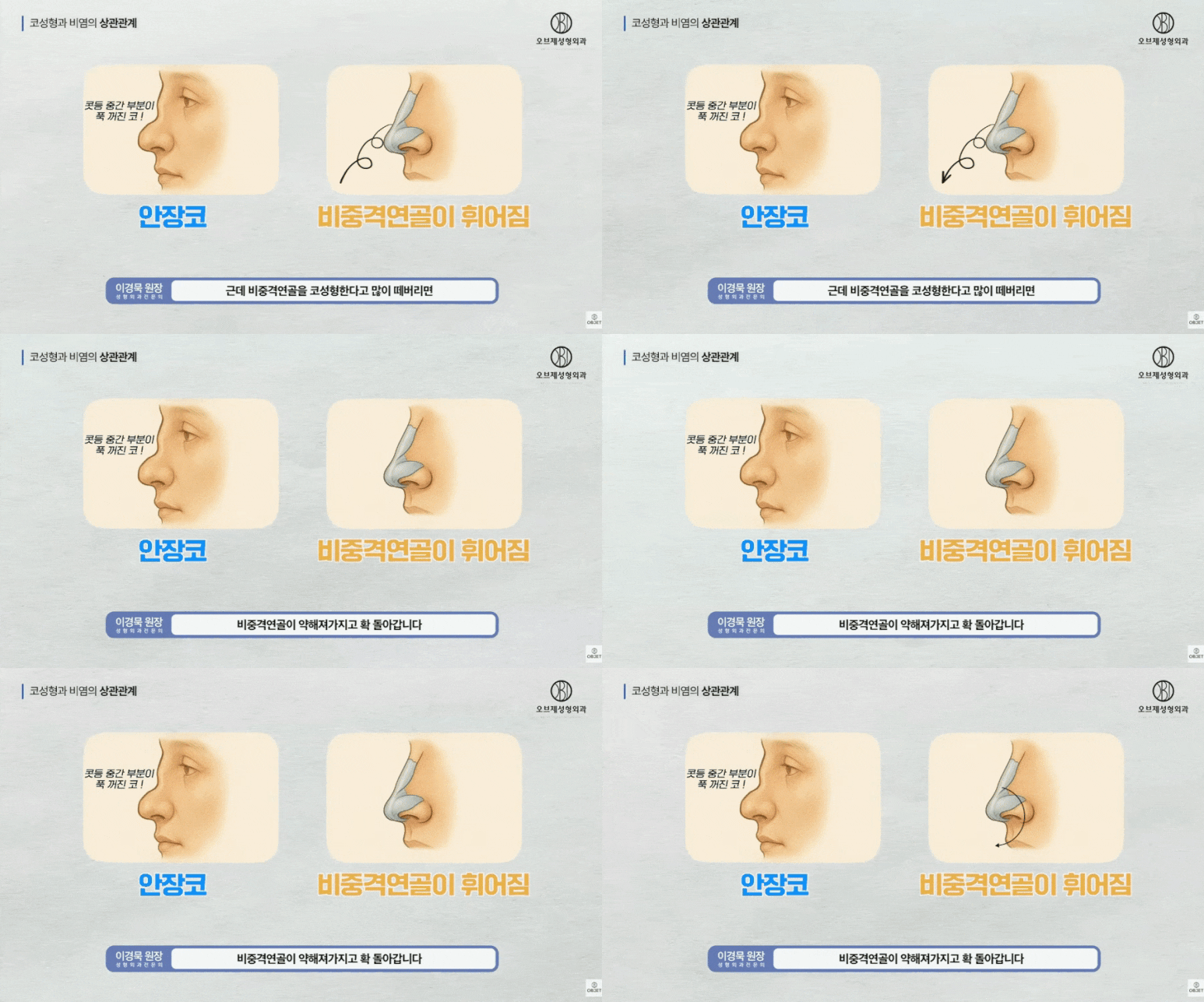
In this case, the shape inside the nose changes,
and discomfort similar to rhinitis
can appear.
So before proceeding with nose surgery,
you should consider these factors thoroughly
and choose the procedure carefully.

Then when can rhinitis surgery and nose surgery
be done together?
If you have rhinitis symptoms
and also want to change the shape of your nose,
you may consider having both procedures at the same time.

The important point is that nose surgery
is not what cures rhinitis,
but that rhinitis surgery and nose surgery
are performed at the same time.
However, this is not possible in every case.
If the septum is tilted to one side
and you need septoplasty,
then rhinitis surgery and nose surgery can be performed together.
Septoplasty often overlaps with the area
addressed in nose surgery.
Since nose surgery already involves a process
of accessing the inside of the nose,
if septal correction is needed, doing it together means
there is no need to make an additional separate incision,
and the recovery period can be handled at once.
Another point you should remember is that
the standard for deciding whether surgery is needed
is symptoms.
If your nose is frequently blocked,
if breathing is uncomfortable during sleep,
or if you have difficulty smelling things,
surgery is considered when there is
practical discomfort.
Even if tests such as CT show a structural problem,
please remember that surgery is not necessary
if there are no symptoms.

Today we looked at how nose surgery
and rhinitis surgery are different procedures,
and in what cases
rhinitis surgery and nose surgery can be performed together.
Director Lee Kyung-mook of Objet Plastic Surgery
checks not only the appearance of the nasal bridge and tip
when consulting on nose surgery,
but also the condition of the septum.

Whether the internal structure of the nose
can remain stable after surgery,
and whether there is any possibility of leading to
nasal valve narrowing or septal deformation,
are also examined as a basic part of the process.
If you are considering nose surgery,
I recommend checking the internal structure of the nose
as well as the shape of the nose.
So far, this has been Objet Plastic Surgery.
Thank you.
<🔽🔽Videos that may be helpful to watch together🔽🔽>
| Consultation and inquiries for nose surgery |
|---|
| Quick phone consultation |
| Kakao simple consultation |
-
This post is medical information written by Objet Plastic Surgery Clinic in compliance with the Medical Advertising Act.
-
Results may vary depending on the individual, and side effects may occur.
We recommend that you fully consult with medical professionals in advance before deciding on a procedure.