Scars Before and After Lower Eyelid Fat Repositioning?
Director Kim Hyun-jo’s <Cutting Through the Worries>

Hello.
This is Objet Plastic Surgery.
For those looking into lower eyelid fat repositioning before and after,
there is one point where they first stop.
That is the part about scars.
Because lower blepharoplasty has a strong image of
making an incision directly in the skin under the eyes,
many people naturally think of lower eyelid fat repositioning
when looking for an alternative.

However, although the name is fairly well known,
it is not as easy as you might think to find detailed information
through search alone about how the surgery proceeds
and what the results look like.
So today, we’ll first address the scar-related concerns,
and also organize the selection criteria
you should check even before scars.
If you read to the end,
you’ll be able to clearly organize what to look into
before deciding on lower eyelid fat repositioning.
Scar concerns?
Set them aside with peace of mind!
When comparing before and after lower eyelid fat repositioning,
the first thing you can feel reassured about is scars.
Lower eyelid fat repositioning is performed by accessing the fat
through the moist mucous membrane on the inside of the eyelid,
that is, the conjunctiva.
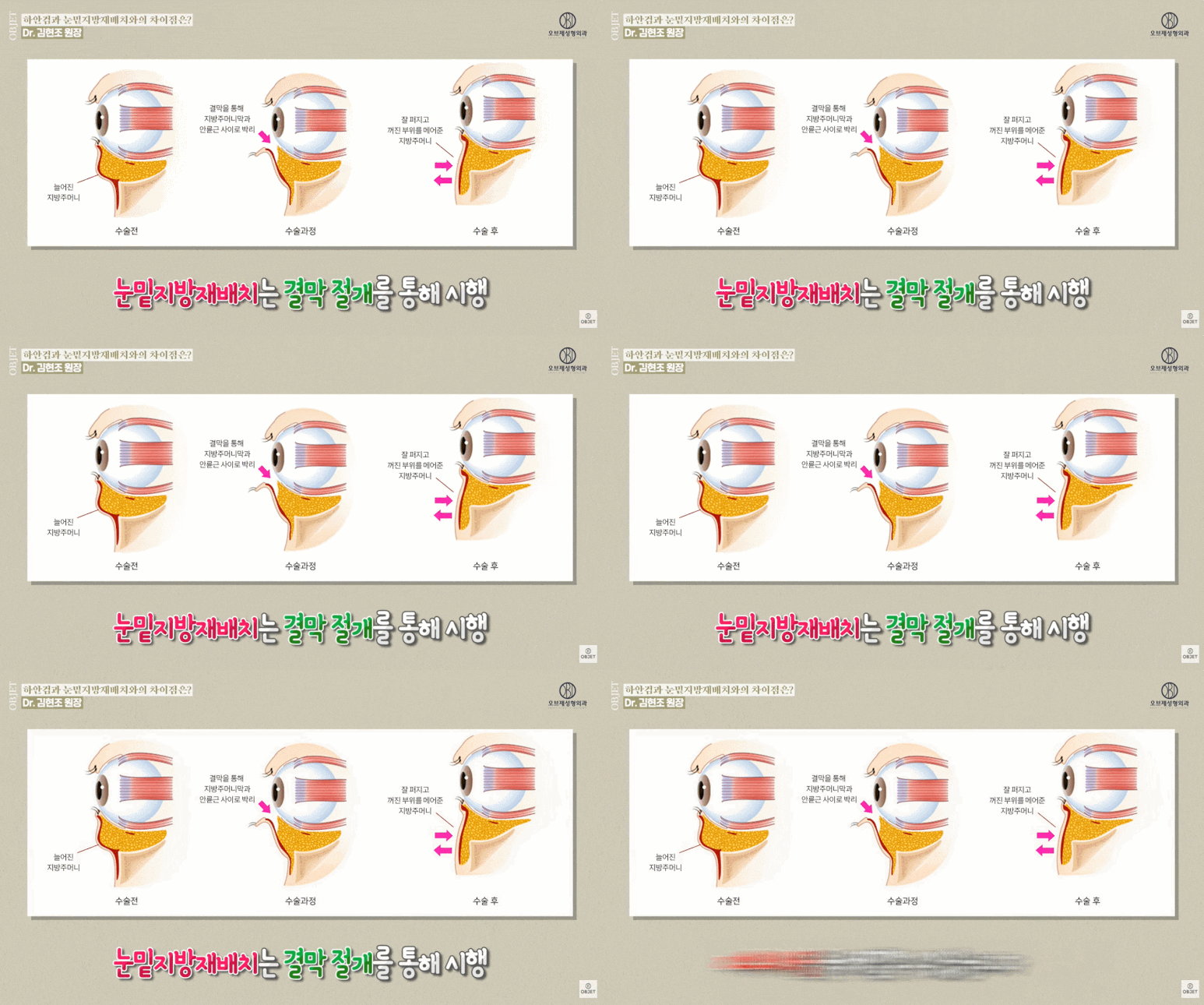
The conjunctiva is an area that is not visible from the outside
when the eyes are open.
Simply put,
because the outer skin is not incised,
there is almost no visible external scar.
Before surgery,
the under-eye fat protrudes forward,
creating a deep shadow,
and dark circles stand out.
After surgery, that fat is moved toward the hollow tear trough,
so the line under the eyes becomes flatter and more refined.

In this process, one of the biggest differences you can feel
when comparing other surgeries with lower eyelid fat repositioning
is that there are almost no incision marks on the outer skin.
The recovery process is also relatively light.
At Objet Plastic Surgery,
because the outer skin is not sutured,
there is no separate step of removing external stitches,
and instead of separate sutures,
the procedure is finished with taping,
so the external care is completed by removing the tape
about 4 days after surgery.
The rate at which swelling and bruising subside,
and the time it takes to return to daily life,
can vary from person to person,
but the fact that you do not need to return to the hospital
to remove external stitches is clearly an advantage.
No scars, so lower eyelid fat repositioning?
Check <this> first

By now, you may be thinking,
“Then I should just get lower eyelid fat repositioning.”
But the truly important story starts now.
The “cause” of why the under-eye area looks dark
and deeply sunken differs from person to person.
In some people, the fat protrudes forward;
in others, the skin itself is lax,
and in some, the overall impression looks heavier
because the muscle has sagged.
Even if it looks like the same concern,
the internal structure is completely different.
The following is when the before-and-after changes from
lower eyelid fat repositioning tend to settle in satisfyingly.
The skin has almost no sagging,
its elasticity is still intact,
and only the fat protrudes forward.

This is often seen mainly in people in their 20s to 30s.
In this case, simply moving the fat through the conjunctiva
to the hollow area is enough to smooth the under-eye line.
If needed, a small amount of fat grafting may also be performed
to create a softer curve.
The representative feature of this group is that the dark,
shadowed impression before surgery becomes much clearer after surgery.
On the other hand, there are also cases where satisfaction is lower.
Not only the fat, but also the skin and muscle have sagged,
and the tear trough is deeply set.

This is a form often seen in people over 40.
If only the fat is adjusted in this state,
the inner volume decreases,
but the outer skin remains the same.
In that case, the remaining skin may fold up in fine wrinkles,
making the fine lines appear even more pronounced.
To compare it to something, it is closer to the loose surface
of a slightly deflated balloon.

That is why some people hear the name of the surgery
called “lower blepharoplasty” during consultation.
Lower blepharoplasty involves making an incision along the lower lash line,
removing the sagging tissue,
and also lifting the sagging muscle.
In complex cases where fat, skin, and muscle are all affected,
the structure is reset from the beginning,
so the overall line is often refined together.
However, because it involves an external incision,
some people feel burdened by the possibility of a scar.

A method that sits between these concerns is “dual lower blepharoplasty.”
This method combines fat repositioning through the conjunctiva
with an incision below the lower lash line,
so it fills hollow areas by moving the fat
while also partially correcting sagging skin at the same time.
This can reduce the concern about scars
while still allowing the sagging line to be refined together.
The recovery flow is also relatively light
compared with standard lower blepharoplasty.

As such, the appropriate method differs depending on the cause and symptoms,
so first of all, it would be good to carefully consider
what the “cause” of your concern is.
Looking back over what we’ve covered so far,
what determines the before-and-after results of lower eyelid fat repositioning is
less the question of whether there will be a scar
and more the question of whether I am a suitable candidate for this surgery.

If you only get fat repositioning when lower blepharoplasty is actually needed,
the sagging skin may remain as it is,
making the shadows look even darker.
Conversely, if someone who only needs fat adjustment chooses lower blepharoplasty,
they end up taking on the burden of an external incision
and the recovery that comes with it unnecessarily.
That is why, when receiving a consultation,
it is best to have the condition assessed from multiple angles
at a place that looks at where the fat is located,
how thick and elastic the skin is,
how the muscle has sagged,
and how deep the tear trough has become,
and then determine the direction that best suits your condition.

Director Kim Hyun-jo of Objet Plastic Surgery
looks at the location and amount of under-eye fat,
the degree of skin elasticity, the type of muscle sagging,
and the tear trough line in a three-dimensional way,
and helps determine together whether fat repositioning,
dual lower blepharoplasty, or lower blepharoplasty is the right direction.
Rather than deciding the type of surgery first based on scars,
the fastest path to satisfying lower eyelid fat repositioning results
is to first check what condition the area under your eyes is in right now.
This has been Objet Plastic Surgery.
Thank you.
<🔽🔽A video that may be useful to watch together🔽🔽>
| Consultation and Inquiries for Lower Eyelid Fat Repositioning |
|---|
| Phone quick consultation |
| Kakao easy consultation |
-
This post is medical information written by Objet Plastic Surgery Clinic in compliance with the Medical Advertising Act.
-
The effects of the procedure may vary depending on the individual, and side effects may occur.
We strongly recommend having sufficient consultation with medical professionals in advance before deciding on the procedure.