If You Have ‘This Type,’ It Can!

Hello.
This is 오브제성형외과.
If the area under your eyes looks dark and sunken every time you look in the mirror,
it is probably something that bothers you.
Even if you apply another layer of bright concealer,
take care to use eye cream,
or get a good night's sleep,
that shadow remains unchanged,
which can leave you feeling frustrated.
People around you may say that you look tired
or older than your age,
and when you take photos,
the area under your eyes may look noticeably darker,
making you even more self-conscious.

At some point, you may have heard somewhere
that lower-eyelid fat repositioning can improve dark circles,
and you may be reading this because you want to know
whether the area under your eyes falls into that category.
To give you the conclusion first,
there is indeed one specific type of dark circle
that can become brighter with lower-eyelid fat repositioning.
Today, I will explain what that type is
and help you determine whether you fall into that category.
By reading to the end,
you will have a much clearer understanding
of which type your under-eye area most closely resembles.
Is the Dark Circle Under Your Eyes
Really a Change in ‘Color’?
When people hear about dark circles,
most first think of an area that has become darker in color.

But when you look closely,
it is much more often a shadow created by light
rather than a change in color.
Here is how it works.
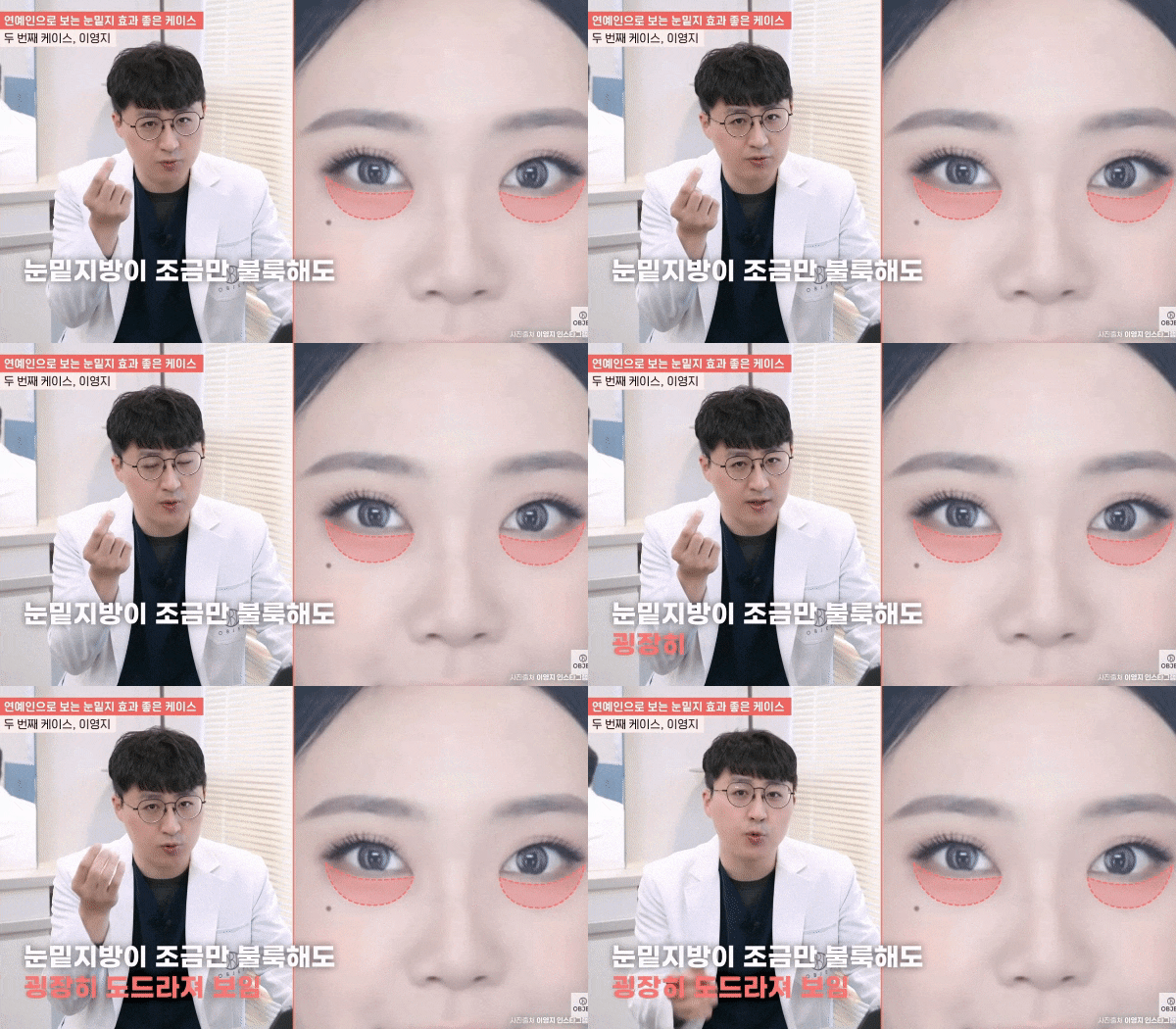
The fat under the eyes normally
acts as a cushion that gently supports the eyes.
As the orbital septum that holds this fat in place from the inside
loosens over time,
the fat gradually pushes forward.
This creates a bulging ridge.
Immediately below it,
there is a ligament that holds the skin to the bone.
Along the line where this ligament is attached,
the area sinks inward like a groove,
and this is the tear trough.
With a bulge above
and a depression below,
it is as if a small ridge and groove
form side by side under the eye.

This is where light comes into play.
The light we receive usually comes from above.
Ceiling lights and midday sunlight work this way as well.
Then the ridge that bulges upward catches the light
and appears bright,
while the groove below it
receives little light and appears dark and sunken.
This dark groove
is what looks like a dark circle.
It is not that the skin itself is black;
rather, the shadow created by the difference in height
appears dark.

That is why there is a limit
no matter how much bright concealer you apply.
Concealer is a cosmetic that covers color with a single layer.
It can brighten the tone of a flat surface,
but it does not change the three-dimensional ridge and groove.
This is why the area may look fine
when you are facing natural light,
but the shadow in the groove looks especially deep
under fluorescent lighting
or in selfies taken from below.
Lower-Eyelid Fat Repositioning
Removes the Shadow ‘This Way’
If the cause of the shadow is an uneven contour,
the solution also becomes clear.
When an uneven surface is smoothed out,
there is no place for the shadow to remain.
Let me point out one important detail here.
If the bulging fat is simply removed,
the ridge above may become lower,
but the groove below remains.
The surface then does not connect smoothly,
so the shadow does not completely disappear.
Therefore, instead of removing it,
the fat that has pushed forward
is moved toward the sunken tear trough directly below it.

The ridge becomes lower
and the groove is filled,
creating one smooth surface from top to bottom.
When the surface becomes flatter,
light does not gather in one place
but passes evenly across it.
As the shadow is dispersed,
the area under the eyes appears brighter overall.
If the groove is particularly deep
and cannot be filled with the repositioned fat alone,
the shortfall can be supplemented with lower-eyelid fat grafting
to adjust the height.

The more prominently the fat under the eyes bulges
and the more clearly the area below it is hollowed,
the more closely the condition matches the type
that may benefit from lower-eyelid fat repositioning for dark-circle improvement.
I Have ‘This Type.’
How Are Other Dark Circles Addressed?
Even if they look like the same dark circles,
when the reason for the darkening is different,
the appropriate approach is different as well.
They can broadly be divided into three types.
The first is darkening caused by pigmentation.

If you have been exposed to ultraviolet rays for a long time,
rub your eyes frequently,
or have a naturally darker skin tone,
pigment can build up under the eyes,
causing the skin itself to appear brownish and dark.
This is a problem of color rather than contour,
so it remains unchanged even if fat is repositioned or added.
Laser treatment to lighten the color
or care to improve skin texture
may be more appropriate as a first step.
The second is when blood vessels show through.
The skin under the eyes is among the thinnest skin on the body,
so the blood vessels beneath it
may show through as bluish or reddish.
This is also closer to a problem of visible color
rather than surface contour,
so it requires a different approach from lower-eyelid fat repositioning.
The third is when the skin has also sagged.
As skin and muscle elasticity decrease with age,
the entire under-eye area moves downward,
making the shadow deeper.

In this case, the issue is not the amount of fat to reposition
but the amount of loose tissue itself,
so lower-eyelid surgery that also addresses the sagging area
may be a better fit.
Let me point out one more thing.
In reality, it is more common for several causes to overlap
than for there to be just one clearly defined cause.
Pigmentation may be slightly added to a shadow,
or sagging may occur along with hollowing.
Therefore, if you group everything under the single term ‘dark circles’
and apply the same method,
the area may not become as bright as expected.

This is precisely why lower-eyelid fat repositioning for dark-circle improvement
does not apply to every under-eye shadow.
To summarize today's discussion:
Under-eye shadows that are difficult to conceal
are often shadows created by contour rather than color.
If the fat under the eyes bulges
and the area below it is hollowed like a groove,
lower-eyelid fat repositioning may be worth considering
for dark-circle improvement.
On the other hand, if the area is dark due to pigmentation,
blood vessels show through,
or the skin has also sagged,
another approach may be more appropriate.

Dr. 김현조 of 오브제성형외과 does not look only at how dark the area under the eyes is.
Instead, he separately examines
how far the fat has projected forward,
how deeply the tear trough has sunk,
and the thickness through which the skin shows what lies beneath.
After determining whether the current shadow comes from color
or from contour,
he decides, based on the condition under the eyes,
whether repositioning alone is sufficient
or whether lower-eyelid fat grafting should be added to fill the area.

If you now have a clearer idea
of which type your under-eye area most closely resembles,
we recommend calmly looking into several options,
but first having a consultation
that examines whether the shadow you see now
is a problem of color or contour.
This has been 오브제성형외과.
Thank you.
<🔽🔽Recommended Video🔽🔽>
| Lower-Eyelid Fat Repositioning Consultation and Inquiries |
|---|
| Quick consultation by phone |
| Convenient Kakao consultation |
-
This post is medical information written by 오브제성형외과의원 in compliance with the Medical Advertising Act.
-
The treatment results may vary from person to person, and side effects may occur.
We recommend that you have a sufficient consultation with a medical professional beforehand before deciding on treatment.