Donated Rib Rhinoplasty
What Is the Best Material for a Nasal Implant?
<Key Summary>

Hello.
This is 오브제성형외과.
These days, when looking through rhinoplasty reviews,
stories about using donated rib cartilage
stand out more often than expected.
As the materials used in rhinoplasty have become more diverse,
more people are wondering
which material they should choose.
Especially for those preparing for rhinoplasty for the first time
or trying to refine an area
that has already been operated on,
choosing can be difficult
when so many material names are being mentioned.

So today,
when considering donated rib rhinoplasty,
I will organize which nasal implant material is best
in a way that is easy to understand,
even for those seeing this topic for the first time.
I will also address some common misconceptions,
so if you read to the end,
you will have a clearer understanding
of the criteria for choosing a material.
What Is the Best Material?
There is no need to look far!
When choosing a nasal implant material,
the first thing a doctor thinks of
is not a flashy new material.
It is the patient's own tissue.
Typical examples include septal cartilage,
obtained from the wall that divides the inside of the nose,
and ear cartilage, obtained from the ear.
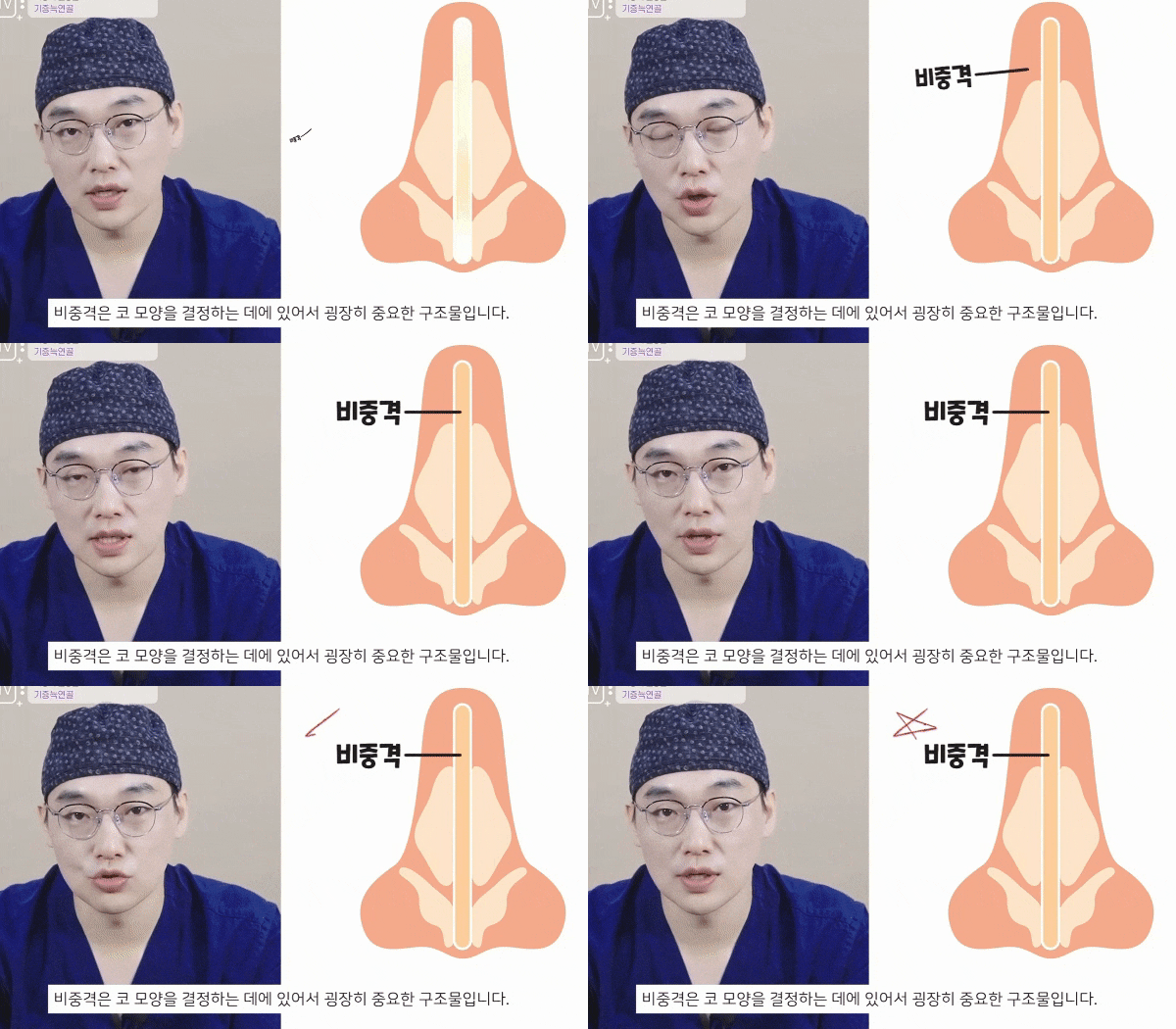
Among these, septal cartilage
is tissue that originally supported the center of the nose,
so it has good strength
and tends to work well
for building up the nasal tip and columella.
In simple terms,
it is like using the material that supported you
to build you back up,
which also makes it advantageous for settling into place.
However, removing too much of the septum
can weaken the support of the nose,
so only the amount that is necessary is used carefully.

To summarize,
the first-choice material for a nasal implant
is always tissue obtained from your own body.
That is the most straightforward answer
to today's question.
If Your Own Tissue Is Best,
Why Use Donated Rib Cartilage?
If your own tissue is the best option,
you may wonder
why donated rib rhinoplasty is necessary.
The reason is simple.
There are times when your own tissue alone
is not enough.
When the septum is small or thin
and cannot adequately support the nasal tip,
or when an area that has already undergone surgery
needs to be rebuilt,
additional supporting material is needed.
In such cases,
autologous rib cartilage, obtained from your own ribs,
may be considered.
Because it is your own tissue, it has considerable strength
and is regarded as an ideal material.

However, using this material
requires an additional incision near the ribs,
which increases the burden during recovery.
Because the scope of surgery is greater,
another disadvantage is that the cost also increases.
Above all, autologous rib cartilage
has a tendency to warp.
Although it settles straight immediately after surgery,
the cartilage may bend slightly over time
and affect the contour.

Just as even a well-dried wooden chopstick
may bend to one side if left for a long time,
cartilage, as living tissue,
can also undergo subtle changes in shape.
A practical alternative
that can reduce these burdens
is donated rib cartilage.
Many people misunderstand donated rib cartilage
as “simply inserting someone else's cartilage,”
but that is not what actually happens.
Donated rib cartilage is carefully processed
and then treated with radiation,
which removes cellular components
and factors that could cause a rejection response
in advance.

Because it undergoes this process,
the possibility of an immune rejection response,
which many people commonly worry about,
is generally known to be quite low.
Two Rumors About Donated Rib Cartilage
We Looked Into Whether They Are True
There are two major claims
that make people hesitate over donated rib rhinoplasty.
One concerns inflammation,
and the other concerns resorption.
Let's look at inflammation first.
Many people believe
that donated rib cartilage is more likely to cause inflammation,
but

some studies have reported
that even compared with one's own rib cartilage,
there was no significant difference
in the rate of inflammation.
However, these results may differ
depending on the patient's condition
and the purpose of the surgery,
so it is difficult to conclude
that one material is unconditionally safer.
Of course, this does not mean
that donated rib cartilage can never cause inflammation.
It means that there is not substantial evidence
to suggest that this material requires particular concern
because it is especially prone to inflammation.
The second issue is resorption.
Some donated rib cartilage
is absorbed by the body over time.
However, it is a misconception
that “it all disappears.”
Some studies have reported
that a considerable amount of donated rib cartilage
is maintained over time,
using the amount of one's own rib cartilage that remains
as a reference.

A certain degree of resorption
can actually be an advantage.
One's own rib cartilage
tends to retain its firmness for a long time,
whereas donated rib cartilage becomes
more natural and softer in texture
as some of it is absorbed.
Therefore, it is difficult to view resorption itself
as a failure.

Ultimately, the key when choosing a nasal implant
is not the material itself,
but “how it is used.”
Because donated rib cartilage is provided
in a preformed product,
the thickness to which it is shaped
can determine the outcome.
If it is shaved too thin,
its supporting strength decreases
and maintaining the shape becomes more difficult,
but if an appropriate thickness is secured,
it can provide good support
and maintain a stable shape.

Also, no single material is suitable for everyone,
so the doctor must consider the condition of the cartilage,
the structure of the nose,
and the purpose of the surgery together
when choosing the material.
Today, before donated rib rhinoplasty,
we reviewed step by step
which nasal implant material may be suitable.
To revisit the key points,
the materials considered first
are tissues from your own body,
such as septal cartilage or ear cartilage.
When additional support is needed for the nasal tip,
or when an area that has already undergone surgery
needs to be rebuilt,
such as when your own tissue alone is insufficient,
autologous rib cartilage or donated rib cartilage
may be considered as alternatives.
Among these, donated rib cartilage
is a practical option that can fill the role of one's own tissue
while reducing the burden
of making a separate incision near the ribs.
Concerns about inflammation or resorption
may differ from the findings of actual studies,
so rather than worrying in advance
based only on the name of the material,
it is much more important to consider
how it suits your condition.

Director 이경묵 of 오브제성형외과
first checks how much septal cartilage remains
and whether there is sufficient strength
to support the nasal tip.
Then, between autologous tissue
and donated rib cartilage,
he selects the material suited to each person.
Therefore, even with the same donated rib rhinoplasty,
please remember that the result can vary
depending on which material is used,
how much is used,
and how it is used.
If you are carefully considering the material,
you are already taking the right steps.
We recommend consulting carefully
at several clinics,
while also keeping today's criteria in mind.
This has been 오브제성형외과.
Thank you.
<🔽🔽Recommended Video to Watch Together🔽🔽>
| Rhinoplasty Consultations and Inquiries |
|---|
| Quick consultation by phone |
| Simple consultation via Kakao |
-
This post is medical information prepared by 오브제성형외과 의원 in compliance with the Medical Advertising Act.
-
The effects of the procedure may vary from person to person, and side effects may occur.
We recommend making a decision about the procedure only after having a thorough consultation with a medical professional in advance.