Repositioning to Avoid Tear Trough Hollowing?
Director Park Si-hyun’s <Guide>
Hello.
This is Objet Plastic Surgery Clinic.
When the area under the eyes appears bulging and you begin looking into surgery,
it is natural to find yourself considering whether to choose “removal” or “repositioning.”
Removing the fat may seem like it would create a cleaner result,
while you may also come across articles saying that repositioning is better.
What is especially concerning are stories of tear trough hollowing becoming more pronounced over time after fat removal.
That may be why some of you clicked on this article wondering, “Should I undergo repositioning?”
Today, we will explain step by step how lower eyelid fat removal and lower eyelid fat repositioning differ,
and which approach may be appropriate for avoiding tear trough hollowing.
We hope this article will help you organize what criteria to consider when choosing a surgical method.
“Removal” and “repositioning”
are not the same procedure
When the area under the eyes looks bulging, the first thought that often comes to mind is,
“Then I should just get rid of this fat.”
In fact, lower eyelid fat removal is a procedure that excises the protruding fat to flatten the area under the eyes.
Immediately after surgery, the bulging area becomes smaller, making the lower eyelid temporarily appear flatter.
However, an important point is that the result immediately after surgery and the result after time has passed may be different.
The area where the fat was removed loses volume.
This may not be noticeable at first,
but over time, the area under the eyes may gradually begin to look sunken,
making the naturally hollow area below the lower eyelid,
that is, the tear trough, appear deeper.
Although removing the fat reduces the bulging,
tear trough hollowing may become more apparent,
making dark circles look more pronounced
or, in some cases, creating an older-looking appearance than before surgery.
Lower eyelid fat repositioning takes a different approach.
Rather than simply removing the protruding fat,
it spreads and moves the protruding fat evenly into the sunken area below.

The bulging area is reduced, while the hollow tear trough is filled,
creating a smooth, continuous contour across the entire lower eyelid area.
In summary,
lower eyelid fat removal is a procedure that “takes fat out,”
while lower eyelid fat repositioning is a procedure that “moves fat.”
Even when the concern under the eyes is the same,
the result over time may differ depending on which approach is chosen.
This is worth keeping in mind.
Why can repositioning also improve
tear trough hollowing?
The most important point in lower eyelid fat repositioning
is not simply reducing the bulging.
If you look closely at the area under the eyes,
there is a groove-like hollow directly below the protruding fat.

This area is the tear trough.
As the area under the eyes becomes more bulging,
the difference in level between the bulge and this groove increases,
creating shadows and a darker appearance.
Lower eyelid fat repositioning is a procedure designed to address this difference in level.

Because the protruding fat is moved downward toward the tear trough and used to fill it,
the protruding area is reduced,
while the hollow area gains volume and the lower eyelid contour becomes more even.
It may be easier to understand by comparing it to a blanket.
If the filling is bunched up on one side of a blanket and thin on the other,
removing the bunched-up filling would only make the blanket thinner overall,
but loosening the bunched-up area and spreading it evenly toward the thin side
would make the blanket more uniform overall.
That is the same principle.
There is one more point worth knowing.

There is a structure under the eyes called the orbital septum.
Simply put,
it acts like a retaining barrier that keeps the fat from pushing forward.
As we age,
when the orbital septum becomes lax,
the fat can push forward.

During lower eyelid fat repositioning,
this orbital septum may also be reinforced when necessary while the fat is being moved.
This takes the supporting structure into consideration so that the fat does not easily push forward again.
Therefore, lower eyelid fat repositioning is not merely a procedure that changes the outward appearance;
it can be understood as a procedure that improves the structure of the area under the eyes itself.
When repositioning alone is not enough,
consider “this method” as well
Although lower eyelid fat repositioning can improve many concerns under the eyes,
repositioning alone is not sufficient for everyone.
For example,
when tear trough hollowing is very deep,
or when there is little fat throughout the face or insufficient midface volume,
the amount of fat available for repositioning may not be enough to sufficiently fill the hollow area.
In such cases,
single-fat-cell grafting may also be considered to supplement the deficient volume.
Single-fat-cell grafting is a method that can evenly add volume even in areas with thin skin, such as under the eyes.
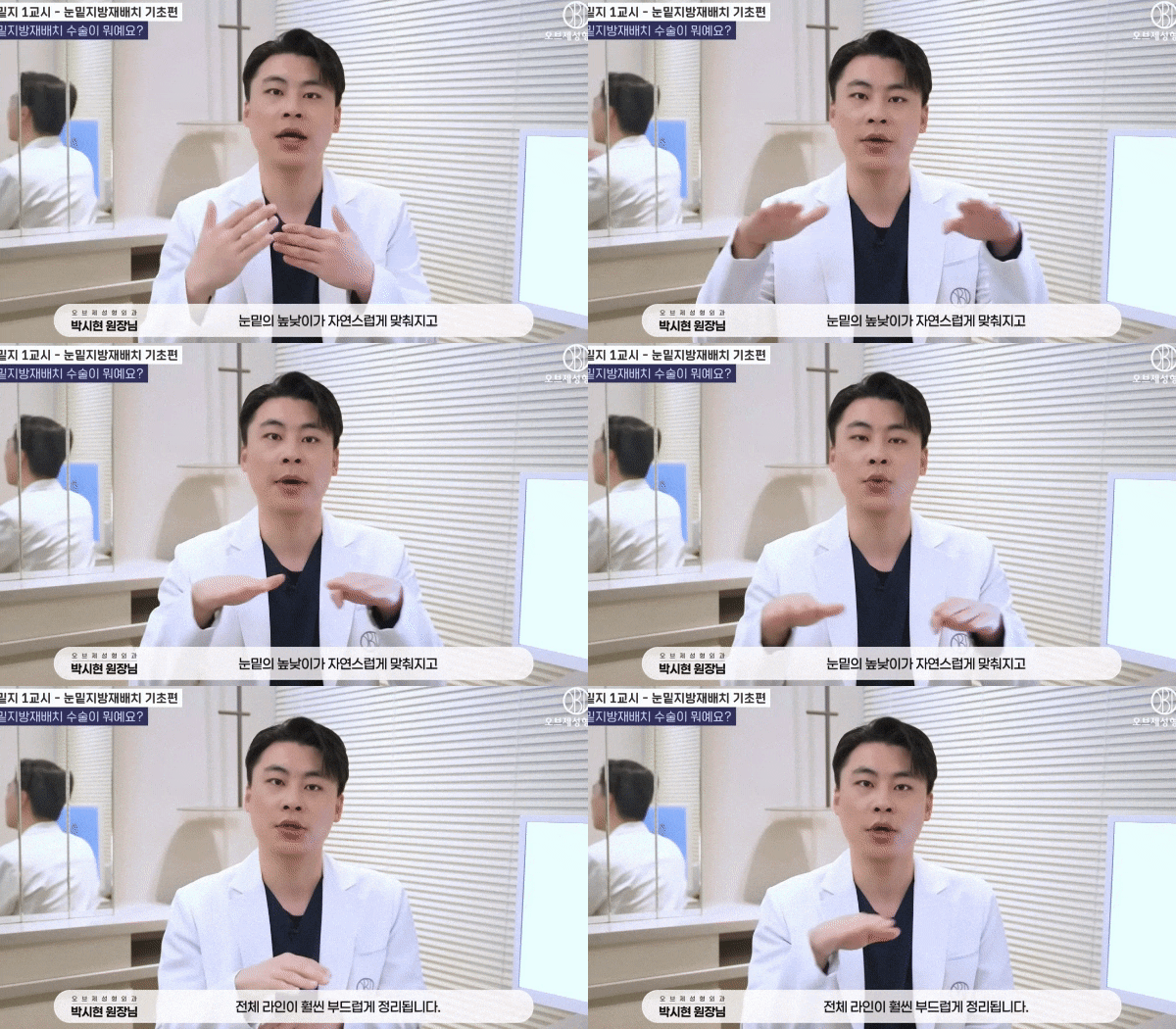
Lower eyelid fat repositioning can address the difference in level between the protruding and hollow areas,
while single-fat-cell grafting can supplement any remaining lack of volume,
potentially creating a smoother and more natural lower eyelid contour.
However, this method is not necessary for everyone.
Depending on the condition of the area under the eyes,
repositioning alone may often be sufficient,
so accurately understanding your current lower eyelid structure should come first.
Today, we looked at how lower eyelid fat removal and lower eyelid fat repositioning differ,
and which approach may be appropriate for avoiding tear trough hollowing.
In summary,
when addressing concerns under the eyes,
what matters more than how much fat is removed
is whether the structure under the eyes can be improved in a balanced way.

Focusing only on reducing the bulging area
may instead lead to a result in which hollowing becomes more noticeable.
Director Park Si-hyun of Objet Plastic Surgery Clinic evaluates the degree of lower eyelid protrusion,
the depth of the tear trough,
and the condition of the orbital septum together,
then designs the amount and direction of fat to be repositioned, as well as the fixation points.
When necessary,
single-fat-cell grafting is also performed to supplement areas lacking volume,
helping the lower eyelid contour continue naturally.
If you are considering lower eyelid surgery,
rather than simply choosing between “removal” and “repositioning,”
we recommend first checking the current condition of your lower eyelid structure.
This has been Objet Plastic Surgery Clinic.
Thank you.
<🔽🔽Video you may also find helpful🔽🔽>
| Consultation and inquiries about lower eyelid fat repositioning |
|---|
| Quick phone consultation |
| KakaoTalk quick consultation |
-
This post is medical information prepared by Objet Plastic Surgery Clinic in compliance with the Medical Advertising Act.
-
The effects of the procedure may vary from person to person, and side effects may occur.
We recommend having a thorough consultation with a medical professional beforehand before deciding to undergo the procedure.