Middle-Aged Double-Eyelid Surgery
What’s the Difference Between Upper Blepharoplasty?
<Differences> Summarized!

Hello.
This is Obje Plastic Surgery.
When looking into double-eyelid surgery for middle-aged patients,
the term “upper blepharoplasty for middle-aged patients”
often appears alongside it.
Both procedures involve making an incision in the eyelid
and creating a double-eyelid crease,
so they can easily appear to be the same method.
However, the fact that they have different names
also means there is a clear difference somewhere
in their purpose or process.

The more you search,
the more information you find,
but some of you may have experienced
that it becomes even more difficult
to determine which approach suits your eyes.

So today,
I will explain step by step
exactly how incisional double-eyelid surgery
differs from upper blepharoplasty,
as well as which method may be appropriate
depending on the condition of your eyes.
After reading to the end,
the criteria for distinguishing the two procedures
should become much clearer.
Even with the same incision,
“this one thing” is different
Incisional double-eyelid surgery and upper blepharoplasty
are the same in that both involve making an incision in the eyelid.
However, the biggest difference
lies in “why the incision is made.”
The main purpose of incisional double-eyelid surgery
is to create a new double-eyelid crease.
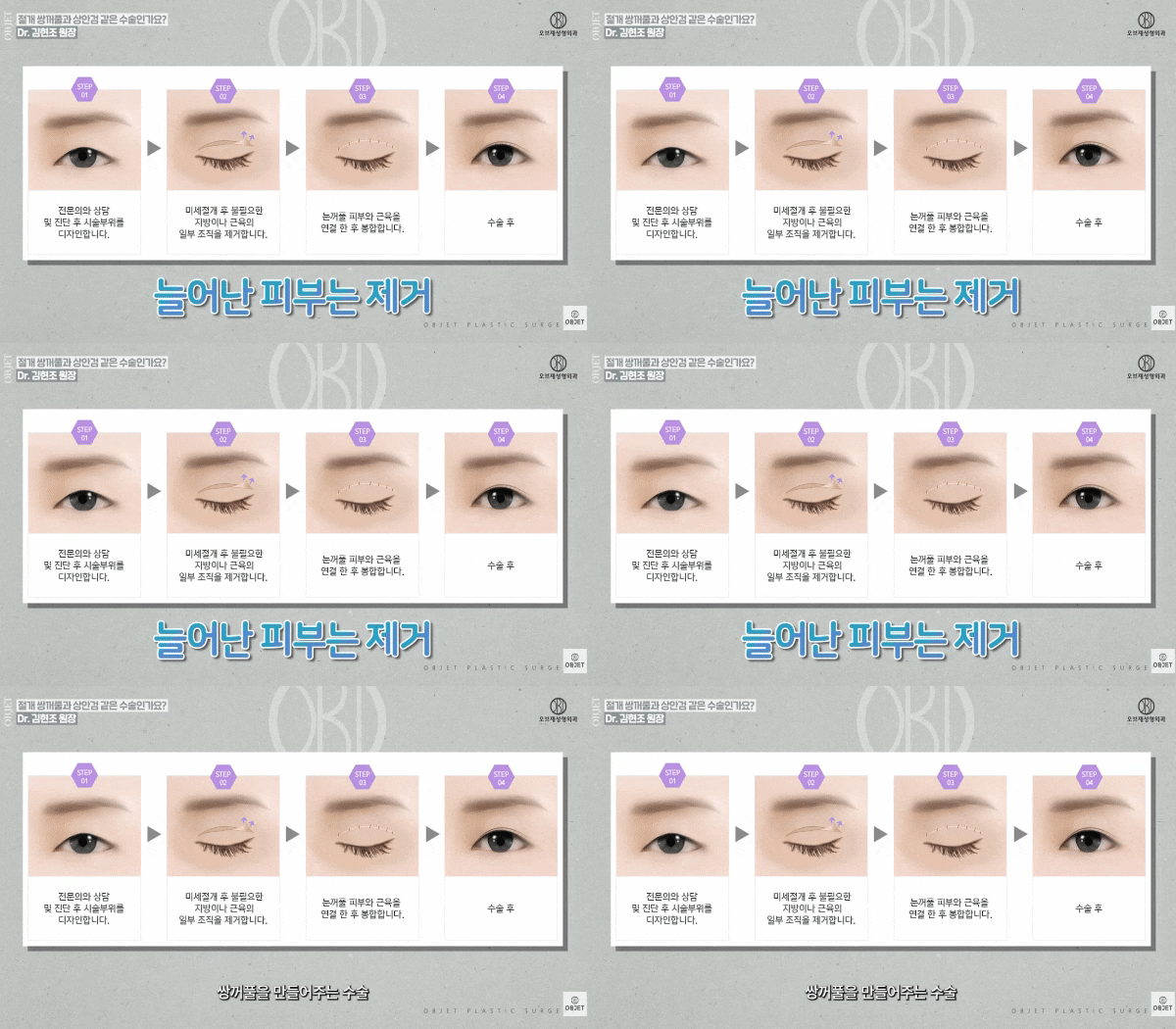
When the skin has not become significantly lax,
an incision is made along the desired crease
to create a defined double eyelid,
with fat being removed or adjusted if necessary.
In this process, little or no skin is removed.
In contrast, the purpose of upper blepharoplasty
for middle-aged patients is to remove excess skin from the eyelid
and also improve the function of opening the eyes.

As we age,
when the eyelid skin becomes lax,
it can cover the existing double-eyelid crease,
making the eyes look heavy
or even obstructing the field of vision.
In this situation,
it can be difficult to expect a change
by simply creating a double-eyelid crease.
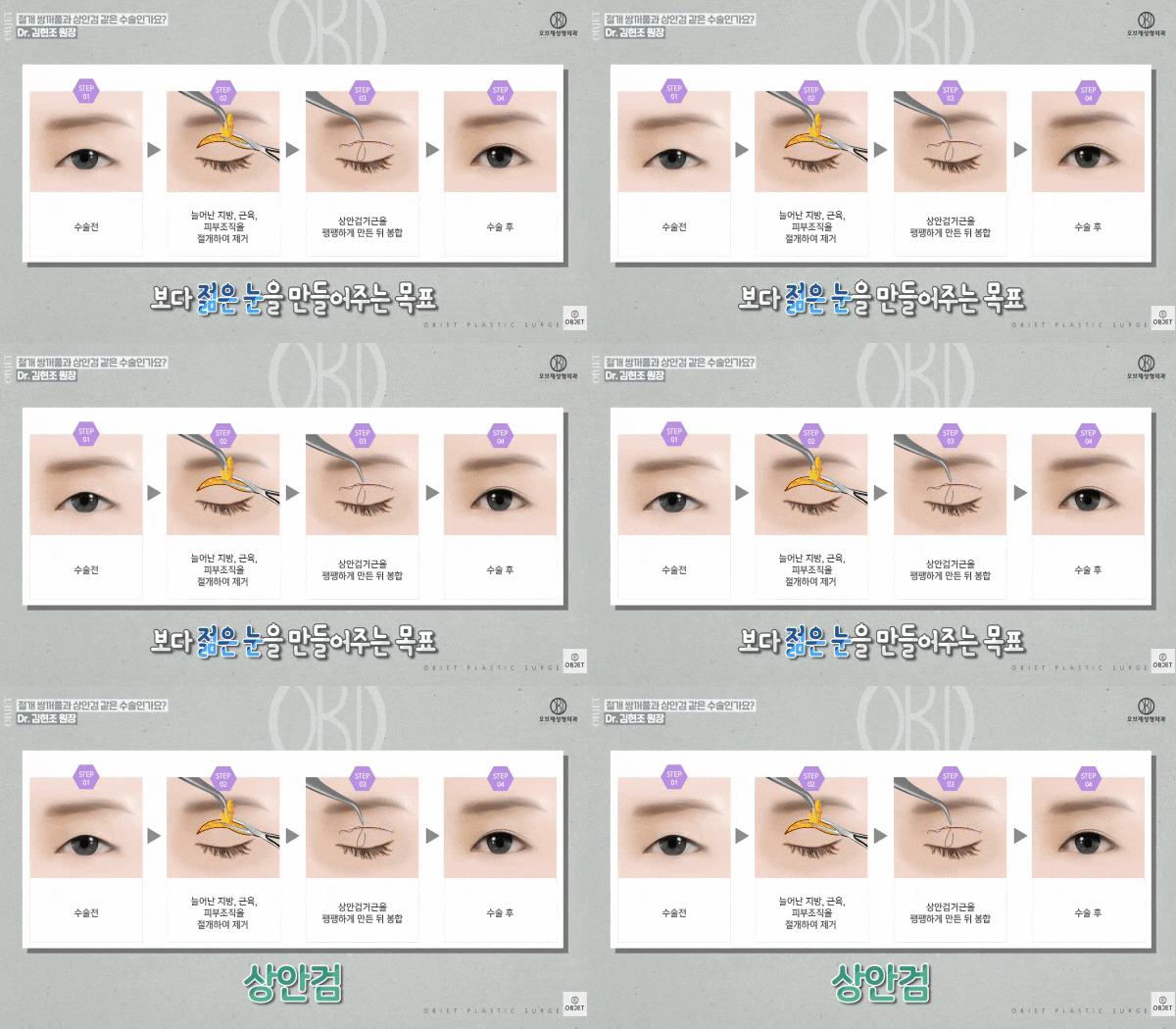
The excess skin itself must be removed
for the eye area to look more defined
and for the field of vision to feel more comfortable.
It is helpful to clarify the difference
between “incision” and “excision” here.
An incision means opening the skin.
It does not involve removing the skin.
Excision is the process of removing
as much excess skin as necessary.

Incisional double-eyelid surgery centers on making an “incision,”
while upper blepharoplasty centers on “skin excision.”
This is the clearest criterion
for distinguishing the two procedures.
Therefore, if you are considering double-eyelid surgery in middle age,
it is important to first determine
whether your eyes need a new crease
or removal of excess skin.

If your eyes fall into “this” category,
the approach will be different
Let’s take a closer look
at which method may be appropriate
for different eye conditions.

Incisional double-eyelid surgery may be appropriate
when the skin is not significantly lax
and you want to create a defined double eyelid.
It may also be considered
when the eyelids are relatively thick
or there is a substantial amount of fat around the eyes,
making it difficult to maintain results with the buried-suture method.
In these cases,
it may be possible to achieve sufficient change
simply by forming and securing the crease
without removing skin.
In contrast,
cases in which upper blepharoplasty for middle-aged patients
may be appropriate are somewhat different.
If sagging eyelid skin makes the double-eyelid crease
appear covered,
if you repeatedly use your forehead muscles
when opening your eyes,
or if people often say that you always look sleepy,
considering an upper blepharoplasty approach
may be appropriate.
In particular, for those who feel heaviness
above the eyelids
or are gradually finding it more difficult
to open their eyes widely,
it is often difficult to achieve the desired change
by simply creating a double-eyelid crease.
Even if you began searching
with middle-aged double-eyelid surgery in mind,
an upper blepharoplasty approach may be more suitable
when the actual condition of your eyes is assessed.
Conversely, even if you are middle-aged,
incisional double-eyelid surgery may be sufficient
if the skin has not become significantly lax.
Ultimately, more important than age
is accurately understanding
the current condition of your eyes.
Is upper blepharoplasty all you need?
Some eyes require more
If you have read this far,
you probably have a general understanding
of the difference between incisional double-eyelid surgery
and upper blepharoplasty.
There is one more point
that is useful to know.

Not every middle-aged eye
can be addressed with upper blepharoplasty alone.
Although the eyelids may appear sagging,
in some cases the eyebrows themselves
have actually descended.
In such cases,
no matter how much eyelid skin is removed,
it may be difficult to feel the desired degree of change.

If lowered eyebrows are the cause,
a brow lift or forehead lift
may also need to be considered.
In addition, if the strength used to open the eyes itself has weakened,
eye-shape correction may also need to be performed
in order to expect the eyes to look more defined.

Whether you are considering
middle-aged double-eyelid surgery
or upper blepharoplasty,
rather than insisting on just one method
associated with a particular name,
it is most important to first determine
what is making your eyes look heavy or obstructed.
Whether the cause is excess skin,
lowered eyebrows,
or weakened eye-opening strength,
the appropriate method will differ.
Today, I summarized
how middle-aged double-eyelid surgery
differs from upper blepharoplasty,
and which approach may be appropriate
depending on the condition of your eyes.
The purpose of incisional double-eyelid surgery
is to create a new double-eyelid crease,
while the purpose of upper blepharoplasty
is to remove excess skin
and improve the function of opening the eyes as well.
Although the procedures may look similar on the surface,
the approach can be completely different
depending on what is needed.
Director Kim Hyun-jo of Obje Plastic Surgery
carefully assesses the thickness and degree of sagging
of the eyelid skin,
the distance between the eyebrows and eyes,
as well as the strength used to open the eyes,
before determining one by one
whether incisional double-eyelid surgery is appropriate,
whether upper blepharoplasty is needed,
or whether both procedures should be performed together.

If excess skin is the cause,
upper blepharoplasty, which removes the excess skin,
may be appropriate.
If the cause is a lowered eyebrow position,
a lifting procedure to raise the eyebrows
rather than the eyelids
may be the appropriate approach.
If weakened eye-opening strength is the cause,
eye-shape correction should also be considered
to achieve a more defined appearance.
Even among middle-aged eyes,
the appropriate method differs when the cause differs,
and these detailed distinctions
make a difference in the outcome.
If you would like to know which approach suits your eyes,
we recommend first receiving a consultation
that comprehensively assesses their current condition.
This has been Obje Plastic Surgery.
Thank you.
<🔽🔽Recommended video to watch together🔽🔽>
| Consultation and inquiries about middle-aged eye surgery |
|---|
| Quick telephone consultation |
| Convenient Kakao consultation |
-
This post is medical information prepared by Obje Plastic Surgery Clinic in compliance with the Medical Advertising Act.
-
The effects of the procedure may vary from person to person, and side effects may occur.
We recommend that you have a thorough consultation with a medical professional beforehand before deciding whether to undergo the procedure.