The answer if you have “this type”!

Hello.
This is Objet Plastic Surgery.
You may have tried changing your eye cream,
using cold compresses,
and even adjusting your sleep schedule,
but the shadows under your eyes just do not seem to disappear.
Because of the shadows under your eyes,
you may look especially tired in photos,
and you may have even been told
that you look older than you really are.

Even though you have not neglected your skincare,
nothing seems to change,
and at some point
you begin to think,
“This may not be a skin problem.”
If you clicked on this post
after seeing its title,
you may already have
one possibility in mind:
that your dark circles may be caused
not by the skin’s surface,
but by the structure beneath your eyes.
That is correct.
Among dark circles,
there is a type that does not improve
no matter what cream you use
or what treatments you receive.
Today, we will explain step by step
what type this is
and why lower eyelid hollowing surgery
can be a way to get rid of dark circles.

By reading to the end,
you may gain a better sense of
where your dark circles originate
and which approach may be appropriate.
Dark circles that do not disappear with cream
are caused by “this type”
The causes of dark circles
can be broadly divided into three categories.
One is pigmentation,
another is visible blood vessels,
and the third is dark circles
caused by changes in the structure beneath the eyes.
Pigmentation occurs when
excess melanin accumulates
in the skin beneath the eyes,
making it look darker.
Visible blood vessels occur because
the skin beneath the eyes is thin,
allowing the color of the underlying blood vessels
to show through.
These two types can be improved
to some extent through brightening care or laser treatment.
However, the third type—dark circles caused by changes
in the structure beneath the eyes—is a completely different matter.
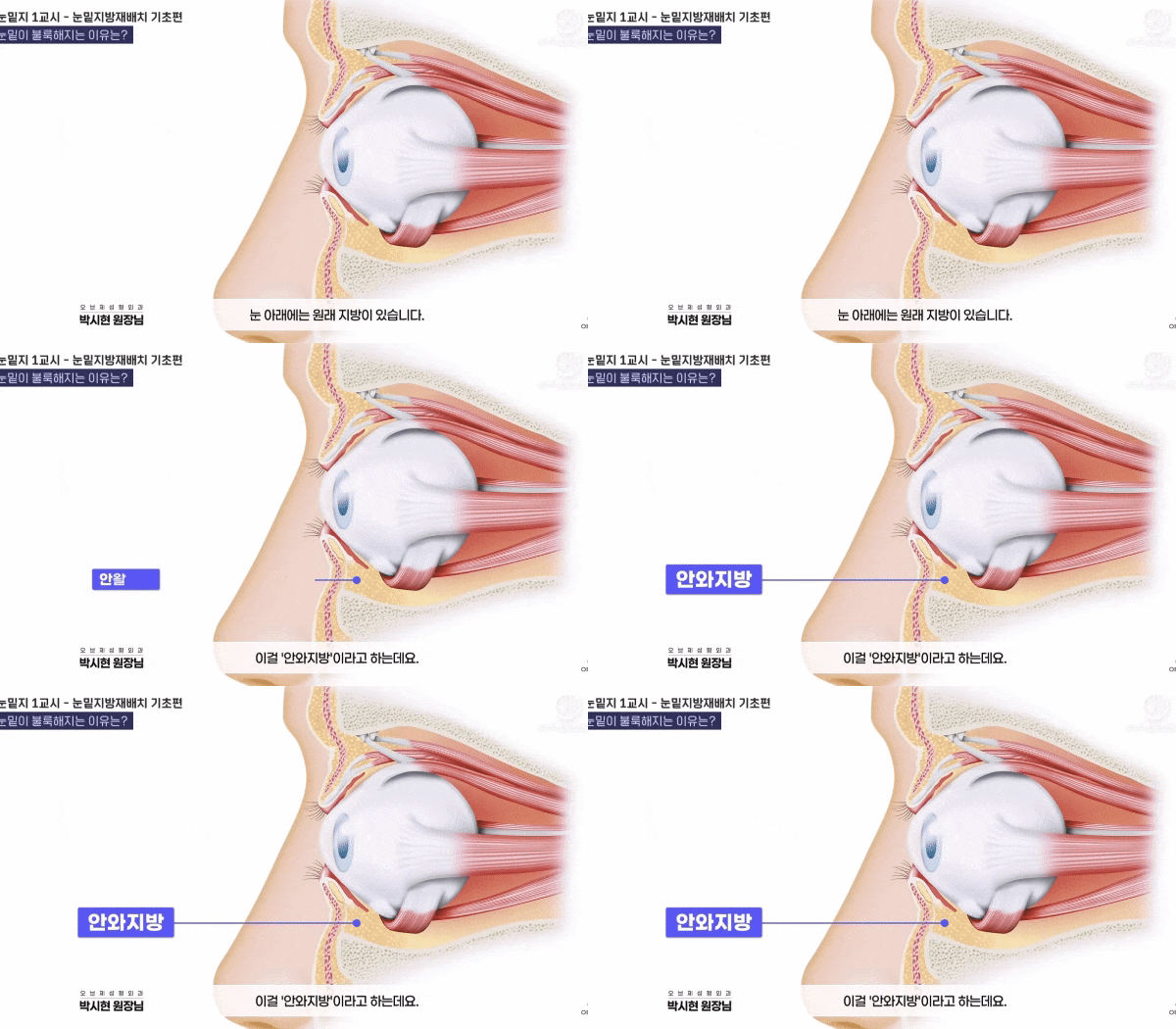
Beneath the eyes is fat
that surrounds and protects the eyeballs.
Medically, this is called orbital fat.
Simply put, it acts like a cushion
that supports the eyes from within.
This fat is normally held in place
by a thin membrane called the orbital septum.
Just as a dam holds back water,
the orbital septum keeps the fat
in its position inside the orbit.
However, as you age or if the orbital septum
is constitutionally weak,
this dam becomes loose
and the fat is pushed forward.

As a result,
the area beneath the eyes bulges outward,
while the tear trough directly below becomes deeper,
making the area look dark, as if it were shadowed.
This is structural dark circles—
the type that does not disappear
with creams or massage.
Because the change occurs not on the outside of the skin,
but in the fat and septum beneath it,
applying products to the surface
does not reduce the bulging,
and the hollowed area does not fill in.

For this type,
the way to get rid of dark circles is
lower eyelid hollowing surgery—
specifically, lower eyelid fat repositioning.
Lower eyelid fat repositioning:
“moving,” not “removing”
When people hear “lower eyelid hollowing surgery,”
many think it is surgery to remove
the fat beneath the eyes.
However, lower eyelid fat repositioning
is not surgery that eliminates the fat.

The key point is this:
The fat that has bulged forward is shaped,
and some of that fat is moved
to the hollowed tear trough below.
The bulging area is reduced
and the hollowed area is filled,
creating a smoother transition
in the contours beneath the eyes.
Here is an analogy.
Imagine that the filling in one part of a quilt
has become bunched up.
The bunched-up area is uneven,
while the area where the filling has shifted away
has become flat.
Rather than removing the bunched-up filling,
if you spread it evenly toward the empty area,
the entire quilt becomes more uniform.
Lower eyelid fat repositioning
works on the same principle.
Then why move the fat
instead of removing it?
In the past, simply removing the fat
was commonly performed.
However, removing only the fat could sometimes
make the area beneath the eyes look even more hollow
over time.
Although the bulging was reduced,
the area could become sunken overall,
leaving the face with a tired appearance.
That is why today,
rather than eliminating the fat,
lower eyelid fat repositioning,
which moves it to areas where it is needed,
is performed more often.
The surgery is performed
through the conjunctiva on the inside of the eye.
Because there is no incision in the skin,
there is generally little visible evidence,
and suture removal is not required.
Although results vary from person to person,
returning to daily life is relatively quick.

In addition, the weakened orbital septum
is reinforced during the procedure.
Therefore, this is not simply a procedure
that moves the fat.
The protruding fat is repositioned,
and the weakened septum is reinforced,
so that the area is treated together
to help prevent the fat from protruding again.

Lower eyelid hollowing surgery:
Be sure to consider “this”
If you have read this far,
you now have some understanding that
dark circles may be caused by a structural issue
rather than a skin problem,
and of the principle behind
lower eyelid fat repositioning.
However, even when the concern is the same,
the approach can differ completely
depending on the cause.
If the area beneath the eyes is bulging
while the area below is hollow,
lower eyelid fat repositioning may be appropriate.

If the area beneath the eyes is generally hollow
without any bulging,
isolated fat-cell grafting
may be more suitable.
If both conditions are present,
lower eyelid fat repositioning and isolated fat-cell grafting
may be performed together.
What matters is not which surgery you receive,
but first determining
what condition the structure beneath your eyes
is currently in.
The direction and extent of the fat’s protrusion,
where the hollowed areas extend,
and the thickness and elasticity of the skin
must all be assessed in detail
before deciding on a method
so that the result looks natural.

Today, we discussed
that there is a type of dark circles
caused not by the skin,
but by the structure beneath the eyes,
and that for this type,
lower eyelid hollowing surgery
can be a way to get rid of dark circles.
Dr. Park Si-hyun of Objet Plastic Surgery
checks the direction and amount of protruding fat beneath the eyes,
the depth of the tear trough,
and the thickness and elasticity of the skin,
then determines the surgical approach accordingly.
Rather than simply treating the bulging area,
the doctor considers the balance with the hollowed area
so that the contours beneath the eyes flow smoothly.
This is regarded as the most important part
of completing the procedure.

During the surgery as well,
left-right balance and the symmetry
of the contours beneath the eyes
are checked from multiple angles,
and carefully adjusted
through the final stage.
If your concerns about the area beneath your eyes
have continued for a long time,
we recommend starting by accurately determining
what your underlying structure is like.
This has been Objet Plastic Surgery.
Thank you.
<🔽🔽Recommended video to watch together🔽🔽>
| Lower Eyelid Fat Repositioning Consultation and Inquiries |
|---|
| Quick phone consultation |
| KakaoTalk quick consultation |
-
This post is medical information prepared by Objet Plastic Surgery Clinic in compliance with the Medical Advertising Act.
-
The effects of the procedure may vary from person to person, and side effects may occur.
We recommend that you have a thorough consultation with a medical professional in advance before deciding whether to undergo the procedure.