
At a functional rhinoplasty hospital
Eliminate nasal discomfort and external stress at the same time!
<Thank You Functional Rhinoplasty>
The nose, located at the center of the face,
is a body part that plays important functional and aesthetic roles.
The nose is the passage through which air enters and exits for breathing,
and it also plays a functional role in smell.
At the same time, the appearance of the nose has a major impact
on a person's overall image.
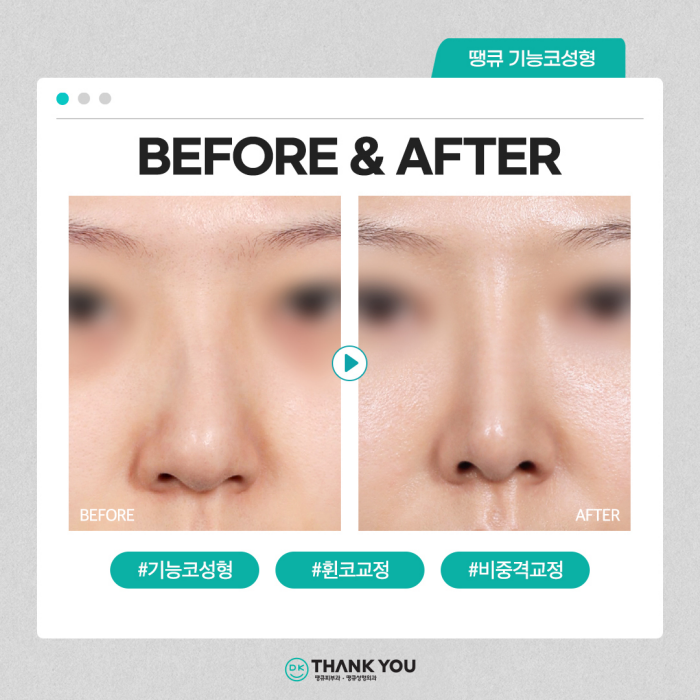
If there is a problem with the functional aspect of the nose,
it can cause inconvenience in daily life.
Depending on the problem,
various symptoms may appear, such as nasal congestion, snoring,
sleep disorders, and headaches.
Recently, interest in functional rhinoplasty has been increasing
to improve both the discomfort caused by structural and functional problems in the nose
and the aesthetic side at the same time.
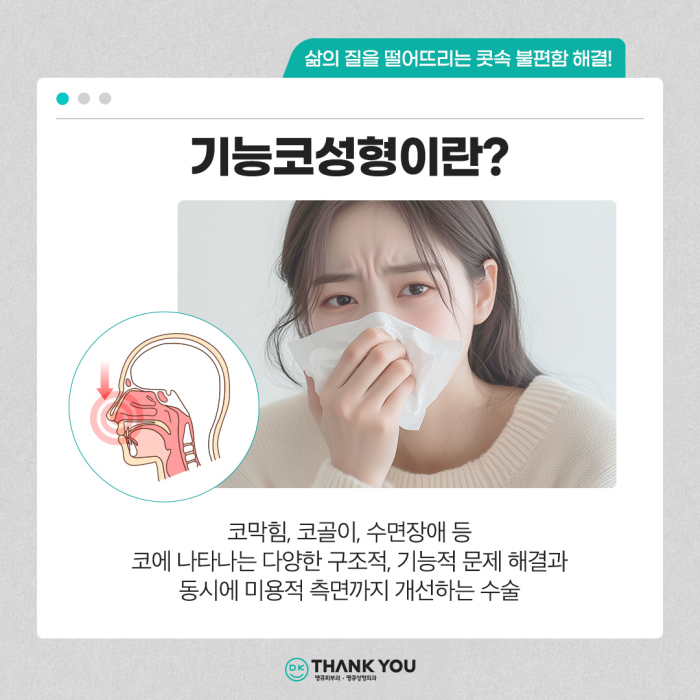
Functional rhinoplasty is a surgery that can
correct structural problems of the nose while also
improving the aesthetic side.
So, what structural characteristics of the nose can
cause functional problems and lead to what conditions,
and how should surgery be performed?
Let’s look into it together with Thank You Plastic Surgery,
a functional rhinoplasty hospital.
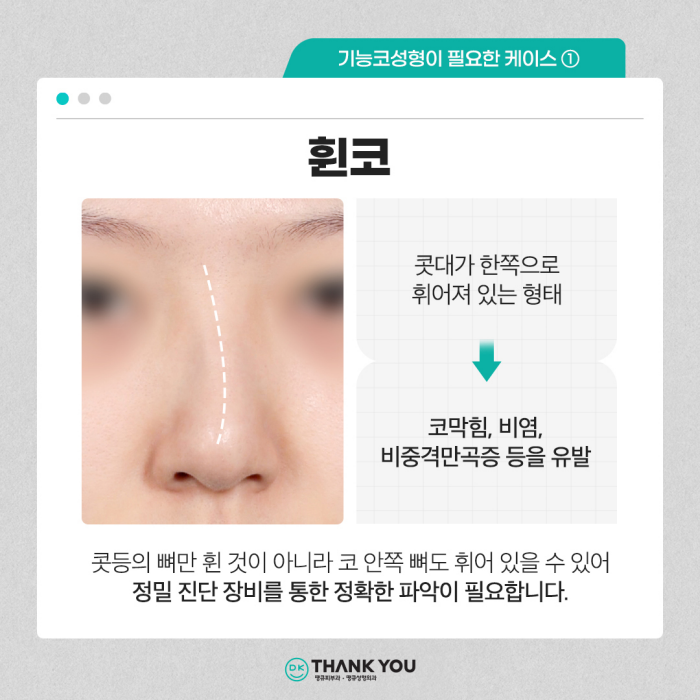
Cases that require functional rhinoplasty 01
Crooked nose
A crooked nose, in other words, a bent nose, causes nasal congestion, rhinitis,
deviated septum, headaches, and more.
Usually, it is not only the bridge bone that is bent,
but the inner bones of the nose are also likely to be bent,
so it is necessary to correctly identify the cause and
set a surgical plan according to the cause.
A crooked nose can be divided into cases where the internal septal cartilage of the nose
is congenitally bent and cases where the nasal bone is bent due to acquired trauma.
The problem can be solved by using a different surgical method
depending on the cause.
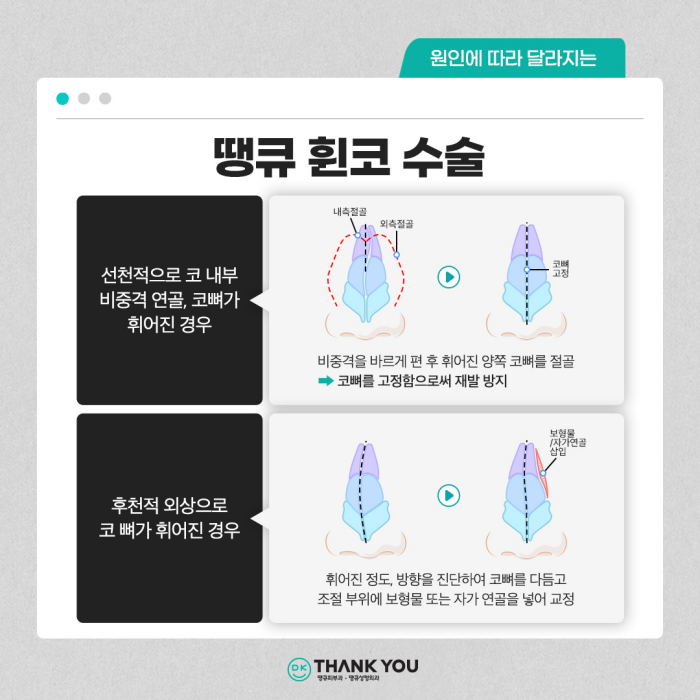
First, when the internal septum of the nose is congenitally bent,
nasal congestion and rhinitis may occur.
In this case, the septum is corrected properly,
and the bent nasal bones on both sides are corrected through internal and external osteotomy,
then the nasal bones are adjusted to help prevent recurrence.
If the nasal bone has bent secondarily due to trauma,
the degree and direction of the bend are diagnosed, the nasal bone is reshaped,
and a prosthesis or autologous cartilage is inserted into the adjusted area to correct it.
Because the surgical method differs depending on how the nasal bone has bent,
it is best to closely analyze the condition of the nose.
Cases that require functional rhinoplasty 02
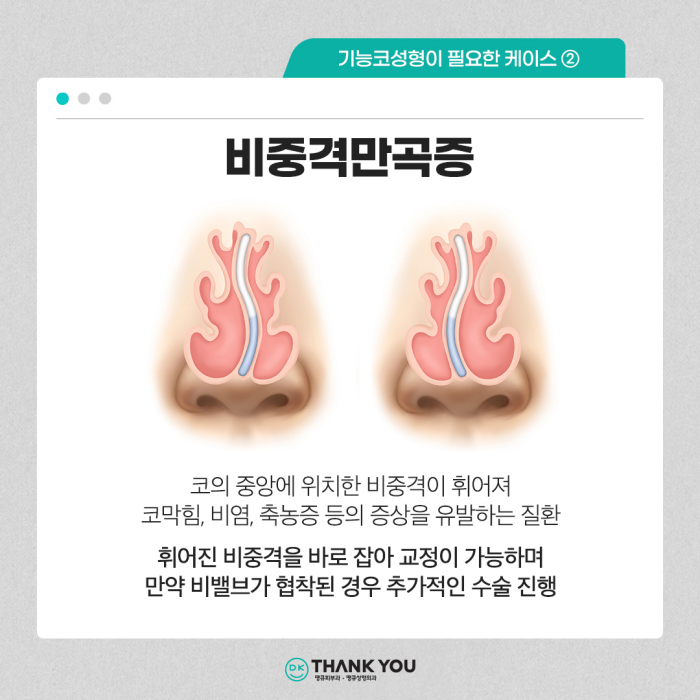
Deviated septum
If the nose is bent like this, there is more than a 90% chance
that a deviated septum may also be present.
A deviated septum refers to the septum located at the center of the nose being bent,
causing symptoms such as nasal congestion, rhinitis, and sinusitis.
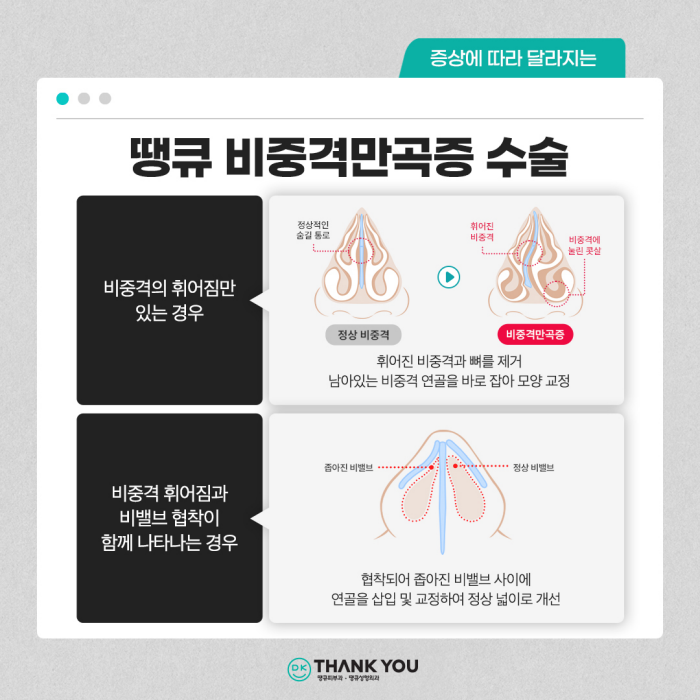
By removing the bent septum and bone,
then straightening and properly correcting the septal cartilage,
the symptoms can be improved.
If nasal valve stenosis is present as well,
it is difficult to improve nasal congestion by simply removing the septal cartilage.
The nasal valve is a key area that regulates breathing.
When this area becomes narrow, breathing can feel uncomfortable,
and symptoms such as nasal congestion, migraine, and sleep disorders may occur.
In this case, cartilage can be inserted between the narrowed nasal valve areas
to correct them back to a normal width.
Cases that require functional rhinoplasty 03
Rhinitis
Another condition that may require functional nose surgery is
rhinitis.
Rhinitis is a symptom many people experience,
and it is an inflammatory disease accompanied by various symptoms such as runny nose,
sneezing, and nasal congestion.
The treatment method may differ depending on the type of rhinitis.
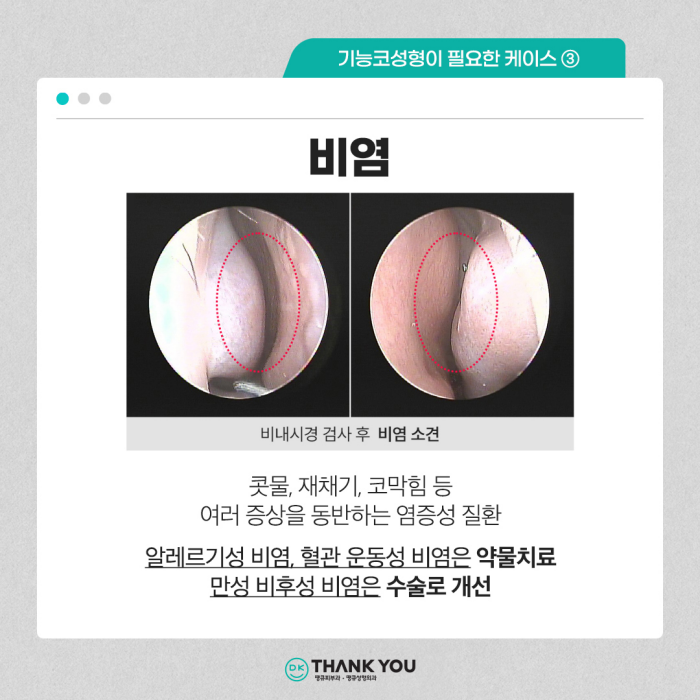
Allergic rhinitis and vasomotor rhinitis can be treated with medication,
while chronic hypertrophic rhinitis occurs due to a deviated septum
and can be improved with surgery.
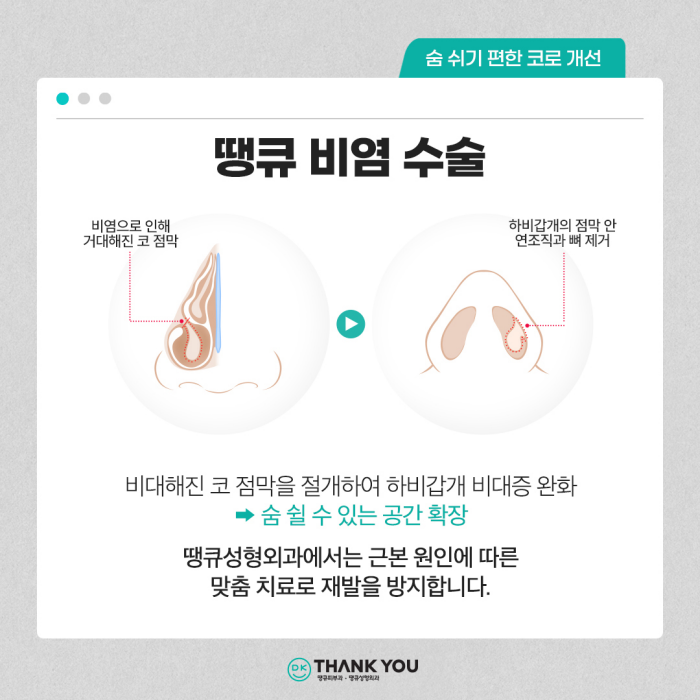
By making an incision in the enlarged nasal mucosa to reduce inferior turbinate hypertrophy
and widen the space available for breathing,
the symptoms can be improved.
We have looked at representative functional problems of the nose
that many people experience.
As you can see, there are various symptoms,
and because the cause and severity of symptoms differ from person to person,
it is important to carefully examine the cause.
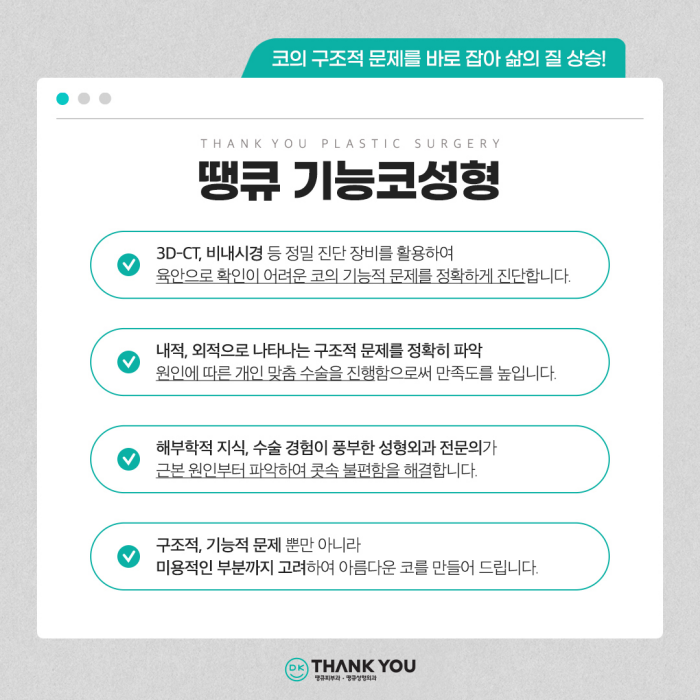
At Thank You Plastic Surgery, which is well known as a functional rhinoplasty hospital,
after analyzing the underlying cause of the symptoms,
we provide one-on-one customized treatment accordingly.
For a more accurate identification of the cause,
3D-CT and nasal endoscopy are used to precisely diagnose functional problems of the nose,
including the bone structure and anatomy that cannot be identified with the naked eye.
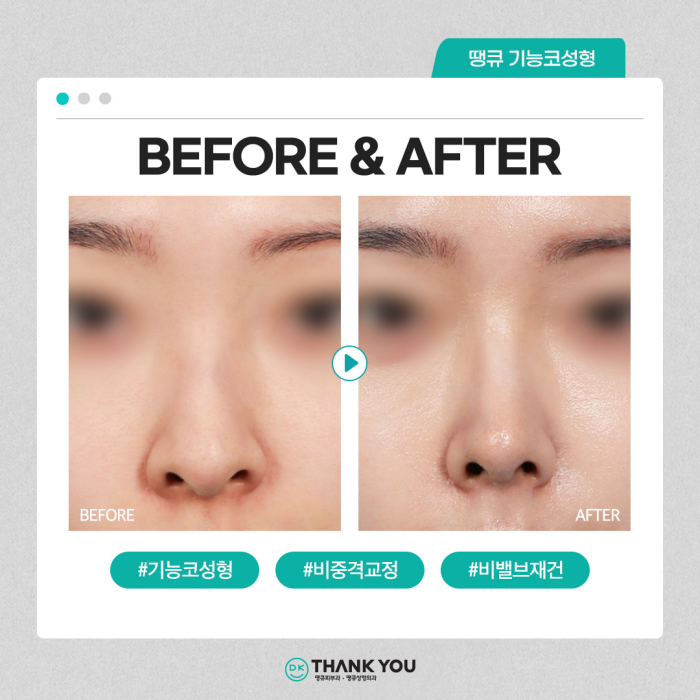
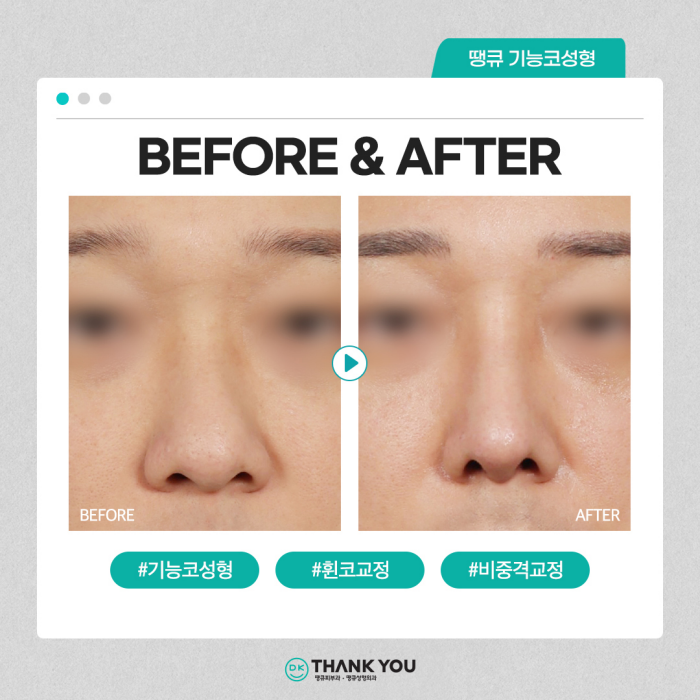
Functional rhinoplasty must improve not only functional problems
but also aesthetic aspects,
so it is considered a highly difficult surgery.
Therefore, we recommend finding a specialist with extensive experience who can properly understand
the structural characteristics of the nose
and who also has a strong aesthetic sense.
Thank You Plastic Surgery
Conveying gratitude, Thank You Plastic Surgery
🟡 Phone inquiries: 02-567-0900
💗 KakaoTalk consultation: https://pf.kakao.com/_Pvrxgb
🍀 Website: https://www.thankyoups.com/
- 446 Gangnam-daero, Gangnam-gu, Hanwell Building, Floors 5, 8, and 9
8th floor (Plastic Surgery reception), 9th floor (Dermatology reception)