
What surgical methods by type does
Thank You, a good place for revision rhinoplasty, recommend? 💕
The nose is an important factor that determines the overall impression of the face.
Because of that, many people choose nose surgery
for a better appearance.
However, after the surgery is actually completed,
there are many cases where the desired shape does not turn out properly
or unexpected side effects appear,
leading to revision rhinoplasty.
If a single surgery was thought to be enough
but it ends up continuing to a second or third surgery,
of course you would feel surprised and worried.
You may also be confused about whether it is right to have revision rhinoplasty now.
In fact, revision rhinoplasty is best performed
after a precise analysis of the cause
and with a thorough surgical plan.
So today, at Thank You Plastic Surgery,
a place known for revision rhinoplasty,
along with the various types that require revision rhinoplasty,
we will explain in detail the proper revision rhinoplasty methods
for each type.
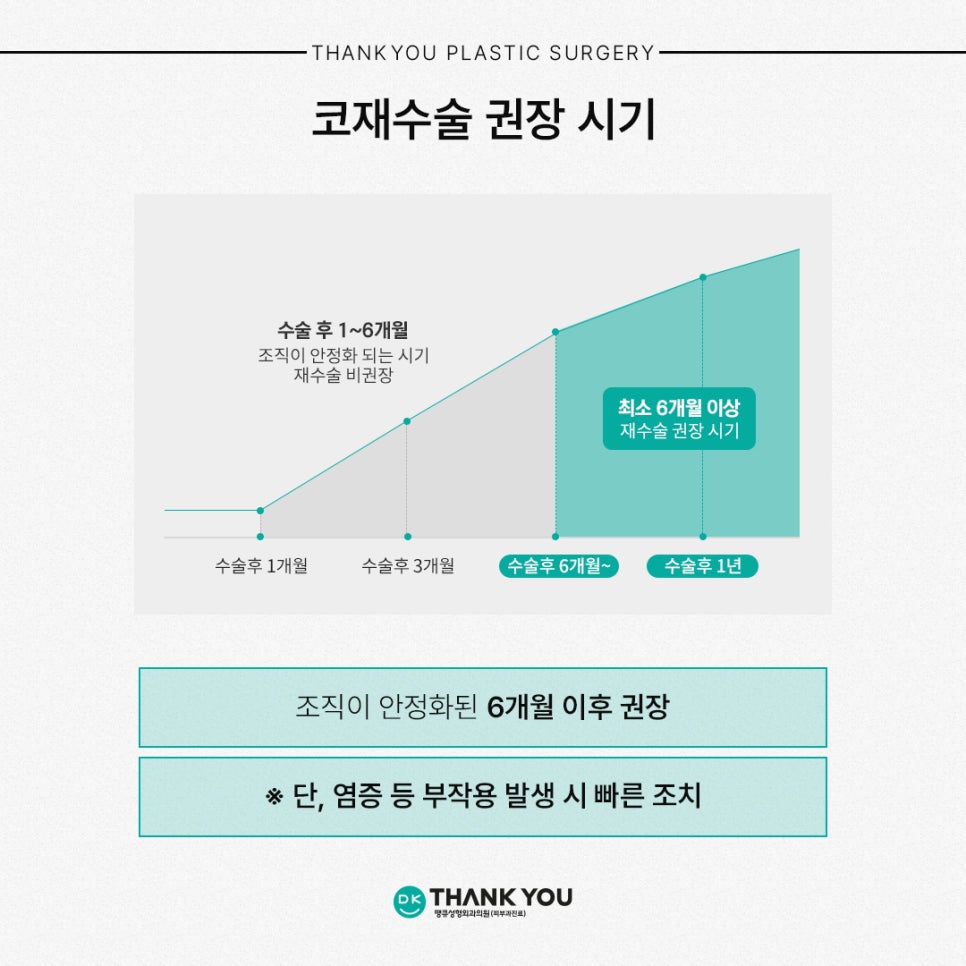
First, revision rhinoplasty is recommended
after at least 6 months have passed since the first surgery.
Until 6 months after surgery, the tissue is in the process of stabilizing,
so it is better to proceed with revision surgery
after the skin tissue has softened enough and stabilized.
However, if inflammation or side effects occur,
even before 6 months have passed,
it is better to receive an accurate diagnosis and take prompt action.
There are five representative cases
that may require revision rhinoplasty.
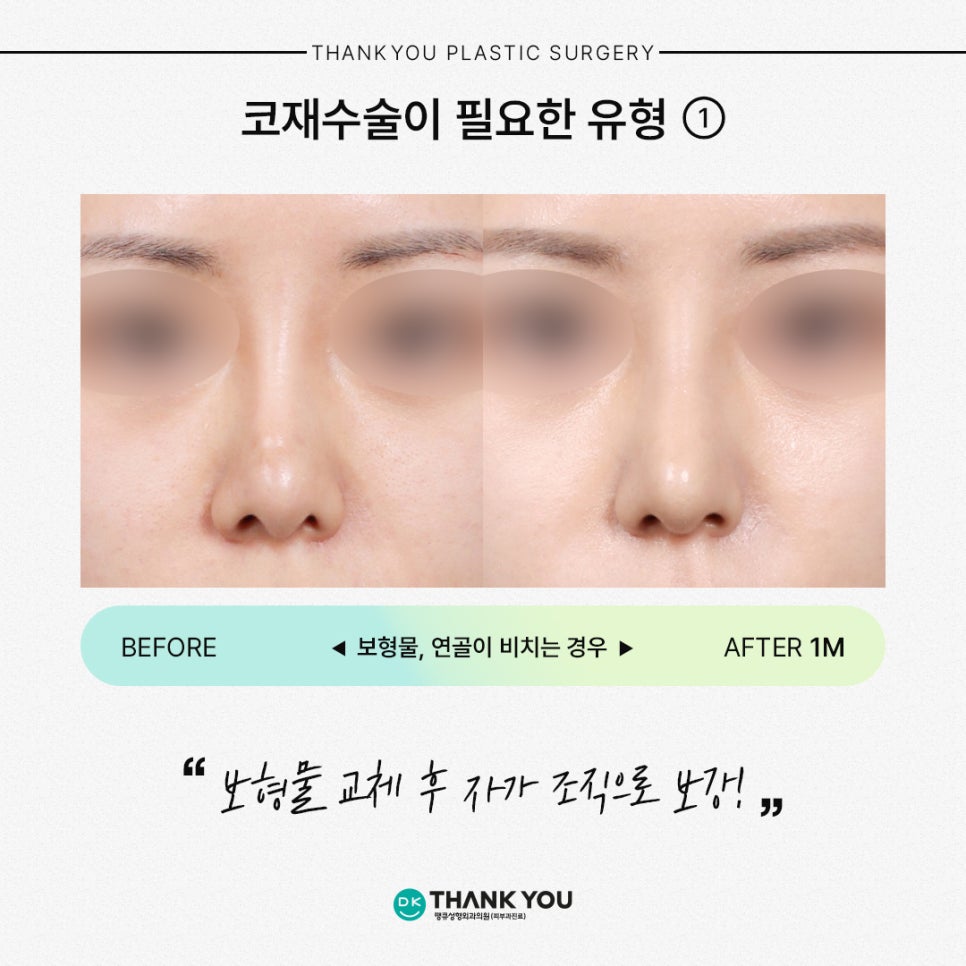
The first is when an implant or cartilage becomes visible.
If an implant that is too high is used or the cartilage is placed incorrectly,
these may become visible through the skin.
In such cases, you need revision rhinoplasty
to replace it with another implant suitable for your nose
or to reposition the cartilage.
There are also cases where the skin becomes thin due to repeated revision surgeries,
causing the implant or cartilage underneath to show through.
When surgery is repeated several times, the skin itself loses
its healing ability and flexibility,
so inserting an implant or firm cartilage increases the risk of skin necrosis.
That is why, in such cases, a good place for revision rhinoplasty
usually recommends revision rhinoplasty using autologous tissue,
which can envelop thin skin more thickly without pushing it outward.
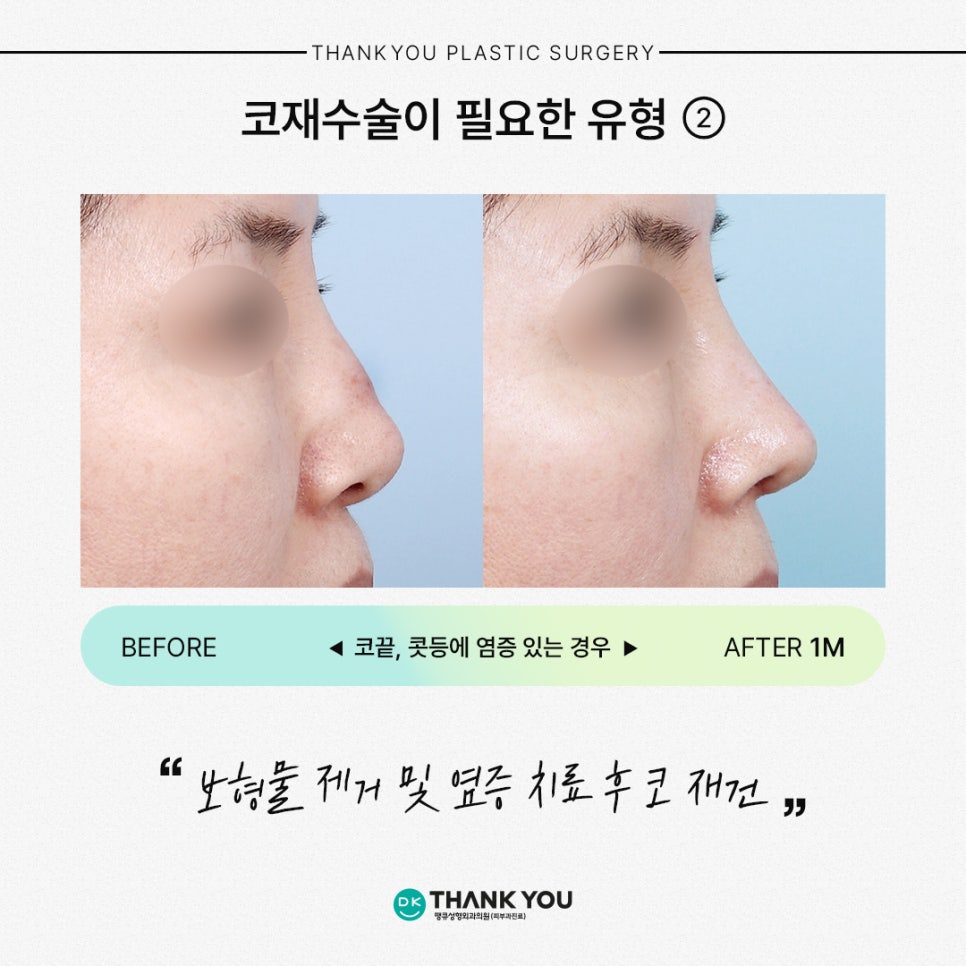
The second is when inflammation occurs at the tip or bridge of the nose.
If symptoms such as a rash or swelling of the skin are observed,
you should promptly remove the implant and begin treatment for the inflammation.
Because there is already an immune rejection reaction caused by silicone,
if an artificial implant is inserted again,
the likelihood of inflammation recurring increases.
For that reason, after promptly removing the implant,
we recommend revision rhinoplasty that uses autologous tissue,
which can heal on its own even if inflammation occurs.
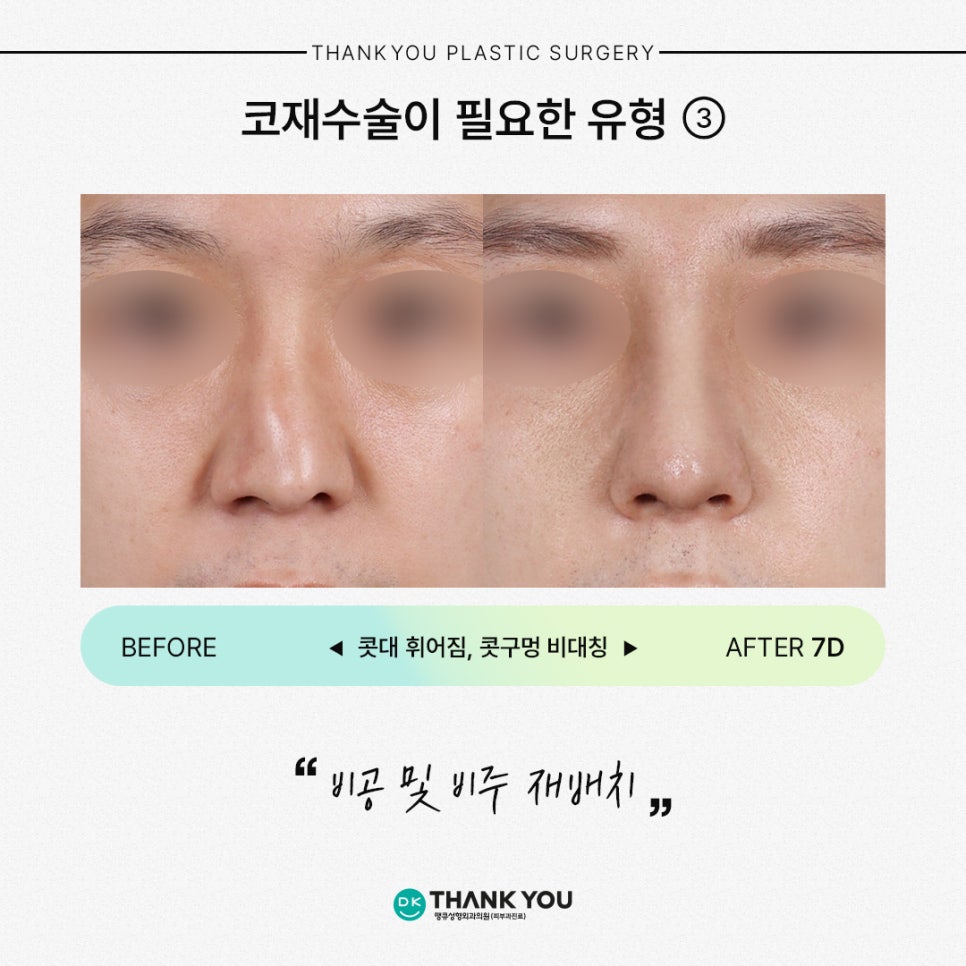
The third is when the bridge of the nose is bent.
In such cases, there is a high possibility that the septum,
the wall inside the nose that separates the two nostrils,
is itself bent.
The septum not only separates the nostrils,
but also serves as the central pillar of the nose,
supporting the tip and bridge of the nose.
If the septum is bent or weak, the nose may become crooked,
the nasal tip may droop,
and asymmetry of the nostrils may also occur.
In this case, it is better to perform septal extension surgery
and reposition the bent nostrils and columella.
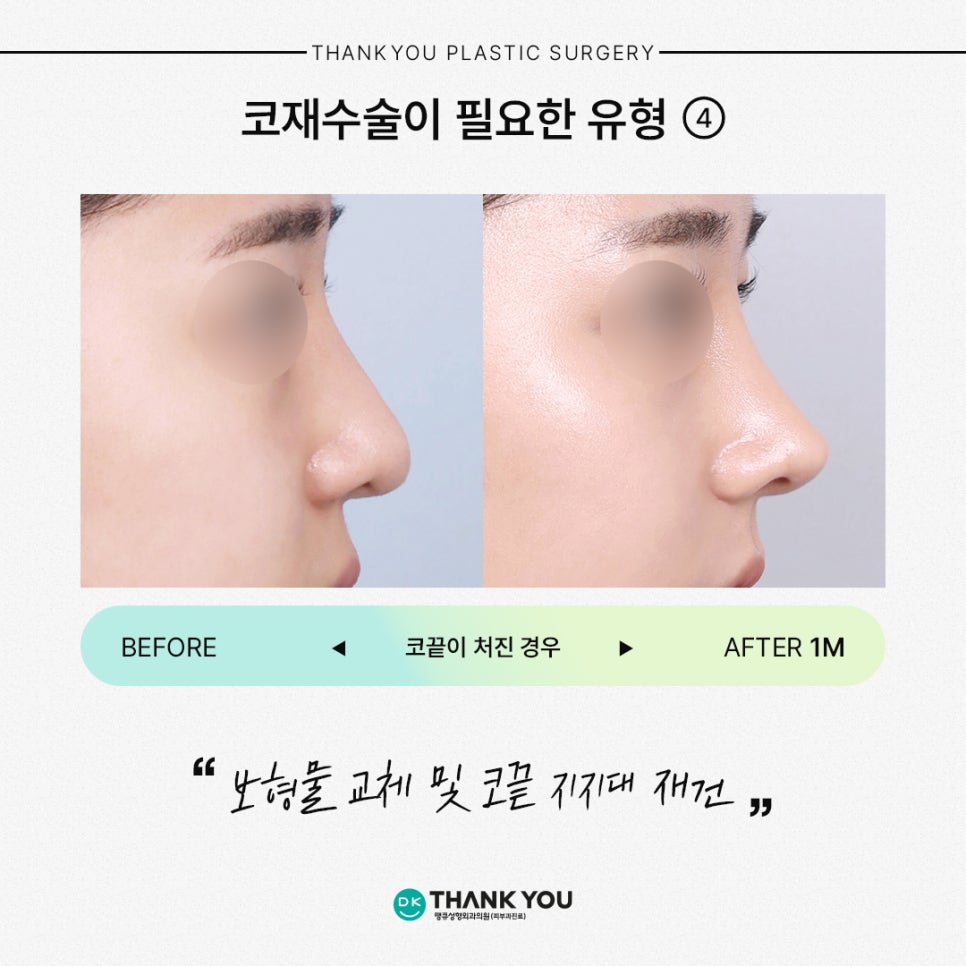
The fourth is when the nasal tip is drooping.
If the septal support is weak or the cartilage has been absorbed,
and the inserted silicone implant is supporting that area instead,
the nasal tip may appear to droop.
When the nasal tip droops downward,
the end of the silicone is pushed forward,
causing pressure on the skin of the bridge and making the skin thinner.
As the implant shows through the thinned skin,
it may become red or, in severe cases, the implant may protrude through the skin.
If revision rhinoplasty is done by simply replacing the silicone in this situation,
the already weakened skin may be placed under even greater pressure.
In such cases, after removing the silicone,
we recommend revision rhinoplasty that reconstructs the nasal tip support first
using the septum, autologous dermis, or donated costal cartilage,
and then reinforces the cushioning with autologous tissue.
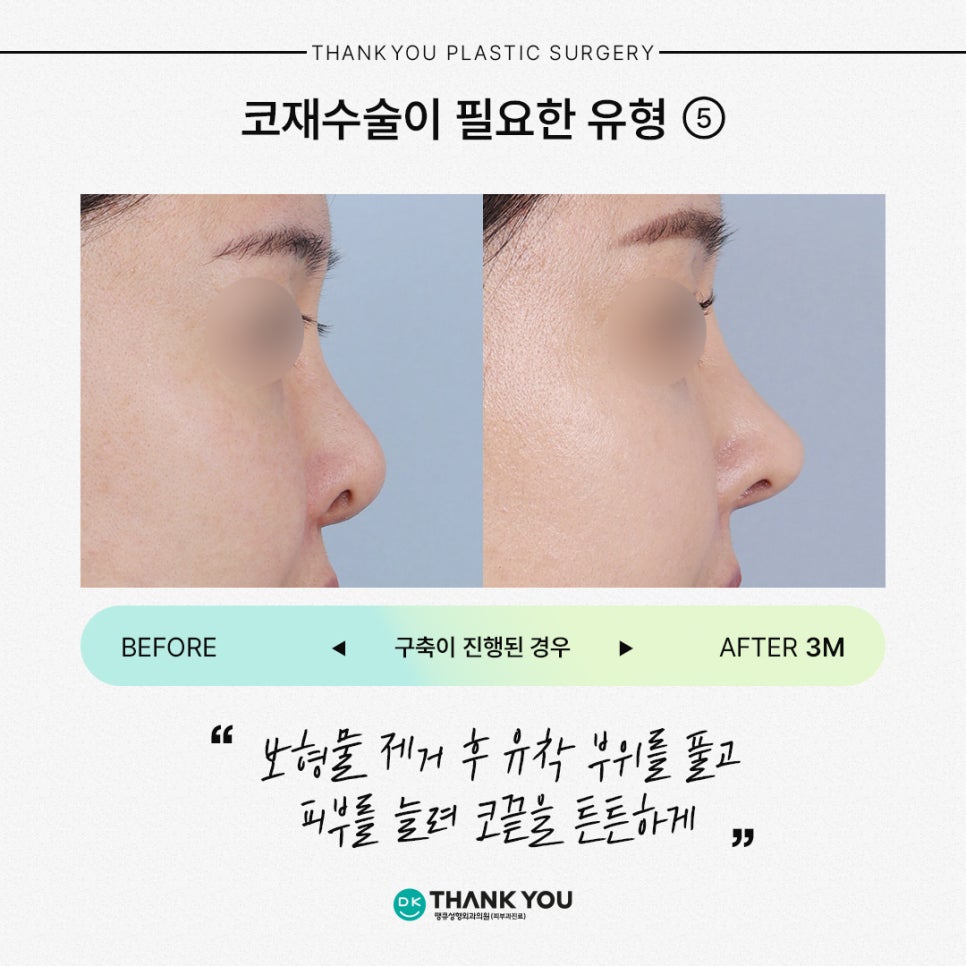
The fifth is when contraction progresses and the nasal tip turns up.
Contracture refers to the formation of abnormal fibrous tissue around
an implant inserted during rhinoplasty,
or a condition in which the nose gradually becomes shorter and harder
because of inflammation or scar tissue.
In such cases, not only does the nasal tip turn up,
but as the skin is pulled, breathing problems may occur in severe cases,
so it is best to undergo revision rhinoplasty as soon as possible.
At this time, revision rhinoplasty is needed in the direction of
loosening the scar-tissue adhesions,
enough skin stretching, and firmly repositioning the nasal tip.
Contracture revision rhinoplasty is not simply a matter of replacing the implant;
it is a high-difficulty surgery that must restore the soft tissue and skin
as well as the internal structural components.
Not only contracture revision rhinoplasty, but also the other types mentioned above,
are performed when tissue damage is already greater than in the first surgery,
so we recommend choosing a good place for revision rhinoplasty,
consulting carefully with an experienced medical team,
and then undergoing surgery.
In particular, Thank You Plastic Surgery,
a place known for revision rhinoplasty,
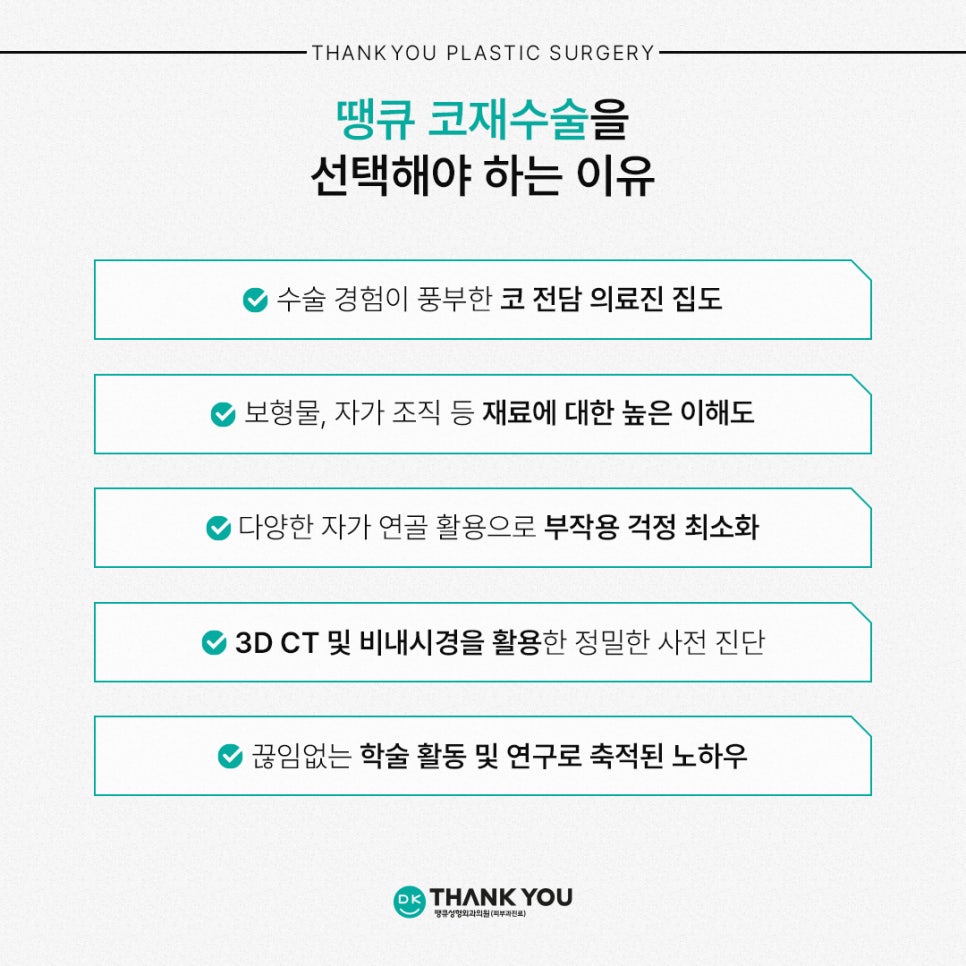
has a dedicated nose surgery team with extensive experience.
Based on a high level of understanding of implants and autologous tissue materials,
the team performs systematic and safer surgeries.
At Thank You, various autologous cartilages such as ear cartilage,
septal cartilage, and costal cartilage are used
to minimize the burden of revision rhinoplasty and concerns about side effects.
In addition, before surgery,
precise preoperative diagnosis is first carried out using 3D CT and nasal endoscopy,
accurately identifying functional issues
such as the nasal skeleton and structure that cannot be seen with the naked eye,
and making every effort to enable fundamental improvement.
Lastly, for a more refined revision rhinoplasty,
we continuously engage in academic activities and clinical research
while steadily building Thank You's own revision rhinoplasty know-how.

Currently, Thank You is running a revision rhinoplasty event
that helps restore a beautiful line.
If you would like to learn more about the event at Thank You,
a good place for revision rhinoplasty that creates results you can be satisfied with
while considering both functional recovery and aesthetic completeness,
please check the link below =]
⬇️Click⬇️
Go to homepage
Thank You Plastic Surgery
Conveying gratitude, Thank You Plastic Surgery (including dermatology care)
🟡Phone inquiries: 02-567-0900
💗KakaoTalk consultation: https://pf.kakao.com/_Pvrxgb
🍀Website: https://www.thankyoups.com/
- 446 Gangnam-daero, Gangnam-gu, Hanwell Building, 5th, 8th, and 9th floors [Reception: 9th floor]