If you’ve already had an eye-opening surgery,
is it okay to have under-eye fat repositioning surgery?!
Under-eye fat repositioning is a procedure that affects a relatively broad area of the tissues beneath the eyes.
That is why it is important to carefully examine not only the current condition but also what type of eye surgery was performed in the past.
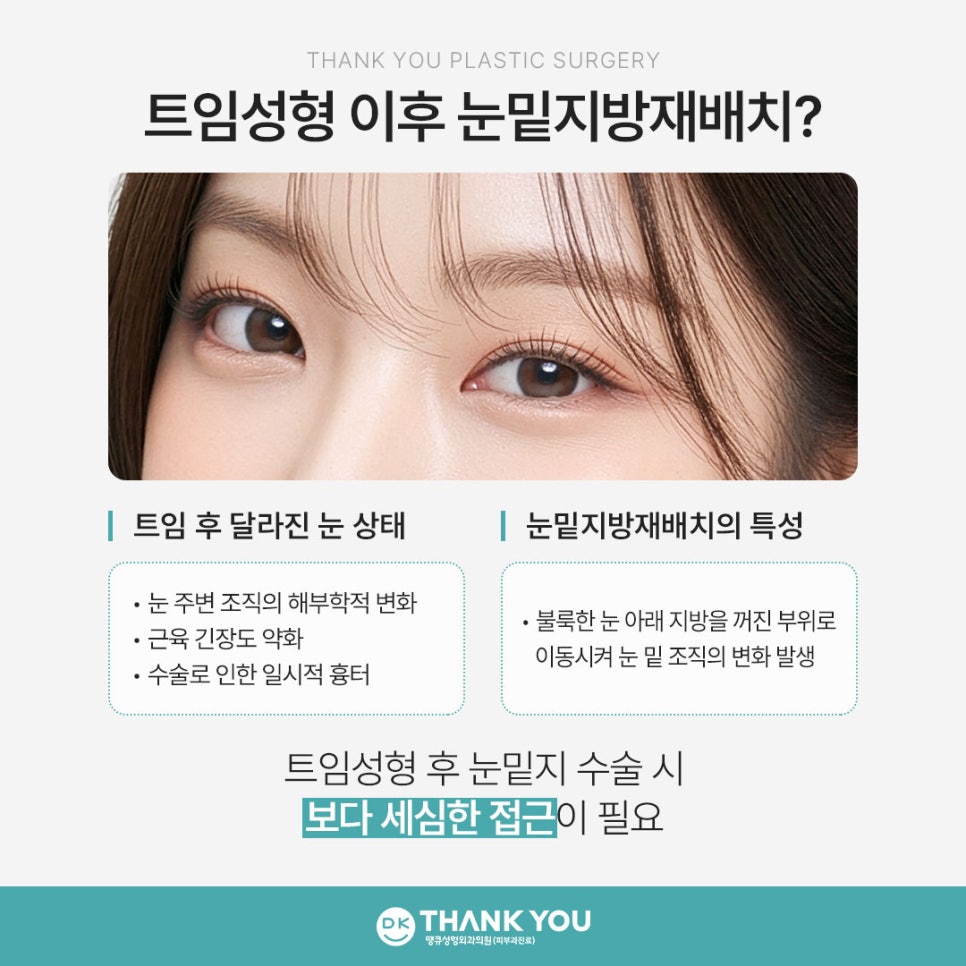
Once tissue has undergone surgery, its anatomical structure, muscle tension, and scar distribution all differ from before.
That is why today, especially for those who have already undergone eye-opening surgery, we will explain in detail why under-eye fat repositioning surgery must be approached with even greater care!

📢 The eyelid moves upward? Upward displacement of the lower eyelid
Among eye-opening procedures, there is a change that is rarely observed in patients who undergo under-eye fat repositioning after medial canthoplasty.
It is the phenomenon known as “upward displacement of the lower eyelid,” in which the lower eyelid is lifted upward and covers more of the eyeball than usual.
In this case, the eyes may appear smaller than before, or the overall impression may seem constrained and dull.
📢 Why does this phenomenon occur?
The key is a change in the tension of the orbicularis oculi muscle.
The orbicularis oculi muscle surrounding the eye is an important muscle that controls eyelid movement.
If the orbicularis oculi muscle, which has already been stimulated once during medial canthoplasty, is affected again during under-eye fat repositioning surgery, its tension may temporarily decrease.
As a result, the force holding the lower eyelid downward becomes weaker, causing the eyelid to relatively roll upward.
Fortunately, this change is usually temporary.
Because the muscle is closer to being “startled” than “damaged,” it may naturally recover over time without additional surgery or medication.
Muscle tension usually returns to normal within approximately two to three months, and the eyelid also returns to its original position.

📢 Entropion requires greater caution after lateral and lower canthoplasty
Entropion refers to a condition in which the lower eyelid rolls inward, causing the eyelashes to irritate the cornea.
Although it can be congenital, entropion may also occur as an acquired complication after under-eye fat repositioning surgery.
It may be particularly more likely to occur in those who have undergone lateral and lower canthoplasty. The reason is relatively clear.
After lateral and lower canthoplasty, the area beneath the eye has already developed scar tissue once.
If under-eye fat repositioning surgery is performed again in this condition, the existing and new scars overlap, causing the tissue to contract more firmly.
The strong contractile force pulls the lower eyelid inward, ultimately resulting in entropion.
When the conjunctiva is examined, the tissue may be observed to be in a fibrotic state, appearing white and tightly matted together.
Unlike the upward displacement of the lower eyelid mentioned earlier, this condition tends to be difficult to resolve through natural recovery alone.

📢 How should it be treated?
Steroid injections may be used to soften and ease hardened scar tissue.
If symptoms do not improve with steroid injections alone, scar adhesion release may be performed to physically separate the tissues that have become stuck together.
If appropriate treatment is provided, the eyelid generally returns to its normal position within three months, and the symptoms of the eyelashes poking the eye also disappear.
📢 If you want a safer outcome?
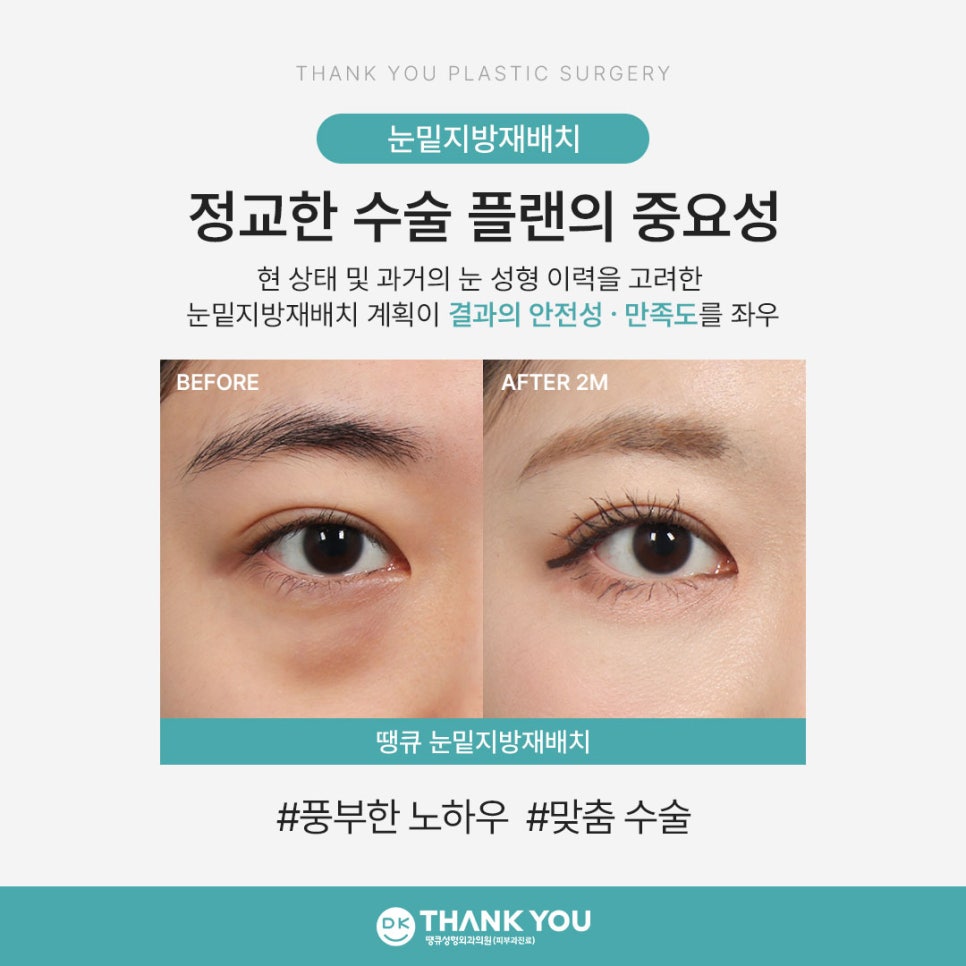
Under-eye fat repositioning is not a procedure that can be performed based solely on the current condition of the eyes.
A safe outcome can only be expected when the patient’s previous surgical history is also taken into consideration.
Especially for those who have already undergone eye-opening surgery, the procedure must be planned with greater precision after fully understanding the changes in the tissues around the eyes and the effects of scarring.
Ultimately, what matters is not the surgery itself, but “how three-dimensionally the individual’s eye condition and surgical history are analyzed and incorporated.”
That difference can determine the line between a natural result and complications.
Thank You Plastic Surgery
With gratitude, Thank You Plastic Surgery (Dermatology Services Available)
🟡Phone inquiries: 02-567-0900
💗KakaoTalk consultation: https://pf.kakao.com/_Pvrxgb
🍀Website: https://www.thankyoups.com/
-Gangnam-gu, 446 Gangnam-daero, Hanwell Building, 8th and 9th floors [Reception: 9th floor]