When consulting with patients about skin,
I often hear questions that surprisingly start
with very small daily habits.
“Doctor, I always sleep on my left side.
Could that be why the smile line on the left
is deeper?”
At first glance, this may seem like a simple question,
but it reflects how many people understand skin.
The idea that one particular action
must have created the skin condition they have now,
and the hope that if that cause is changed,
the current concern can be resolved as well.
In short,

“
It can have an effect,
but it is not the decisive cause.
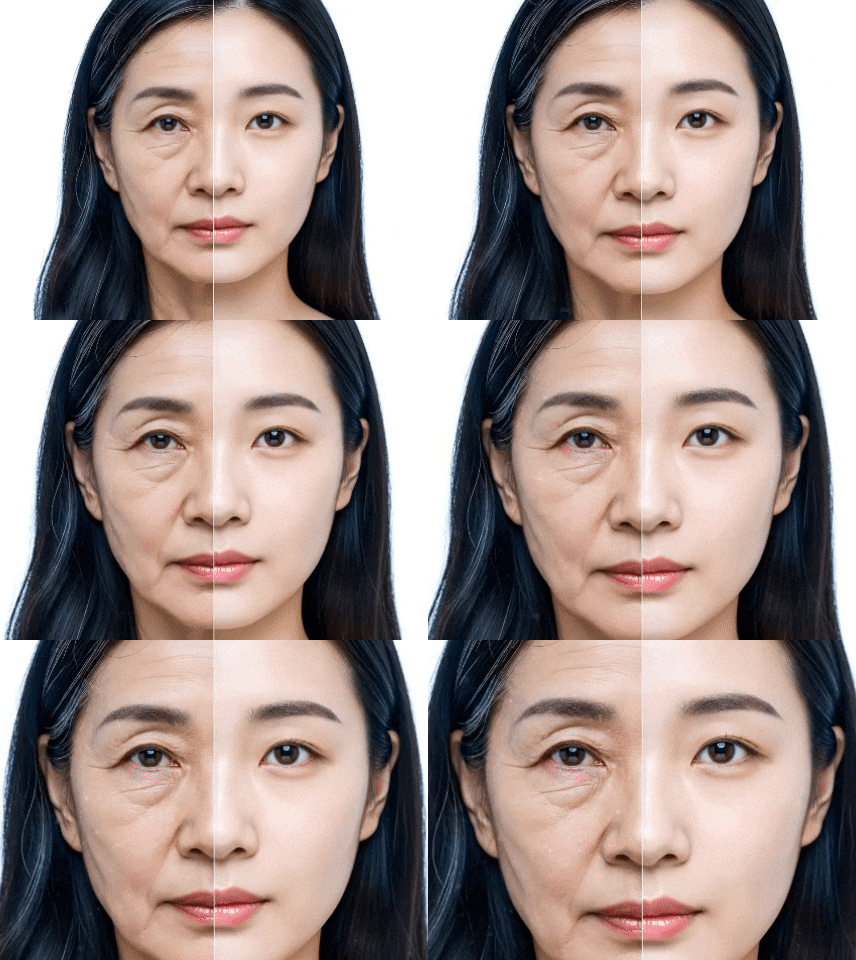
In fact, the habit of sleeping on your side
can create repeated pressure and folding
on the skin,
which can make left-right asymmetry appear a bit more
distinct.
But when we examine patients,
we find that the depth and shape of smile lines
have a far more complex structure
than can be explained by a single sleeping position.
So the answer to this question does not end with
“that could be the case.”
It is also necessary to understand what the more important cause is,
and from what structure the current wrinkle has formed.

Does sleeping position really have an effect?
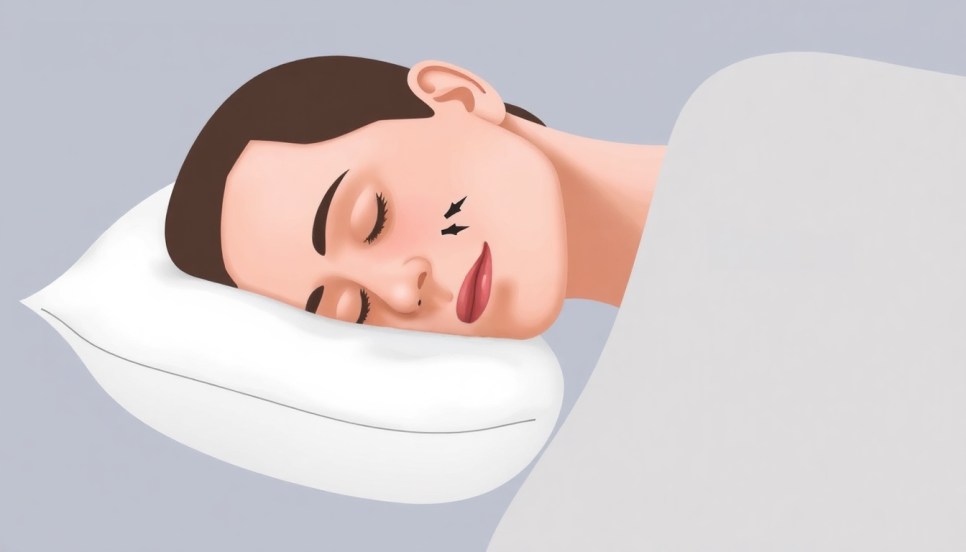
When sleeping on your side,
→ your face is pressed against the pillow
→ repeated pressure on one side of the skin
If this continues for a long time,
→ the smile line on that side may appear
more pronounced,
and especially under the following conditions,
the effect can be greater.
When the skin is thin and less elastic
A face with little fat (with hollow cheeks)
A habit of sleeping in the same direction for years
In actual clinical practice,
among patients with left-right asymmetry,
→ cases where they “always sleep on the same side”
are confirmed at a fairly high rate.
But this is not the number one cause.
This is the important part.
Smile lines are not a structure
that is created by sleeping position alone.
The main causes are separate.
Cheek sagging (midface sagging)
Fat redistribution + loss
Reduced skin elasticity (collagen loss)
Bone structure
In other words, sleeping position
should be viewed as an “auxiliary factor that creates asymmetry.”
That is why, even in actual treatment,
it is rare for a case to improve dramatically
just by changing posture.
This is the point patients most often misunderstand.
So how far does management really matter?!

As a lifestyle habit, management
certainly has meaning.
If possible, sleep on your back (supine).
When sleeping on your side, limit the use of very high pillows.
Minimize pressure on the face (memory foam/soft pillows).
However, if smile lines have already formed,
→ rather than correcting posture,
→ lifting + volume + improving skin quality
These three approaches are much more important.
Smile lines are not all the same
Structural classification at Gangnam Station Dermatology
In actual treatment, smile lines are not
viewed as a single problem.
| Category | Features | Cause |
|---|
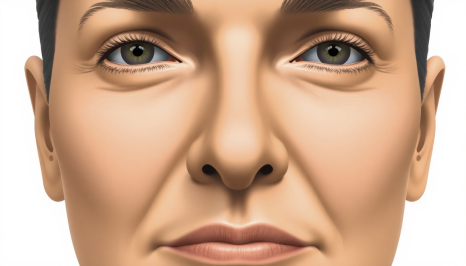
| 1. Volume Deficit TypeA smile line that looks like a hollow | The smile line looks more like a “hollow” than a lineThe midface is flat and lacks volumeThere is always a shadow even when not smiling | → deep fat loss + retaining ligament emphasis |
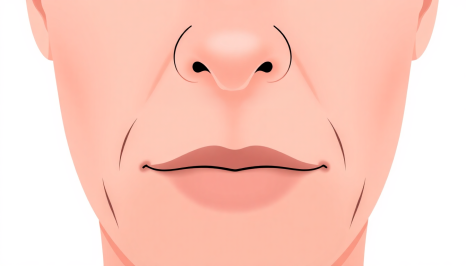
| 2. Sagging TypeA structure that is pressed down from above | The area above the smile line sags thicklySmiling makes it look deeperJawline becomes less defined, and jowls appear | → ligament laxity + SMAS descent |
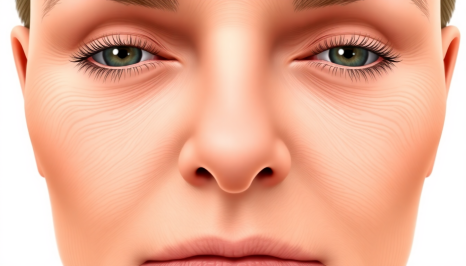
| 3. Skin Quality TypeWrinkles in thin, folding skin | Fine wrinkles are the main issue rather than deep wrinklesThe skin is thin and less elasticLacks shine and folds like thin paper | → dermal matrix degradationcollagen/elastin decrease |
| Category | Treatment strategy (key point) | Recommended treatment structure |
|---|
| 1. Volume Deficit TypeA smile line that looks like a hollow | Do not fill the wrinkle directlyRestoring midface volume is the top priority. | SculptraA concept of “lifting from above”collagen lifting |
| 2. Sagging TypeA structure that is pressed down from above | Lifting comes before volumeHere, the important point is thatvector design, rather than a simple procedure,determines the outcome. | Ultherapy Prime Ulthera (SMAS tightening)Thermage FLX (dermal tightening)Titanium / RF-based treatments can also be combinedIf necessary, a small amount of skin booster※ The purpose is to support the skin structure,and excessive injection can actually cause sagging. |
| 3. Skin Quality TypeWrinkles in thin, folding skin | Change the skin rather than the structure | Skin boosters:Rejuran HBStem Cell and Elavie RituoBelotero ReviveEnergy: Genesis laser / M22 / Opus, etc. |
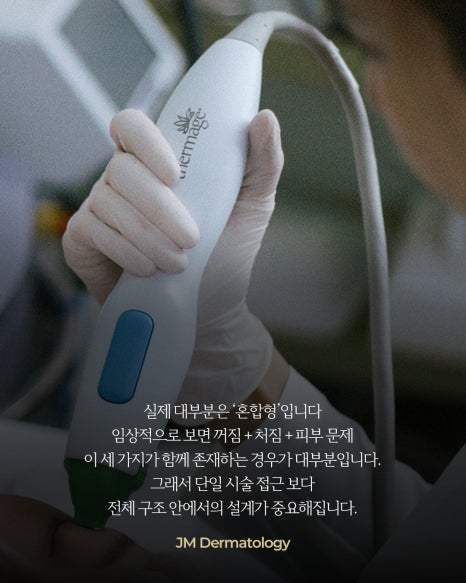
In reality, most cases are “mixed type.”
Clinically,
hollowing + sagging + skin problems
These three factors are usually present together.
That is why, rather than a single-procedure approach,
a plan based on the overall structure becomes important.
To summarize:
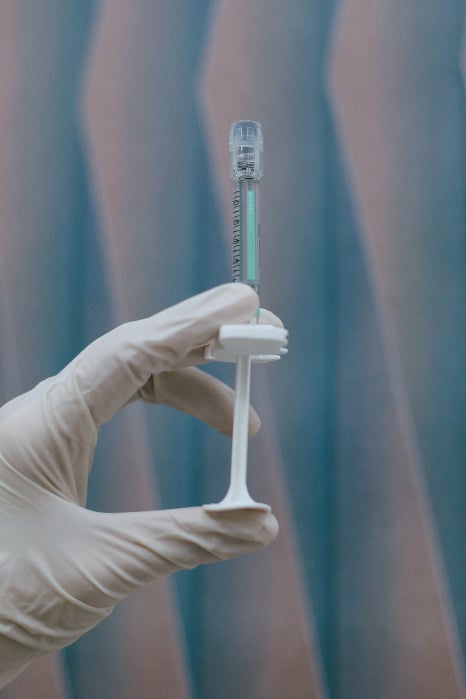
Evaluate midface volume, and if it is lacking
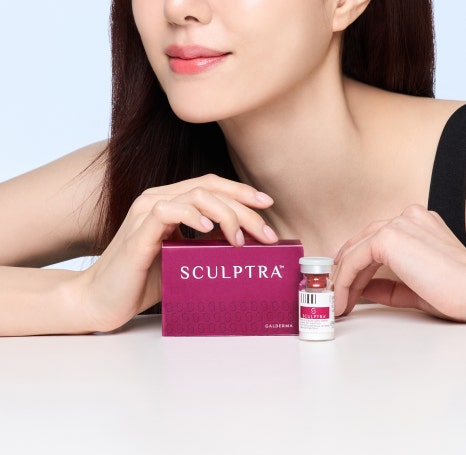
→ collagen boosters such as Sculptra and Radiesse
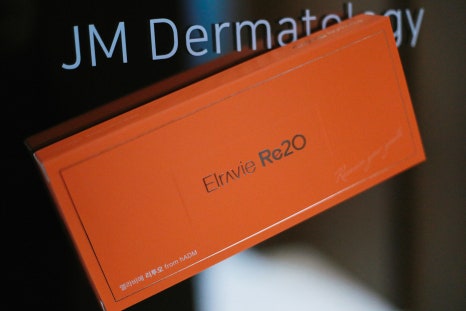
→ ECM boosters such as Elavie Rituo

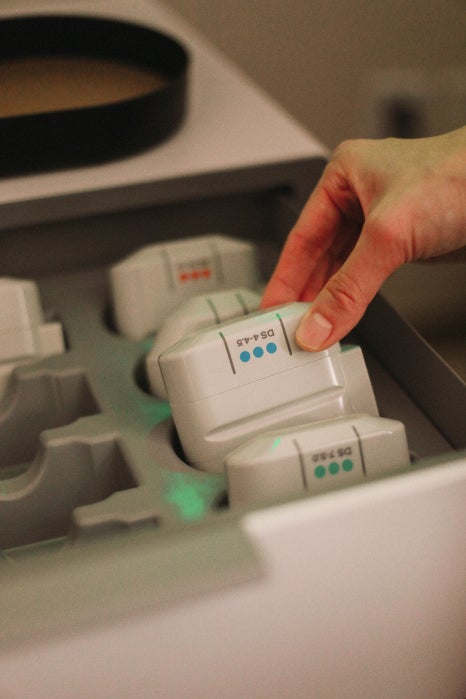
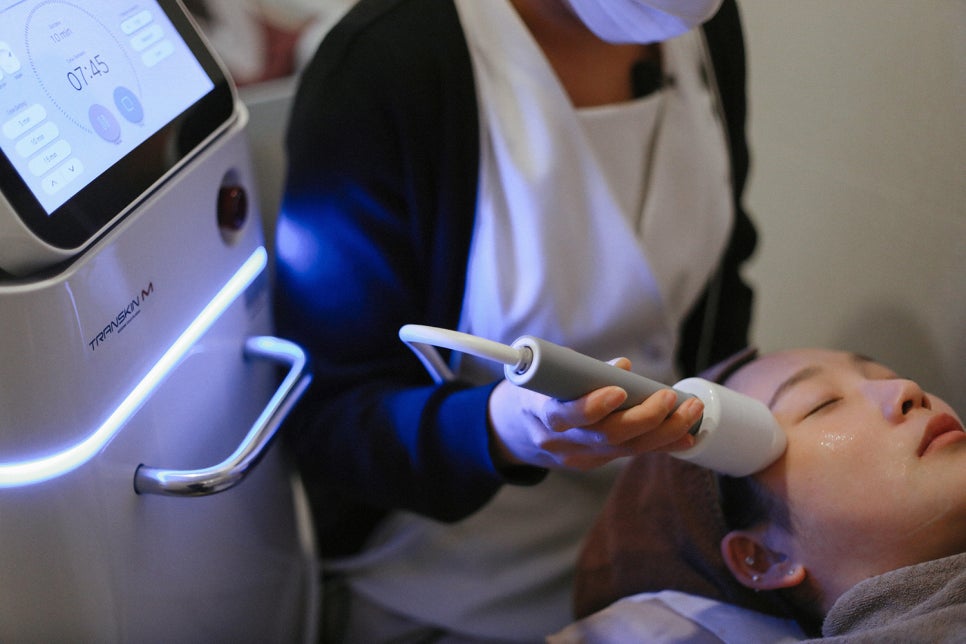
If lifting is needed
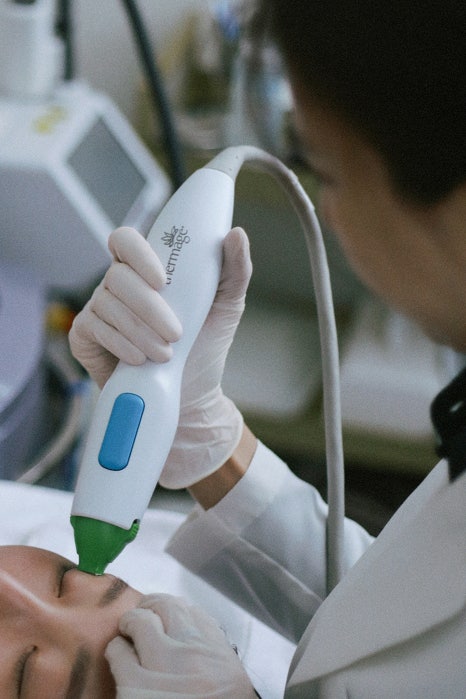
→ consider Ultherapy Prime, Thermage, etc.

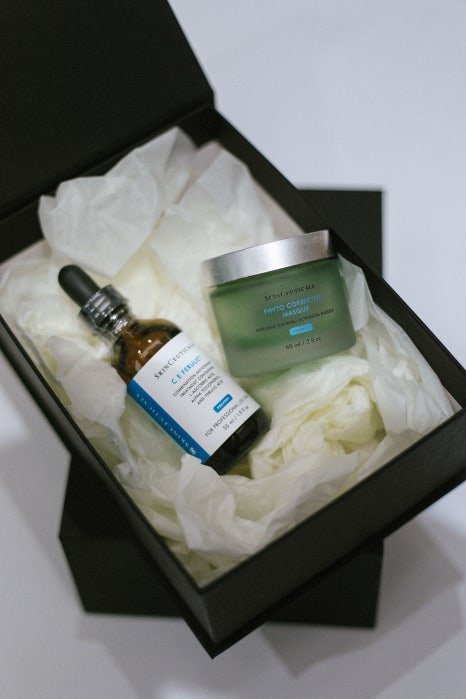
If the skin is thin
→ skin boosters should be considered as essential

The habit of sleeping on your left side
can definitely have an effect.
But it is not
the main cause
of smile lines.
What matters is
not a simple lifestyle habit,
but accurately understanding the structural cause.

Rather than viewing smile lines as a single “line,”
I hope you approach them based on a standard of care
that sees them as a structure where volume, lifting,
and skin quality are combined,
and focuses on designing more precisely,
rather than more aggressively.