Why has Ultherapy become a procedure people consider doing under sedation anesthesia?
The medical reality behind HIFU pain
When consulting about lifting procedures, one of the most common questions I hear is, "Can I get Ultherapy without sedation anesthesia?" Why has a lifting device known worldwide as the "gold standard" ironically become something people fear? We looked into the medical causes of Ultherapy pain, which cannot be explained simply by saying it "hurts," and analyzed why sedation anesthesia is seriously considered for this procedure in particular.
- The paradox of the magnifying-glass effect: thermal coagulation points (TCP) at 60–70°C
Ultherapy works using high-intensity focused ultrasound (HIFU). Like concentrating sunlight with a magnifying glass to burn a spot on paper, it focuses ultrasound energy deep within the skin to create tiny thermal injuries. The temperature of the thermal coagulation points (TCP) formed at this time reaches as high as 60–70°C. This is the optimal temperature for inducing collagen regeneration, but at the same time it is hot enough to make pain receptors in the body cry out. Each time the energy is condensed into a single point, the nerve endings receive direct heat stimulation. As hundreds of shots are delivered, this sharp stimulation is repeated, and the patient reaches both psychological and physical limits.
- Periosteum stimulation
A dull pain that resonates through the bone
The decisive reason Ultherapy feels especially painful compared with other lifting procedures lies in its depth of penetration. Ultherapy targets the SMAS, the fascial layer at a depth of 4.5 mm, which is the core layer of lifting. Anatomical limitations: facial skin is thinner than you might think. In particular, in the cheekbone, jawline, and forehead areas, the periosteum, the membrane covering the bone, lies just beneath the fascial layer. When ultrasound energy reaches the periosteum beyond the fascial layer, or when heat is conducted there, patients feel a deep, dull pain, saying it feels "like a toothache" or "like being stabbed in the bone with an awl." This sensation is beyond the reach of topical anesthetic creams.
- The relationship between "total energy" and "effect"
From a clinician's perspective, the biggest concern during Ultherapy is the energy intensity.
High Energy = High Result
Clinically, when a certain level of energy is delivered in Ultherapy, collagen contraction and regeneration effects are maximized. If the patient is in too much pain and the energy is lowered, the pain is reduced, but the expected lifting effect will also inevitably be diminished. As the idea spread that "you have to endure the pain to get proper results," sedation anesthesia became one option for receiving a high-energy procedure while completely blocking pain.
- Is sedation anesthesia the answer? (Safety vs. convenience)
Sedation anesthesia provides comfort to the patient, but from the clinician's perspective, there are aspects that require caution. This is because real-time feedback cannot be seen or heard. When the patient is awake, if the energy reaches near a nerve canal and the patient flinches, the direction can be adjusted immediately. However, in a sedated state, the patient's reaction cannot be observed, so the practitioner's skill and anatomical knowledge become even more important. Also, although very rare, there are risks associated with sedation anesthesia itself, such as respiratory suppression, so it must be performed in a place equipped with monitoring devices and safety systems.
The conclusion is this! An alternative for lifting without pain
Ultherapy's powerful effects are certainly appealing, but many people give up on the procedure because they fear the pain. Against this backdrop, devices that change the very mechanism of pain have recently been gaining attention. A representative example is ONDA lifting, recently introduced at Bellevue Clinic. Unlike ultrasound that stimulates the periosteum or radiofrequency that heats the upper dermis, it uses microwaves to deliver energy directly to layers with fewer nerve distributions. Thanks to this, it is now possible to expect line-contouring effects comparable to Ultherapy even without sedation anesthesia or anesthetic cream.
Lifting should not be a procedure that requires painful endurance. Considering your own pain sensitivity and skin condition, please discuss in depth with a medical professional whether Ultherapy's powerful one-shot effect is necessary or whether a smart treatment such as ONDA is more appropriate. Have you been hesitating to get lifting because of the pain? At Bellevue Clinic, receive a direct comparative consultation on the pros and cons of pain-free ONDA lifting and Ultherapy.
When it meets Bellevue Clinic's
meticulous design,
you can discover the most beautiful angles,
texture, and radiance you already have.
Come see for yourself at Bellevue now.
Thank you!
If you have any questions at any time,
please contact Bellevue Clinic.
We will provide detailed and friendly guidance.
Thank you.
"Skin diagnosis specialized focus"
Bellevue Clinic
The Mark-Vu skin diagnostic test allows you to check, all at once, various skin concerns that are difficult to see with the naked eye, such as skin texture, pigmentation, pores, wrinkles, skin tone, dark circles, radiance, redness, melanin, sebum, and acne bacteria.
At Bellevue, we use this to scientifically analyze your skin and make a final diagnosis of the procedures needed, if any. Through detailed consultations, we will do our best to provide the most effective treatment for each patient.


💎Bellevue Clinic💎
-
Uses genuine products in proper amounts
-
Experienced medical staff with years of procedure experience
-
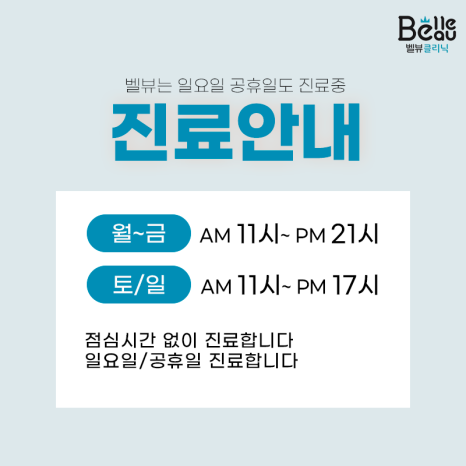
Open on Sundays and public holidays
-
Customized procedures after skin diagnosis with Mark-Vu
#GangnamStationDermatology #BellevueClinic #GangnamBotox #GangnamDermatology #GangnamStationFiller #GoalIsToBeTheBestDermatologyClinicInGangnam #WeLoveYouCustomer #AHappyHospitalEveryDay #ThankYou #BellevueClinic #BellevueLifting #ONDALifting #ONDAEvent #PainlessLifting #PainlessLifting #ONDALiftingEvent
🌸Botox.Filler.ThreadLifting.Lifting.Obesity
🌸Scars.Pores.Various Pigmentation.Acne.Hair Removal
🌸Contour Injections.CoreSculpt.NobleShape.HPL.Violet Injection
🌸Diet medication prescription after InBody
🌸Hair loss medication, Viagra prescription
📱Procedure inquiries and reservations
02-533-1200
<Consultation Information & Directions>