Hello, this is Bellevue Clinic. Have you ever suddenly noticed small, unidentified bumps appearing on your forehead, cheeks, or under your eyes and tried squeezing them with your fingertips?
“ I thought it was acne and squeezed it hard, but no sebum came out—only blood.”
“ There were only one or two at first, but they seem to have gradually spread over time.”
“ I thought they were milia or skin tags, but their shape is a little unusual.”
Many people experience stress because of unidentified yellowish or flesh-colored bumps that develop on the face with age. They cannot be squeezed out by hand, and trying to cover them with makeup can actually make them look more prominent, making them particularly bothersome. These may be a condition called sebaceous hyperplasia.
Today, we will take an in-depth medical look at sebaceous hyperplasia, a representative difficult-to-treat skin condition that is easily mistaken for acne, skin tags, or milia. We will explain why it develops and why you should never try to squeeze it at home.
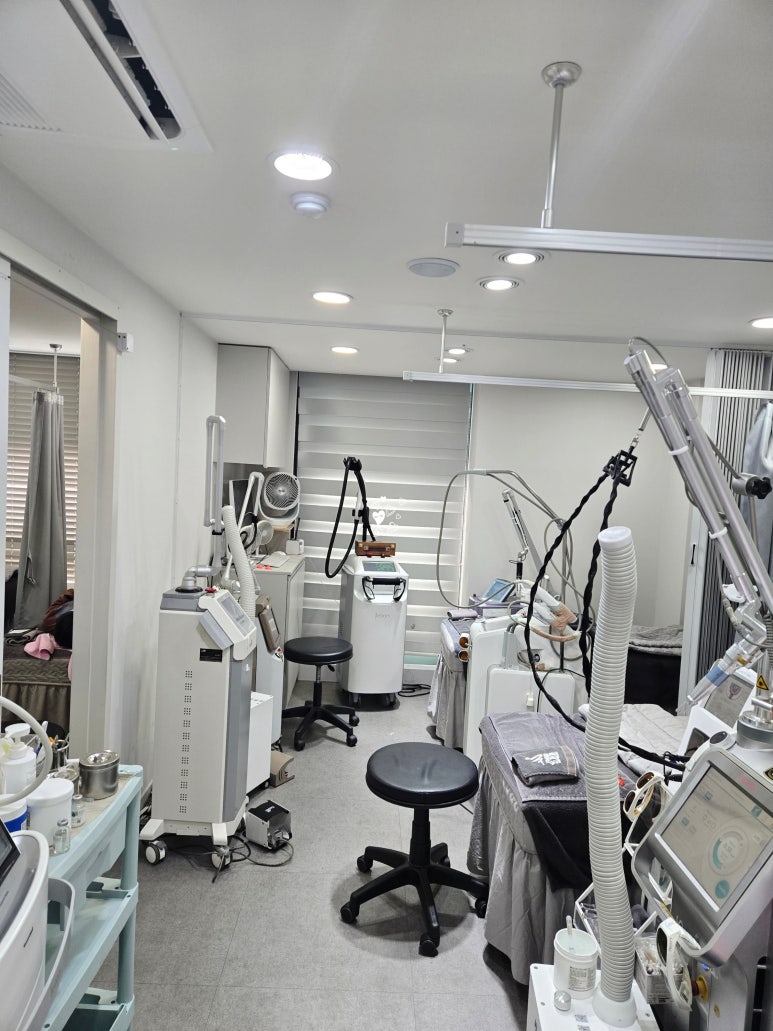
Bellevue Clinic Sebaceous Hyperplasia Treatment
Bumps That Cannot Be Squeezed—Neither Skin Tags nor Acne
‘Sebaceous Hyperplasia’—Its Causes and
Proper Treatment
- What Is Sebaceous Hyperplasia?
The skin contains sebaceous glands that secrete oil, or sebum, to protect the skin and prevent moisture loss. Normal sebaceous glands are so small that they are not visible, but when the cells that make up these glands proliferate excessively and abnormally, causing them to bulge above the skin’s surface, the condition is called sebaceous hyperplasia.
Simply put, it is a condition in which the sebaceous gland “factory” becomes abnormally enlarged and becomes visible externally. It usually develops on the forehead, cheeks, and around the nose, where sebum production is active, and generally appears as a soft, flesh-colored or pale-yellow bump measuring 2–3 mm.
▶ The Most Distinctive Visual Feature of Sebaceous Hyperplasia
On closer examination, the center of the bump may appear indented like a navel, a phenomenon known as central umbilication. This characteristic morphological feature occurs because the enlarged sebaceous glands cluster in a doughnut-like shape around the central opening through which sebum is secreted.
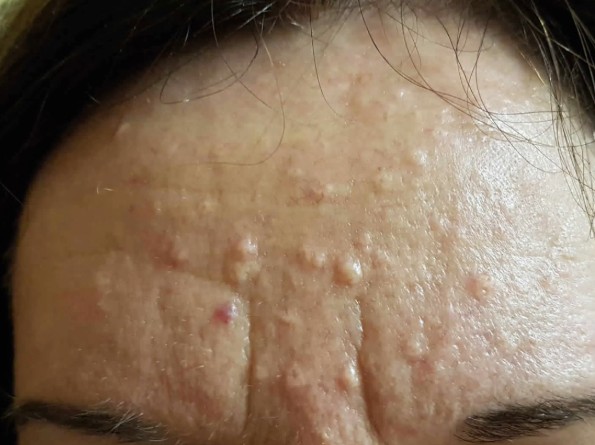
Bellevue Clinic Sebaceous Hyperplasia Treatment
- Why Does It Develop? (Causes)
The exact cause of sebaceous hyperplasia has not yet been identified with complete certainty, but the medical community believes that the following factors may act together.

① Skin Aging and Changes in Androgen Hormones (the Primary Factor)
In the past, this condition was commonly found in people in their late 40s and older and was sometimes called “senile sebaceous hyperplasia.” As people age, the cell turnover, or regeneration, cycle slows. As aging progresses, the sensitivity of sebaceous gland cells to androgens, or male hormones, changes. As a result, sebaceous gland cells may proliferate excessively instead of degenerating. Recently, the incidence among people in their 30s has also been increasing rapidly, reportedly due to intense ultraviolet exposure and stress.
② Genetic Factors
If someone in your family has particularly oily facial skin or has had sebaceous hyperplasia, there is a much higher likelihood that multiple lesions may develop even at a young age.
③ Chronic Ultraviolet Exposure
Ultraviolet (UV) rays from sunlight not only destroy collagen in the skin but may also stimulate the sebaceous glands and act as a catalyst for abnormal cell proliferation.
Bellevue Clinic Sebaceous Hyperplasia Treatment
- Comparison with Similar Conditions That Are Easily Confused with It
It is very difficult for patients to distinguish facial bumps on their own before they are examined visually or with magnification by a professional. Many people end up with scars after attempting home care based on an incorrect diagnosis, so please use the table below as a general comparison.
| Condition | Main Features | Distinguishing Points |
|---|
| Sebaceous hyperplasia | Yellowish bumps measuring 2–3 mm | The center is indented like a navel; nothing comes out when squeezed |
| Acne (comedone) | Caused by sebum accumulating inside a pore | A hard sebum plug, or comedone, may come out when squeezed; inflammation may also occur |
| Milia | Small white bumps resembling grains of millet, approximately 1 mm in size | The interior is filled with keratin, which shows through as a thin, whitish area on the skin’s surface |
| Syringoma | Flesh-colored bumps caused by proliferation of sweat ducts | Usually occurs in multiple clusters around the eyes and may become larger by merging together |
| Skin tag | A localized overgrowth of soft skin tissue | Feels as though it is dangling when touched |
Bellevue Clinic Sebaceous Hyperplasia Treatment
- “Why You Should Never Squeeze It at Home”
Many people try to squeeze sebaceous hyperplasia at home using an extractor or needle because they think it is acne. We strongly advise that you never do this.
[Excessive attempt at self-extraction]
↓
[Excessive damage to the skin surface and dermal layer]
↓
[Bacterial infection and inflammatory response]
↓
[Permanent or semi-permanent “depressed scars” developing where the structure has been destroyed]
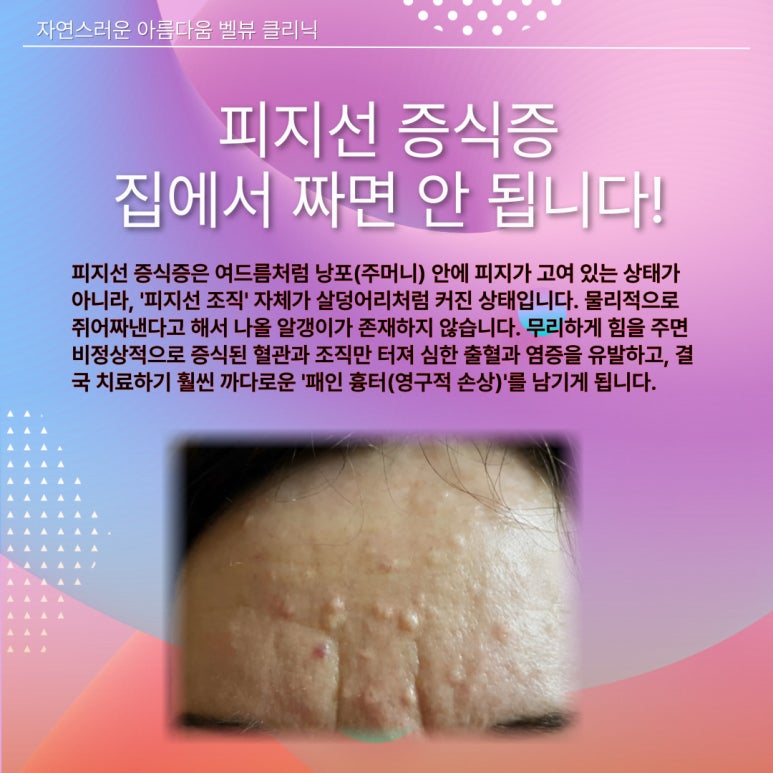
Unlike acne, sebaceous hyperplasia is not a condition in which sebum has accumulated inside a cyst or sac. Rather, the sebaceous gland tissue itself has enlarged like a mass of flesh. There is no plug that can be physically squeezed out. Applying excessive pressure can rupture only the abnormally proliferated blood vessels and tissue, causing significant bleeding and inflammation and ultimately leaving a “depressed scar (permanent damage)” that is much more difficult to treat.
Bellevue Clinic Sebaceous Hyperplasia Treatment
- Professional Treatment Methods for Sebaceous Hyperplasia
Unfortunately, sebaceous hyperplasia does not disappear naturally. If left untreated, it tends to gradually increase in size or multiply in number around the surrounding area. Therefore, it is advisable to seek medical assistance for safe removal in the early stages after discovery. The key to treatment is how cleanly the sebaceous gland mass located deep in the dermis can be destroyed while minimizing damage to the surrounding normal skin.
① Carbon Dioxide (CO2) Laser and Er:YAG Laser Treatment
This is one of the most commonly used methods. The laser precisely resurfaces the skin’s surface and burns away the proliferated sebaceous gland tissue. It is effective for small, shallow, early-stage lesions. However, because sebaceous hyperplasia can extend deeper into the dermis than expected, aggressively resurfacing too deeply in a single session may leave scars. For this reason, dividing treatment into two or three sessions may be safer.
② High-Frequency Microneedle Treatment (Highly Recommended)
This is a premium treatment method that has recently gained considerable attention. A specially designed fine insulated needle is inserted into the center of the sebaceous hyperplasia, and radiofrequency (RF) energy is then delivered to selectively cauterize, or burn away, only the causative sebaceous gland mass in the dermis without damaging the skin’s surface. Because the outer skin is not resurfaced, large scabs generally do not form after treatment, allowing a very quick return to daily activities. In addition, because the root itself is destroyed, the recurrence rate is considerably lower, making this treatment highly effective for persistent, difficult-to-treat conditions.
③ Topical and Oral Medications
When there are numerous lesions—dozens or more spread across the entire face—an oral vitamin A derivative, isotretinoin, may sometimes be used for a short period alongside laser treatment to suppress sebum production. This may help inhibit the formation of new lesions.
Bellevue Clinic Sebaceous Hyperplasia Treatment
- Post-Treatment Care and Tips for Preventing Recurrence
Post-treatment care for sebaceous hyperplasia is just as important as the procedure itself. Because sebaceous glands are living tissue, you should keep in mind that recurrence may occur at any time if the aging process continues.
-
Wear a healing dressing such as DuoDERM — If you have undergone laser treatment, keep a healing dressing applied for at least one week to prevent bacteria from entering and to help the area heal without scarring.
-
Thorough sun protection — If ultraviolet rays reach the treated area, melanocytes may be stimulated, causing post-inflammatory hyperpigmentation (PIH). When going outdoors, be sure to apply sunscreen with an SPF of at least 30 thoroughly.
-
Maintain the skin’s oil-moisture balance — When the skin is dry, the body tends to produce more sebum to protect it. After treatment, applying plenty of a primarily hydrating cream that is not overly oily may help maintain the oil-moisture balance and prevent recurrence.

Bellevue Clinic Sebaceous Hyperplasia Treatment
Accurate Diagnosis Determines the Quality of Treatment
The first step in treatment is accurately distinguishing whether a facial bump is sebaceous hyperplasia, simple acne, or another tumorous skin condition. This is because the laser wavelength, depth, and application method must vary completely depending on the type of condition.
At Bellevue Clinic, before treatment we use the Mark-Vu advanced skin diagnostic device to scientifically analyze the density and depth of sebaceous glands—which are difficult to assess with the naked eye—as well as the skin’s overall oil-moisture condition and degree of aging. Based on these findings, we design customized laser and radiofrequency treatment programs suited to each patient’s skin thickness.
Please visit us for a comfortable consultation and diagnosis, and we hope you can regain your naturally smooth and clear skin. We will always do our best to provide honest and safe medical care. Thank you.
▣ All procedures may cause side effects such as swelling, bruising, or erythema depending on the individual, so a thorough consultation with a physician is necessary.
▣ This column is an informational post reviewed and written by the medical staff of Bellevue Clinic to help patients better understand the medical information.

For office workers who have difficulty making time on weekdays due to their busy schedules, Bellevue Clinic at Gangnam Station provides regular medical services on Sundays and public holidays to support convenient weekend care. However, please note that the clinic is regularly closed every Wednesday when arranging your schedule. Even in July, one of the most tiring months of the four seasons, we hope you will take care of clear and healthy skin. Thank you~!
“Focused on Specialized Skin Diagnostics”
Bellevue Clinic
The Mark-Vu skin diagnostic examination can identify various skin concerns at once, including skin texture, pigmentation, pores, wrinkles, skin tone, dark circles, radiance, redness, melanin, sebum, and acne-causing bacteria, many of which are difficult to confirm with the naked eye.
Bellevue Clinic scientifically analyzes the skin to determine the treatments needed and strives to provide the most effective and beneficial procedures for each patient through kind and detailed consultations.



💎Bellevue Clinic💎
-
Use of genuine products in the prescribed quantities
-
Skilled medical staff with many years of treatment experience
-
Medical services available on Sundays and public holidays
-
Customized treatments following Mark-Vu skin analysis
🌸Botox · fillers · thread lifting · lifting · obesity
🌸Scars · pores · various types of pigmentation · acne · hair removal
🌸Contour injections · CoreSculpt · NobleShape
HPL · V-Olet injections
🌸Diet medication prescriptions after an InBody analysis
🌸Prescriptions for hair-loss medication and Viagra
📱Treatment inquiries and reservations
02-533-1200
<Medical Services & Directions>