Removing Jowls
Facelift Surgery to Lift a Sagging Face in Your 50s

As we age, the facial line often loses its definition and the area below the jaw begins to sag, making the so-called “jowls” stand out more prominently. In particular, once people enter their 50s, these changes become even more noticeable, sometimes leading to concerns that they simply look heavier or that their expression appears tired.
Many people brush it off as just a decline in skin elasticity, but in reality, it may be the result of a more complex change in which not only the skin but also the SMAS layer sags together. Therefore, in cases where simple care does not solve the problem, a more fundamental approach is needed.
Why do jowls look more prominent in your 50s?

There are several reasons why jowls become more pronounced in your 50s. As skin elasticity decreases and structural changes in the deeper layers of the face progress at the same time, sagging accelerates.
| Main checklist of reasons jowls become prominent |
|---|
| Decreased skin elasticity and reduced collagen |
| Sagging of the facial SMAS layer |
| Downward movement and accumulation of fat |
| Weakening of the jawline support structure |
| Long-term sagging due to gravity |
These changes are not simply a problem on the surface of the skin, but a change in the overall facial structure, so care that only pulls at the outer layer may have limitations.
Are simple procedures limited in treating jowls?

Procedures such as lifting lasers and thread lifting are widely used as relatively simple ways to improve elasticity. However, because these methods mainly act on the skin surface or shallow layers, their effect may be limited when sagging has already progressed into deeper layers. In particular, there are physical limits when it comes to sufficiently lifting tissue that has shifted downward, as in jowls.
| Summary of the limitations of simple procedures |
|---|
| Difficult to pull on the deep SMAS layer |
| Relatively short duration of effect |
| Increased need for repeated procedures |
| The more severe the sagging due to weakening jawline support, the more limited the improvement |
Therefore, to clearly improve sagging that has already progressed, a more structural approach is needed.
Why is a facelift needed to improve jowls?
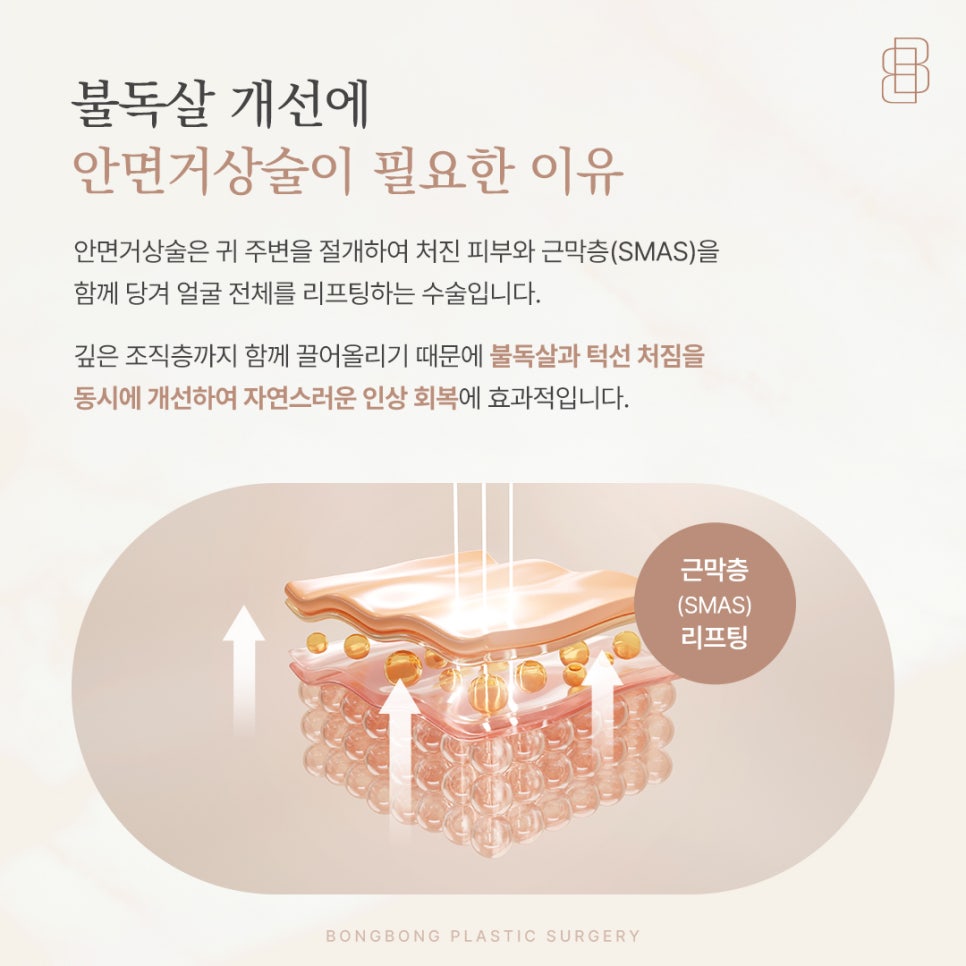
A facelift is a surgery that pulls not only the skin but also the facial SMAS layer, focusing on restoring sagging tissue to its original position. Rather than simply pulling the skin, it lifts the layer that supports the facial structure as well, allowing for more natural and longer-lasting results.
| Key features of a facelift |
|---|
| Lifting together with the SMAS layer |
| Repositioning sagging fat and tissue upward |
| Improving the jawline and facial contour |
| Relatively long-lasting results |
In particular, because tissue that has sagged downward, like jowls, requires not just improved elasticity but a restoration of position, a method that corrects the SMAS layer as well can be an effective choice.

Jowls are not simply the result of aging, but rather the result of several structural changes acting together. To improve them, the first step is to accurately understand your current condition. Since the degree and cause of sagging differ from person to person, it is important not to choose a specific procedure or surgery unconditionally, but to find the method that suits your own condition.
An approach that considers not only visible changes but also the underlying causes is needed, and through that, more natural and satisfying results can be expected.