Causes of Dimple Indentations After Thread Lifting and
Care Methods to Ease Them

�
As more people consider thread lifting to improve facial sagging and maintain skin elasticity, interest is also growing in the various changes that can appear after the procedure. One of the relatively common changes discussed is the “dimple phenomenon.”
�
After thread lifting, many people worry that the procedure may have gone wrong if part of the skin appears slightly sunken or indented. In particular, when a specific area looks pulled while looking in the mirror or the skin feels folded when making facial expressions, it is easy to feel anxious.
�
Why does the dimple phenomenon occur after thread lifting?

�
The dimple phenomenon that appears after thread lifting is said to possibly occur during the process in which the skin and threads become fixed in place. Thread lifting approaches sagging tissue by pulling it upward and securing it, and during this process the thread may interlock with internal skin tissue, causing certain areas to look momentarily pulled. In particular, if the skin is thin or there is little fat beneath it, or if tissue adhesion forms strongly, there may be cases where the skin surface appears indented.
�
In addition, right after the procedure, tissue swelling and pulling are both present, so the dimple phenomenon may feel more noticeable. Depending on the case, a temporary folding sensation when making facial expressions may also occur, and these changes are sometimes explained as part of the initial stage while the thread settles into place. The dimple phenomenon may appear during the process of the thread and skin tissue adapting.
�
Not all dimples are a side effect!
�
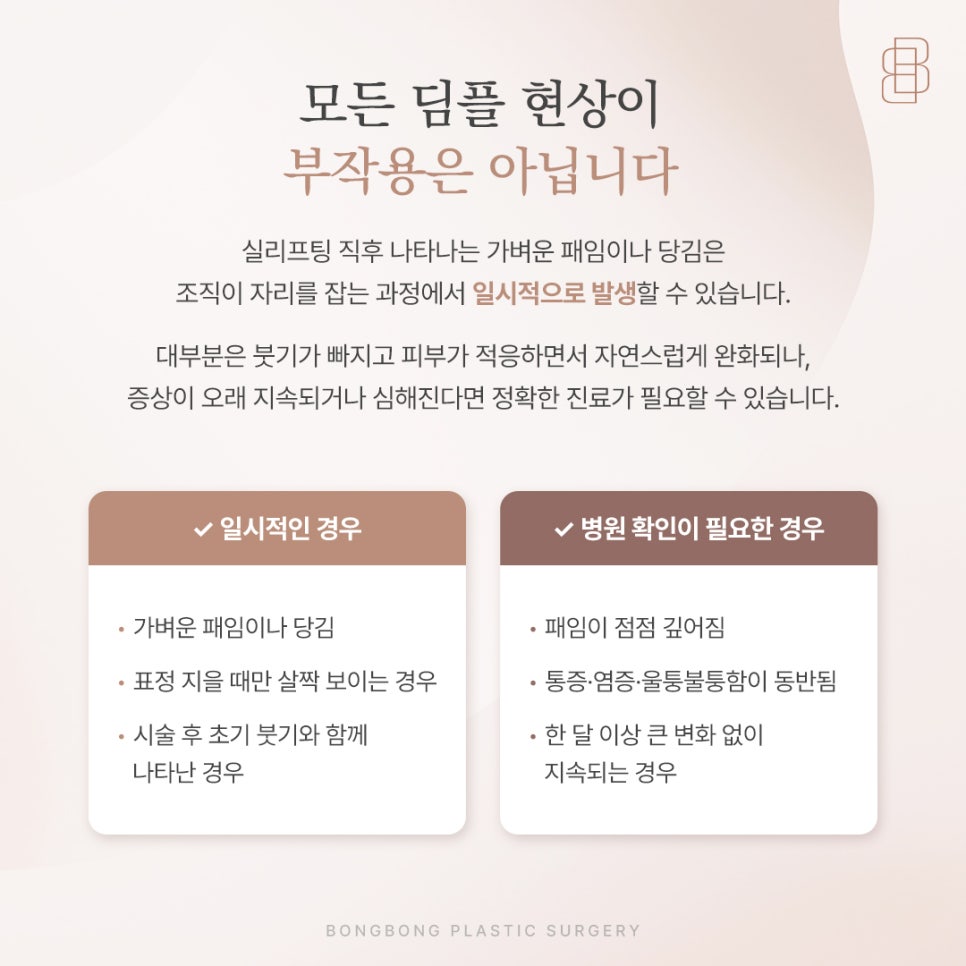
If the skin appears slightly indented after thread lifting, it may not necessarily lead to a serious side effect in every case. In fact, mild dimpling that appears immediately after the procedure may naturally ease over time as the tissue adapts and swelling decreases. In the early stage especially, because the skin is in a pulled state and tissue swelling is also present, the surface may temporarily look uneven. As time passes, when the thread settles more stably into the surrounding tissue and skin tension is relieved, it is also explained that the line may gradually become more natural.
�
However, if the indentation remains severe or is accompanied by pain or inflammation, it may be important to recheck the current condition. Initial dimpling may also be a temporary change.
Most mild dimpling is sometimes explained as part of the recovery process, but in some cases there may be situations that require additional confirmation.
�
-
The indentation remains severe even as time passes
-
The skin feels fixed in an uneven way
-
Pain or warmth is present
-
Redness and inflammatory reactions continue
-
One side feels excessively pulled
-
Facial movement is restricted to the point of discomfort
�
If these changes continue, it may be important to determine whether this is simply part of recovery or whether the current tissue condition should be checked again. Persistent indentation and pain may require evaluation.
�
How can the dimple phenomenon be eased?

�
When dimpling appears after thread lifting, it may be important to keep the recovery process stable rather than irritating the skin forcefully. In the early stage, excessive massage or strong pressure is generally avoided, and opening the mouth too widely or making intense facial expressions may also need to be limited for a certain period.
�
In addition, saunas, high-temperature environments, and strenuous exercise may increase swelling and irritation, so caution may be needed during the early recovery period. In some cases, gentle tissue care or follow-up checks may be carried out under the clinician’s judgment. Above all, it is important not to repeatedly touch the skin yourself or try to press it flat by force. Reducing skin irritation during early recovery may be important.
�
�
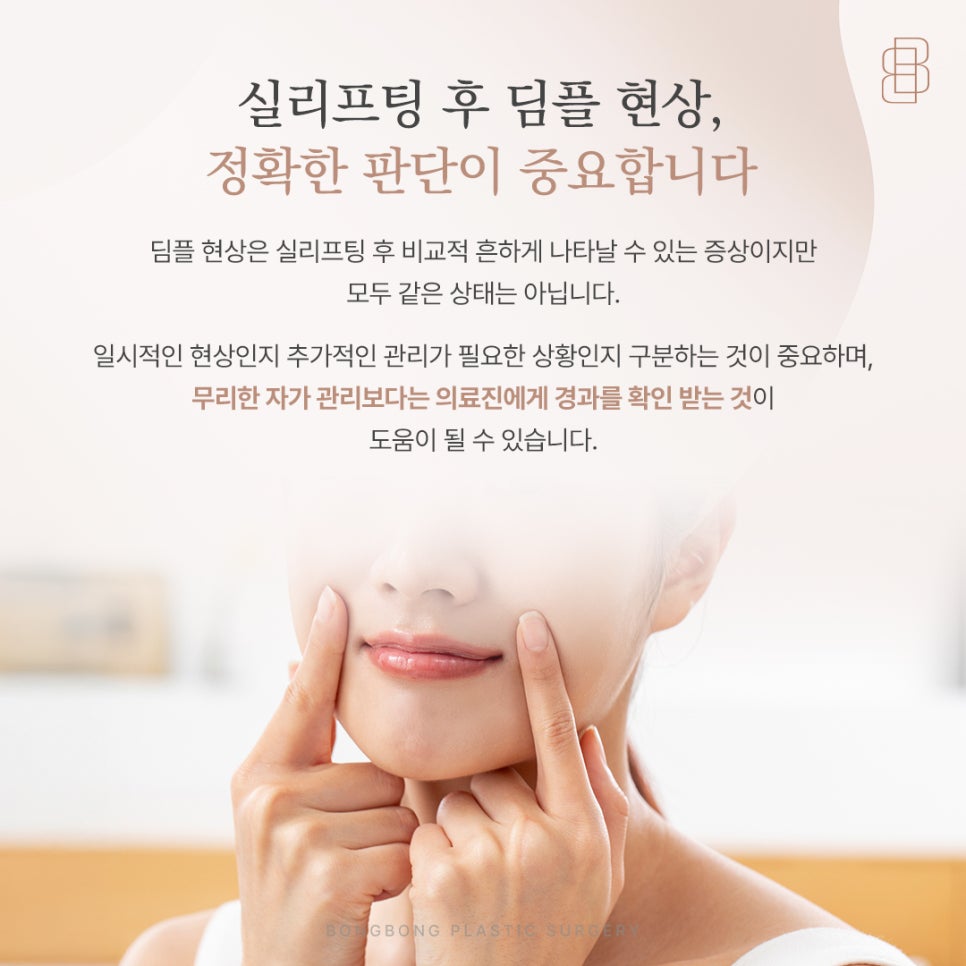
The dimple phenomenon that appears after thread lifting may also be a temporary change that occurs while the skin tissue and thread settle into place. In particular, immediately after the procedure, skin pulling, swelling, and the tissue adhesion process are all underway, so the sunken or uneven feeling may appear more noticeable temporarily. However, as time passes and the tissue stabilizes and skin tension eases, the change may gradually become more natural. Rather than making a definitive judgment too early, it may be important to observe the recovery course sufficiently.
�
That said, if the dimpling lasts for a long time or changes such as pain, warmth, or asymmetry appear together, it may be difficult to view this as part of simple recovery alone, so it may be necessary to check the current condition accurately. In addition, during early recovery, avoiding excessive massage or strong stimulation and maintaining lifestyle care that helps stabilize the skin tissue are both considered important.
�
In the end, when it comes to dimpling after thread lifting, it is important to approach the issue accurately by considering not only the visible change itself but also the skin condition and the recovery process together.
�

�