Mirajet Scar Care Guide: Old Depressed Marks
Smoothing Them Through Dermal Layer Regeneration

Many people believe that scars or marks left on the skin will naturally disappear over time. However, old scars and depressed marks may remain unchanged for months or even years, sometimes becoming a source of stress in daily life.
In particular, depressed marks such as acne scars, post-traumatic scars, and old stretch marks are often related not simply to an issue on the skin's surface, but to changes in the underlying skin structure.
Today, we will look at why old scars and marks do not disappear easily and why skin regeneration care is important.
Why do old scars and depressed marks remain for so long?
When the skin is damaged, it undergoes a process of self-recovery. However, if sufficient collagen is not produced during the regeneration process or the dermal layer is damaged, the skin surface may remain depressed.
Because these changes do not naturally restore themselves simply with the passage of time, they can lead to old scars or marks.
Scars such as the following may be associated with damage to the deeper layers of the skin.
| Types of scars that may be associated with damage to the deeper layers |
|---|
| Acne scars Chickenpox scars Post-traumatic scars Old white stretch marks |

Why skin regeneration care is important for older scars
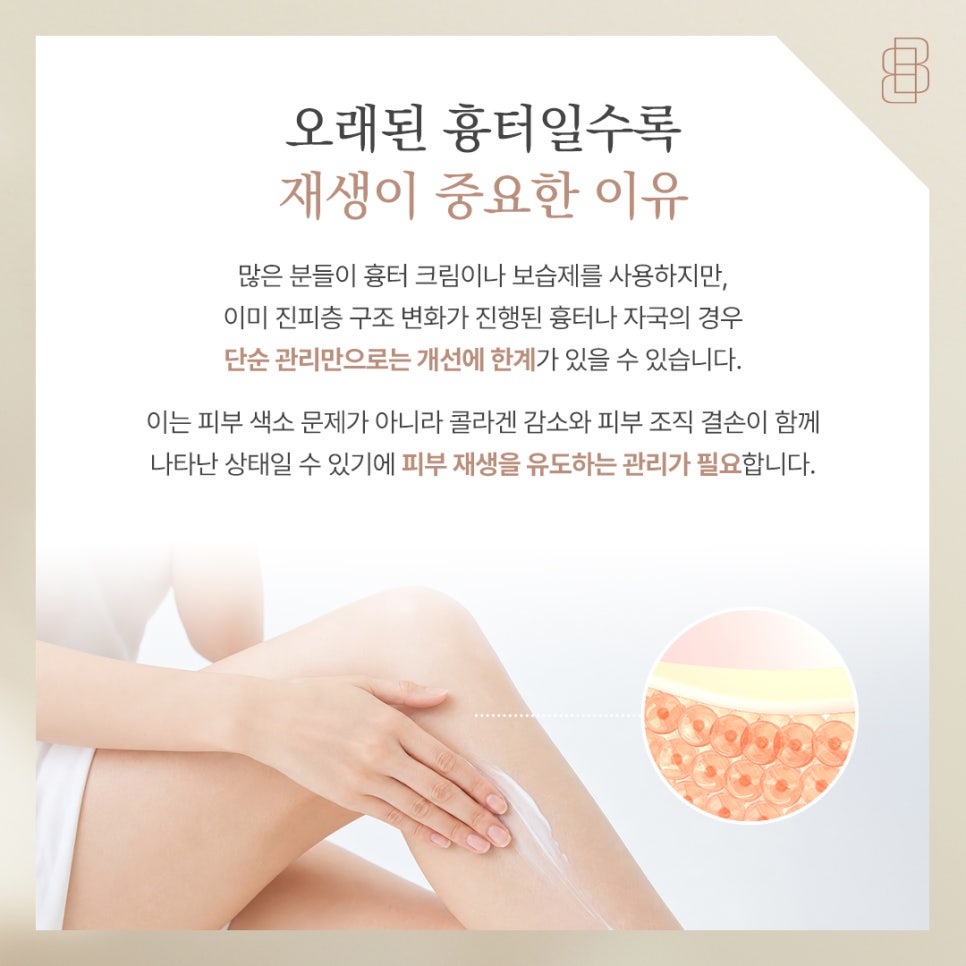
When scars develop, many people consistently use scar ointments or creams and moisturizers. While these may be helpful for early care, old scars in which structural changes in the dermal layer have already progressed may have limitations when treated only with simple surface care.
This is because the condition may involve not only skin pigmentation issues but also tissue loss and reduced collagen.
Therefore, for old scars and marks, an approach that improves the skin's internal regenerative environment may be more important than care that simply covers the skin's surface.
The key to scar care is creating an environment in which the skin can recover on its own.
What care methods help promote skin regeneration?
Various care methods that promote regeneration within the skin without causing significant irritation to the skin's surface have recently been used.
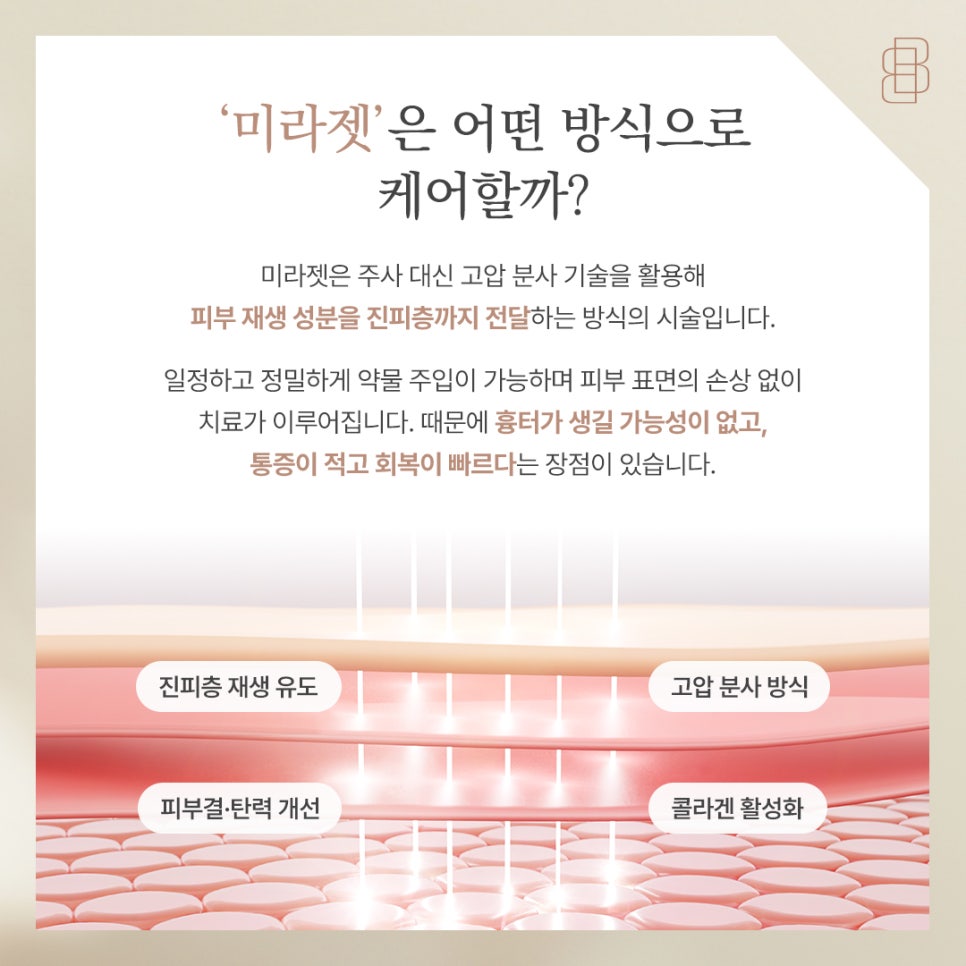
Among them, Mirajet is known as a treatment method that uses high-pressure injection technology to deliver skin-regenerating ingredients to the dermal layer.
It can deliver substances consistently and precisely without using injection needles, and is characterized by helping improve the skin's regenerative environment while minimizing damage to the skin's surface.
The following are the care objectives that may be pursued through this approach.
| Care objectives |
|---|
| Improving the regenerative environment of the dermal layer Improving skin texture and elasticity Promoting collagen activation Stimulating regeneration within the skin |
The key to scar and mark care is recovery within the skin
Old depressed scars and stretch marks may become more difficult to manage over time. However, this does not mean you have to give up.
What matters is not covering the scar from the outside, but improving the regenerative environment of the damaged dermal layer and managing it in a way that enhances the skin's natural ability to recover.
In addition, suitable care methods may vary depending on the cause, depth, and extent of the scar, as well as the skin type. It is advisable to create an individualized plan based on sufficient consultation and an accurate diagnosis.
When care suited to the condition of the skin is provided, old scars and marks may also show more positive changes.

Old scars and depressed marks may not be issues that time alone can resolve. More satisfactory improvement may be expected when care takes into account both damage to the dermal layer within the skin and the regenerative environment.
If you are concerned about acne scars, chickenpox scars, post-traumatic scars, or old stretch marks, it may be helpful to accurately assess your current skin condition and establish a regeneration-focused care plan suited to your individual skin characteristics. Skin recovery begins with understanding the regenerative environment within the skin, rather than focusing only on its surface.