When the weather is cold,
to protect skin condition from dropping severely out of control,
you need to look into a variety of methods.
Of course, it is important to keep the skin from being exposed
to dryness, cold, and UV rays,
and it also takes effort to make sure
it does not lack moisture and nutrition through self-care.
However, even with these efforts, it is difficult to restore
the skin elasticity that seems to disappear day by day.
Because it is an unavoidable phenomenon caused by aging,
it is better to receive a procedure that helps the skin
more directly.
There are several procedures that are good for improving elasticity,
but if you want a more delicate touch,
it is a good idea to try skin Botox.
It is a method of diluting the botulinum toxin
commonly used for cosmetic procedures and injecting it into the dermis.
For those who know about it, this is one of the many management options
that people get often, and there are already several choices.
So, what types of skin Botox are there,
and what are the strengths of each one?
Today, I will briefly organize them for you.
Differences in the Injection Layer
Before looking into the types of skin Botox,
let’s compare it with other uses of botulinum toxin
that may feel more familiar and look at the differences.
In the cosmetic procedures people commonly know,
it is often understood as helping improve wrinkles
rather than elasticity.
Although the same ingredient is used,
the process is clearly different,
so the difference is significant.
One difference worth noting in particular
is the location where the ingredient is injected.
If you have visited dermatology clinics often,
you probably know that care is performed at different layers
depending on the area of concern that needs improvement.
The skin is made up of the epidermis, dermis, and muscle layer,
and the care method differs for each layer.
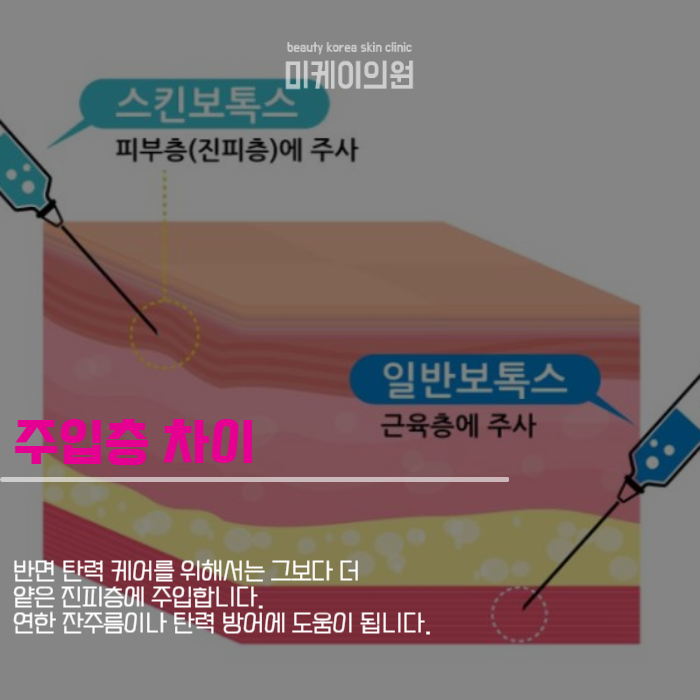
The wrinkle Botox most people know is injected into the muscle layer,
which is located deeper.
Since the purpose is mainly to address deep-set wrinkles
rather than elasticity,
it improves wrinkles by suppressing muscle movement.
On the other hand, for elasticity care,
it is injected into the dermis, which is a shallower layer.
It helps with fine lines and protecting elasticity.
Principle of Improvement
Even if the types of skin Botox are different,
they all help with elasticity care.
I will briefly explain the procedure principle
for how this kind of result can be created.
The dermis, where it is injected, is responsible for elasticity, radiance, and tension,
and it is composed of cells such as fibroblasts and tissue cells,
as well as connective tissue made of elastic fibers.
Among these, fibroblasts produce collagen,
elastin, and hyaluronic acid.
These structural substances play a role in helping the skin maintain
stronger elasticity.
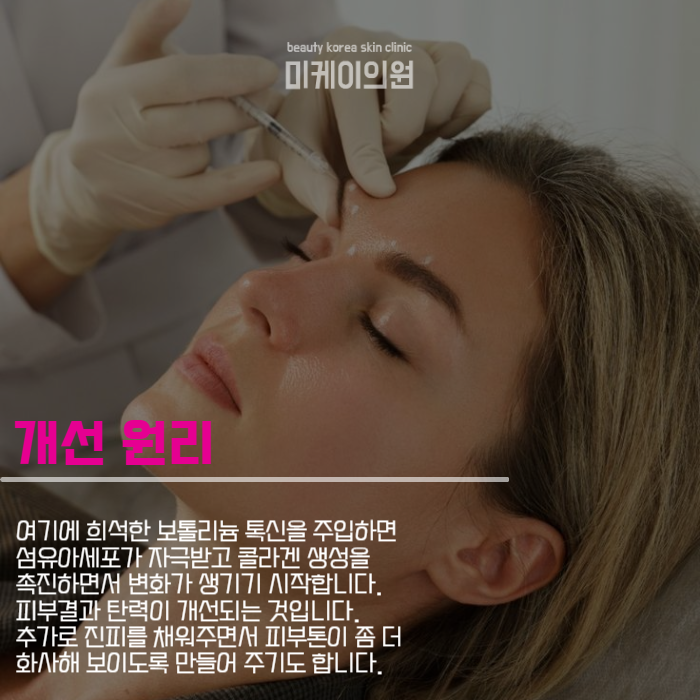
When diluted botulinum toxin is injected here,
fibroblasts are stimulated and changes begin
as collagen production is promoted.
This improves skin texture and elasticity.
In addition, it fills out the dermis,
which can make the skin tone look brighter.
While these basic effects remain the same,
differences arise depending on the product.
There are domestic products and imported products.
Differences in the Products
I mentioned this briefly earlier, but I will explain it again
as a way of organizing the concept.
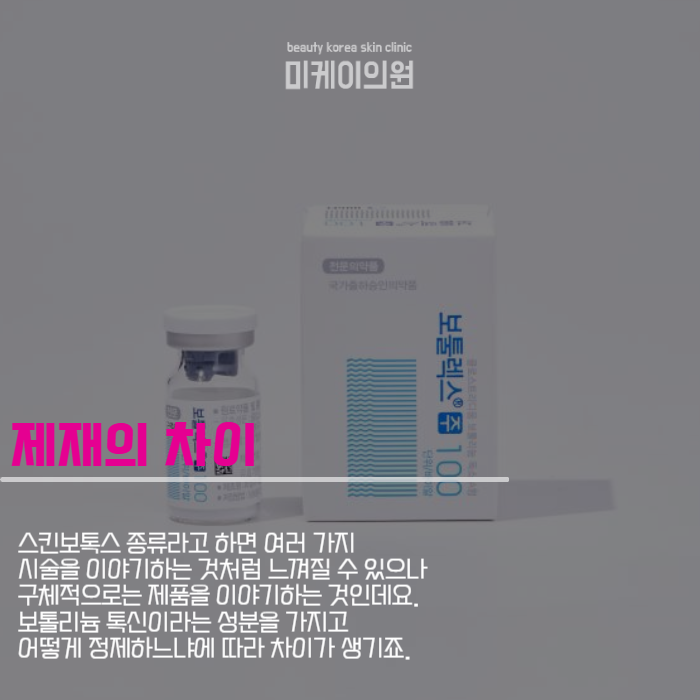
When people say skin Botox types,
it may sound like they are talking about several different procedures,
but more specifically, they are talking about products.
Differences arise depending on how the botulinum toxin ingredient is refined.
Domestic products include Botox and Coretox,
while Xeomin is a representative imported product.
Developed by Merz in Germany, Xeomin is a product
that does not require concern about resistance,
which is considered the biggest issue.
That is because it is a pure botulinum toxin
with the complex proteins that cause resistance removed,
using German raw materials combined with advanced technology.
Of course, even if it is not Xeomin,
domestic products such as Botox and Coretox also have many strengths.
Botox is a product that is well loved enough to be FDA-approved
and exported.
Because they are being developed in ways that can bring about more direct and better changes
than existing toxin formulations,
while reducing the burden of the number of administrations and resistance,
it is important to carefully decide which product to receive treatment with.
At Clinics That Carry It
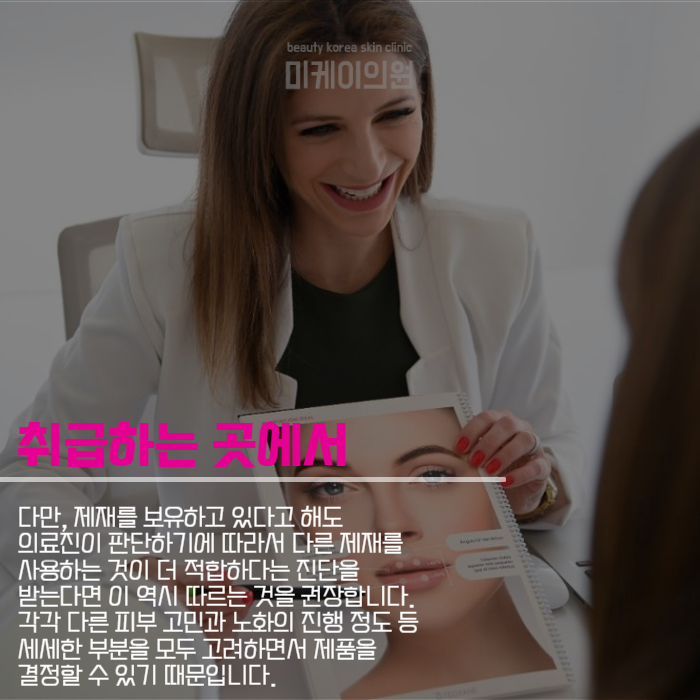
Unfortunately, you cannot freely choose the type of skin Botox.
Since each dermatology clinic carries different products,
even if you want a specific formulation,
you may need to proceed with another one.
For this reason, it is a good idea to check in advance
which products they have and use.
However, even if they do have the product,
if the medical staff determines that a different product
is more appropriate, it is recommended to follow that judgment.
That is because the product can be decided
while taking into account all the detailed factors,
such as different skin concerns and the degree of aging progression.
Therefore, the best choice is generally to find a place
that carries excellent products without concerns about resistance.
If they have the two types mentioned above,
Xeomin and Botox,
that is good because you can choose according to each product’s strengths.
Common Precautions

No matter which type of skin Botox you choose,
the precautions are the same, so it is good to remember them.
First, there are things to be careful about during the consultation process.
It is best to avoid places that insist on a large number of sessions
or arbitrarily set the interval too short, if possible.
This is because adjusting the dosage and frequency
is the first way to prevent problems.
The recommended interval is once every two months,
and depending on the skin condition, two to three sessions are recommended.
Since one injection lasts about two to three months,
it is possible to have another procedure when the change starts to become less noticeable.
However, after two to three additional sessions,
maintenance can last up to six months depending on how well it is managed.
There are, of course, precautions immediately after the procedure as well.
Since the medication is injected thinly into the dermis,
small raised bumps may appear.
These subside within one day, and bruising or swelling
will go down after about two to three days,
so do not touch the area and focus on moisturizing care.
On the day of the procedure, you should avoid drinking,
smoking, exercise, makeup, and washing your face,
so it is also important to plan your schedule with this in mind.