Hello,
This is MIKAY Clinic, where we work with you to address your skin concerns.
As the weather is gradually getting hotter
and humidity is rising,
the rainy season is quickly approaching.
Around this time of year, when sweat and oil production increase,
pores become easily clogged,
and concerns about acne tend to increase as well.
If your skin remains unchanged after 6–8 weeks of care,
or red inflammation, pustules, and scarring keep recurring,
that may be the time to consider seeking medical care.
Acne is not simply a temporary skin problem.
It is a chronic inflammatory condition that develops in the hair follicles and sebaceous glands,
and leaving it untreated may lead to scarring.
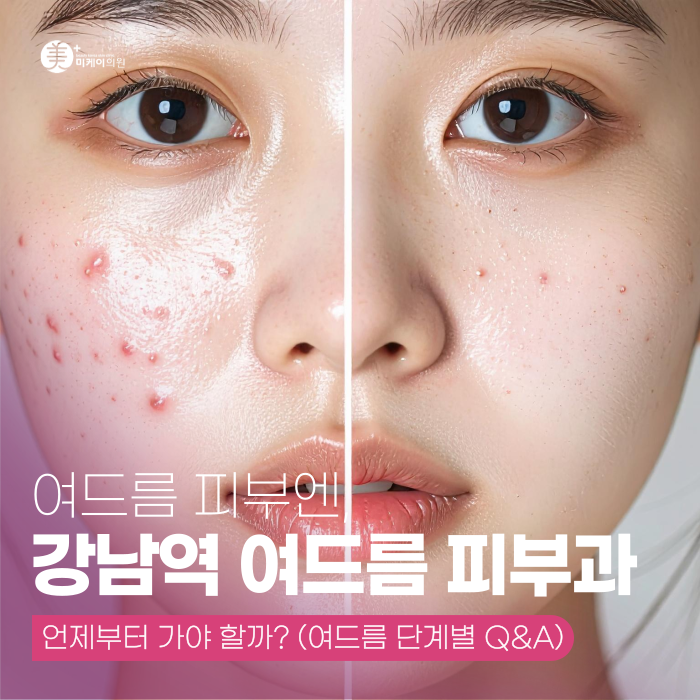
If you are wondering whether to visit a Gangnam acne clinic,
the first step is to determine
what stage your acne is currently in.
Q1. Is my acne unusually severe compared with everyone else?
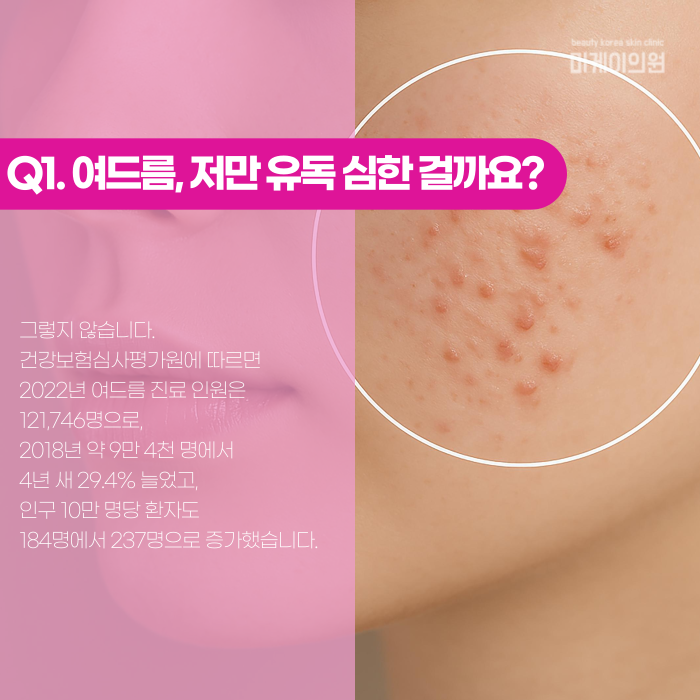
Not at all.
According to the Health Insurance Review & Assessment Service,
the number of people receiving medical care for acne in 2022 was 121,746,
an increase of 29.4% over four years from approximately 94,000 in 2018.
The number of patients per 100,000 people also increased
from 184 to 237.
By age group, people in their 20s accounted for the largest share at 47.0%,
followed by those in their teens at 22.1% and those in their 30s at 18.7%.
There was also no significant difference between men and women.
Contrary to the common belief that acne is a condition of adolescence,
the number of adults visiting hospitals for acne is increasing rapidly,
so you are not alone in dealing with it.
(Health Insurance Review & Assessment Service)
Q2. Does acne have different “stages”?
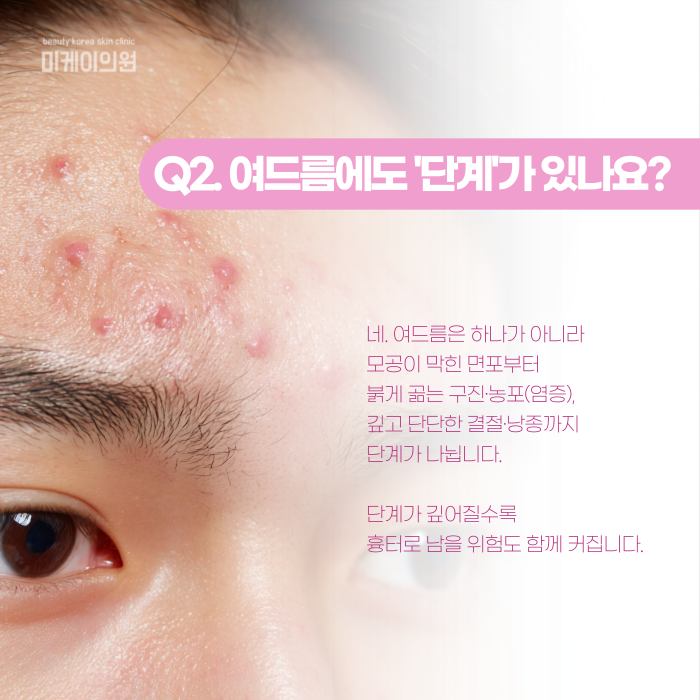
Yes. Acne is not all the same.
It ranges from comedones caused by clogged pores
to red, pus-filled papules and pustules (inflammation),
and deep, firm nodules and cysts.
The deeper the stage,
the greater the risk of scarring.
It often begins with comedones that appear like tiny bumps,
and when inflammation develops, it progresses to a stage where the skin becomes red, swollen, and filled with pus.
Even when acne looks similar,
the approach to care differs depending on its stage,
so the first step is to find out which stage you are currently in.
Q3. Why does acne keep coming back in the same spot?
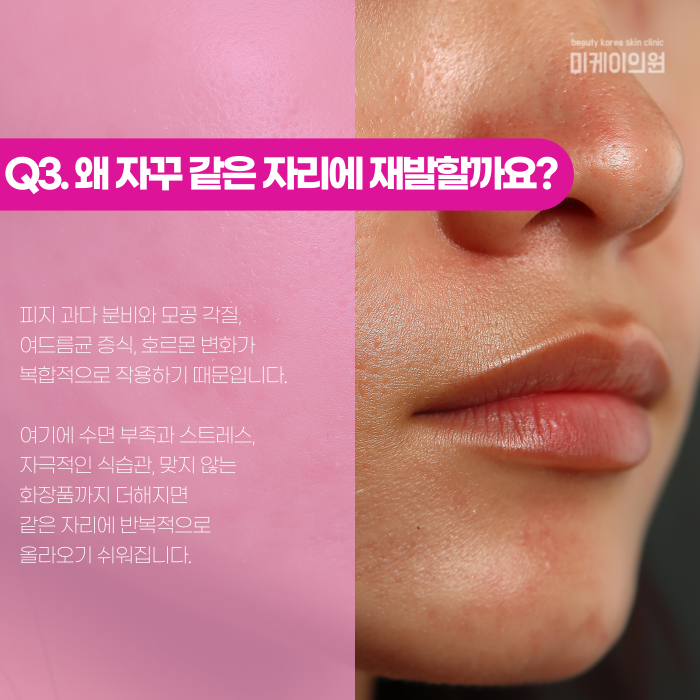
This is because excessive sebum production, dead skin buildup in the pores,
proliferation of acne-causing bacteria,
and hormonal changes all work together.
When lack of sleep and stress,
irritating eating habits, and cosmetics that do not suit your skin are added,
acne is more likely to recur in the same areas.
Especially on hot and humid days like these,
sweat and sebum production increase,
which can make symptoms worse.
That is why Gangnam acne clinics do not look only at the acne visible on the surface.
They first assess the skin’s stage and the underlying factors,
and then determine an appropriate approach to care.
Q4. Does acne improve all at once? What about care at home?
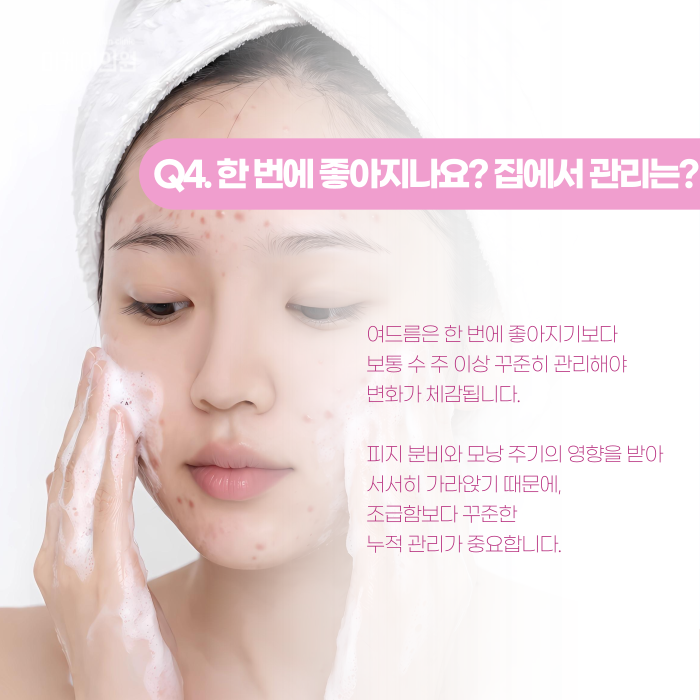
Rather than improving all at once,
acne usually requires consistent care for several weeks or longer
before you can notice a change.
Because it gradually settles down under the influence of sebum production and the hair follicle cycle,
consistent, cumulative care is more important than impatience.
At home, the basics are to wash your face twice a day with minimal irritation,
protect the skin barrier with a low-oil moisturizer,
and make sure to use sunscreen.
However, many people find that home care alone has its limitations.
Combining it with care at a Gangnam acne clinic
can make it easier to keep the condition stable.
Signs that it may be time to have your skin checked
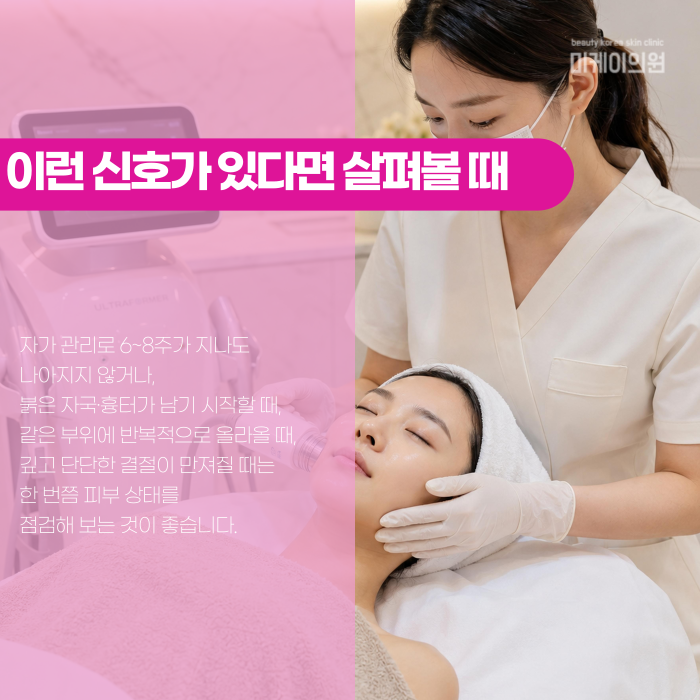
If your acne does not improve after 6–8 weeks of self-care,
red marks or scars are beginning to remain,
it keeps recurring in the same areas,
or you can feel deep, firm nodules,
it is a good idea to have your skin condition checked at least once.
In particular, manually squeezing acne yourself
should be avoided because it can worsen inflammation
and leave scars or hyperpigmentation.
If you notice these signs,
having the stage of your acne assessed at a Gangnam acne clinic
may help reduce scarring.
It is safest to discuss the appropriate approach with a medical professional.
In closing

Acne is a common condition,
but the appropriate approach to care differs depending on its stage and underlying factors,
and there is no single method that works equally well for everyone.
That is why knowing what stage your skin is currently in
is the starting point for care and the first step toward preventing scars.
The most accurate way to determine which stage your skin is in
is through an examination by medical professionals at a Gangnam acne clinic.
At this time of year, when the rainy season and hot weather can easily make skin more sensitive,
we recommend prioritizing an accurate diagnosis
rather than attempting excessive self-care.
※ Treatment effects and responses may vary from person to person,
and side effects may occur.