
Hello, we are 미케이의원, here to help you care for your skin.
During the summer, air conditioning and UV exposure can leave the skin dry on the inside and shiny on the surface, making it look dull and rough.
As more people seek skin booster injections to replenish inner moisture, many also wonder, “Is it okay to get them frequently?”
Skin booster injections directly deliver moisturizing ingredients such as hyaluronic acid into the skin to replenish inner moisture and add radiance.
Unlike topical moisturizers, which are applied to the surface, this treatment is based on the concept of replenishing moisture inside the skin, so questions about treatment intervals are especially common.
The key is not to receive skin booster injections as frequently as possible, but to find the appropriate interval.
Q1. What exactly are skin booster injections?

Skin booster injections deliver hyaluronic acid and similar ingredients into the dermal layer to replenish moisture within the skin and improve its texture.
Because the concept is to replenish moisture directly inside the skin rather than apply it to the surface, they are primarily used to manage inner dryness and roughness.
As interest in these moisture-replenishing skin boosters has grown, the global market is projected to grow at an average annual rate of 8.6% through 2030. (Straight Research)
Q2. How long do the effects last?
The duration varies considerably depending on the ingredients used and the condition of the skin. However, many people find that their skin feels steadily more hydrated as treatments accumulate over multiple sessions rather than after just one.
The effects gradually diminish over time.
Therefore, the perspective of “staying consistently hydrated” is generally more appropriate than expecting “dramatic results all at once.”
It is helpful to understand in advance that periodic care is needed to maintain the results.
Q3. So, is it okay to get them frequently?
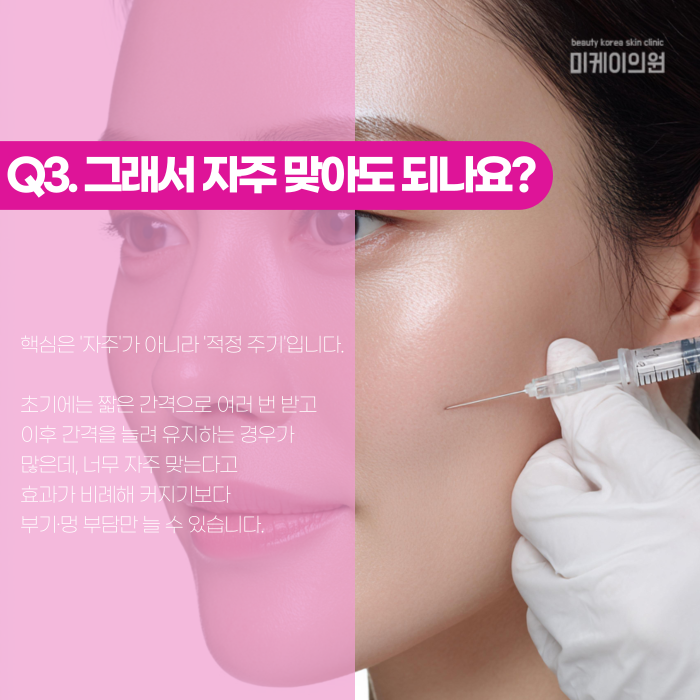
The key is not “frequently,” but rather the “appropriate interval.”
In the beginning, people often receive several treatments at shorter intervals and then extend the intervals for maintenance. However, receiving treatments too frequently may not increase the effects proportionally and may only increase the burden of swelling and bruising.
Therefore, when receiving skin booster injections, it is important to follow an interval suited to your skin rather than an excessive frequency.
Since the appropriate interval varies depending on the condition of your skin, it is best to determine it together with a medical professional.
Q4. Who may benefit from them? How should you care for your skin afterward?
Skin booster injections may be considered by people whose makeup separates because of inner dryness, whose skin feels rough due to air conditioning or UV exposure, or who want to manage their skin texture without a significant burden.
However, suitability varies depending on the condition of the skin.
On the day of the treatment, it is best to avoid saunas, strenuous exercise, and alcohol, while also making sure to drink enough water, moisturize, and use sun protection.
Small daily care habits often affect how long the results last, so post-treatment care is as important as the procedure itself.
Things to know before treatment

Because this is an injection-based treatment, stinging, swelling, and bruising may occur. These usually subside within a few days, but individual differences are possible.
Caution is needed if you are pregnant, have inflammation at the treatment site, or have an allergy to any of the ingredients, so it is safest to consult a medical professional in advance.
If you have an important event coming up, it is best to schedule the treatment with enough time to account for the possibility of swelling and bruising.
In addition, combining skin booster injections with at-home care such as moisturizing and UV protection makes it easier to maintain hydration for longer than with a single treatment alone.
In closing

Skin booster injections replenish moisture within the skin, but receiving them as frequently as possible is not necessarily better. The key is to follow an interval suited to the condition of your skin.
The same number of treatments and intervals are not right for everyone.
The most accurate way to determine the number and interval suited to you is to consult a medical professional who can directly assess your skin.
Rather than choosing an excessive frequency, start by checking the appropriate interval for you.
※ Treatment results and reactions may vary from person to person,
and side effects may occur.