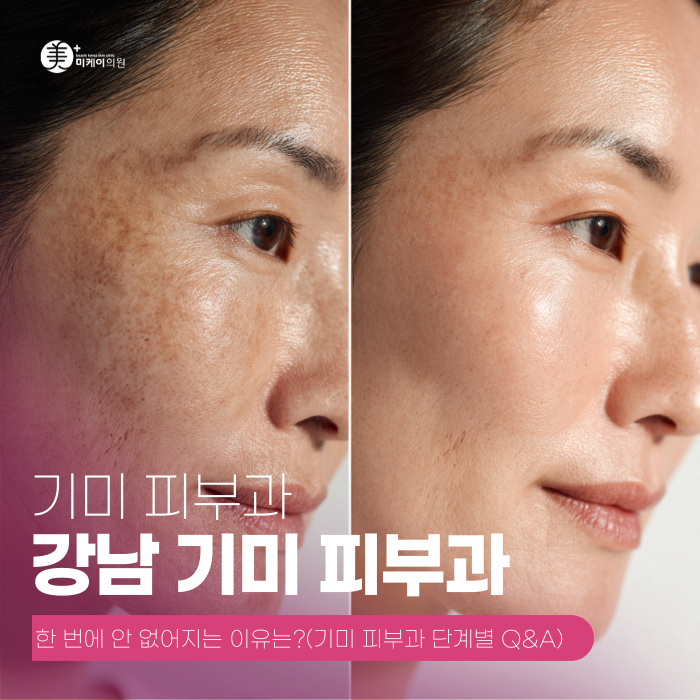
Hello, this is 미케이의원, where we work with you to address your skin concerns.
During the summer, when UV exposure becomes stronger, many people feel stressed because the melasma on their cheeks or forehead appears darker and more pronounced.
Why does melasma keep coming back even after treatment?
Melasma is a common pigmentation disorder that appears as irregular brown patches on the face, caused by a combination of factors including UV exposure, hormones, and genetics.
Once it develops, it can be difficult to manage and often recurs, leaving many people wondering where they should seek care.
Before looking for a Gangnam melasma dermatology clinic, the first step is to determine whether your pigmentation is actually melasma.
Q1. Why does melasma develop?

Melasma develops through the combined effects of UV exposure, changes in female hormones, genetic factors, and more.
UV exposure, in particular, is a major factor that worsens melasma, and it is known to occur more commonly in women of reproductive age.
Because multiple factors are involved rather than a single cause, melasma can easily return after treatment if its contributing factors are not managed together.
(Seoul National University Hospital Medical Information)
Q2. Are sunspots and melasma different?
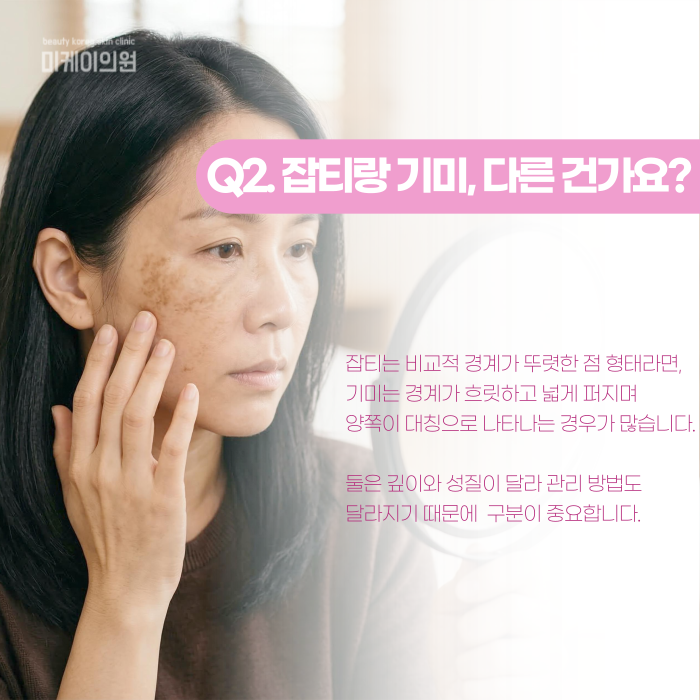
Sunspots tend to appear as spots with relatively distinct borders, whereas melasma often has indistinct borders, spreads over a wider area, and appears symmetrically on both sides of the face.
Because they differ in depth and characteristics, their management methods also differ, making it important to distinguish between them.
Even if they look similar, treating melasma like sunspots may be less effective or may even cause the pigmentation to become darker.
Q3. Can it be removed in one session? How should it be managed?
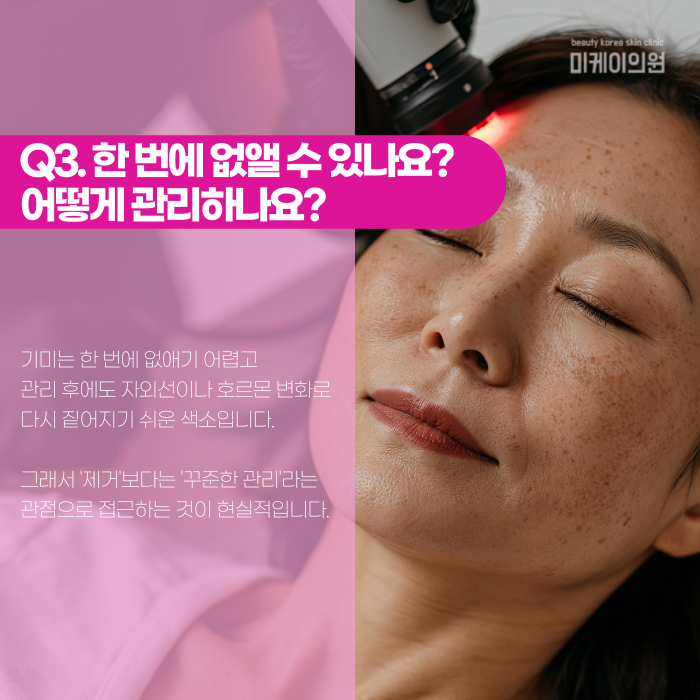
Melasma is difficult to eliminate in a single session, and it can easily become darker again after treatment due to UV exposure or hormonal changes.
For this reason, a realistic approach is to view it as requiring “consistent management” rather than “removal.”
Melasma often requires a comprehensive approach that combines pigmentation treatments such as laser toning with UV protection and lifestyle management.
Trying to resolve it all at once with a powerful laser can instead cause the pigmentation to worsen, so adjusting the intensity and intervals is important for safety.
When should you have these signs checked?
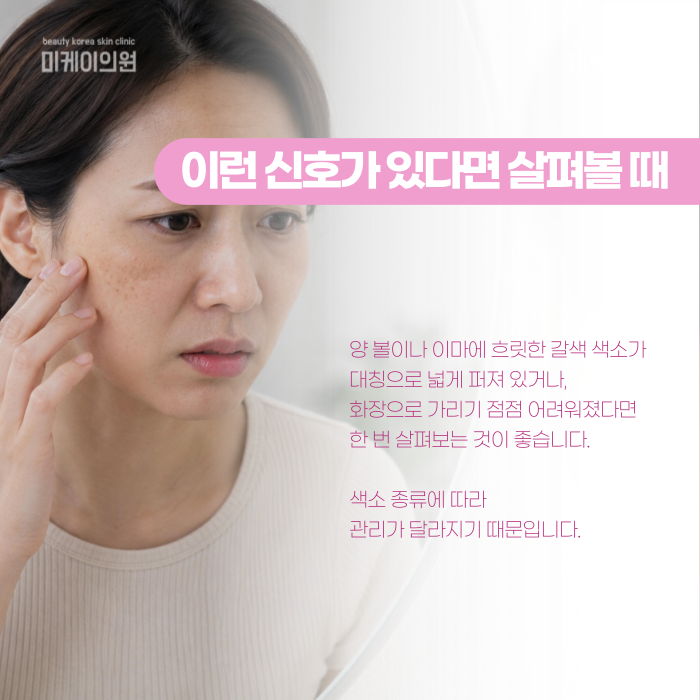
If faint brown pigmentation is spread broadly and symmetrically across both cheeks or the forehead, or if it has become increasingly difficult to conceal with makeup, it is a good idea to have it checked.
This is because management differs depending on the type of pigmentation.
Confirming the type of pigmentation first at a Gangnam melasma dermatology clinic can help you avoid unnecessary procedures and establish an appropriate treatment direction.
The deeper and older the pigmentation, the more difficult it is to assess on your own, so evaluation should come first.
Things to know before treatment

Because overly aggressive treatment with a powerful laser can actually make melasma darker, it is important to adjust the intensity and intervals.
If you are pregnant or breastfeeding, or if you are taking any medication, it is safest to inform the medical provider in advance.
UV protection is also essential—not optional—in melasma management.
Even during treatment, exposure to UV rays can quickly cause the pigmentation to return, so it is advisable to use daily UV protection along with care at a Gangnam melasma dermatology clinic.
In conclusion

Melasma is common but difficult to manage and prone to recurrence, so consistent care and prevention are more important than procedures intended to “remove it all at once.”
The first step is to accurately determine whether your pigmentation is melasma.
The most accurate way to determine whether it is melasma or sunspots and which type of care is appropriate is to consult the medical professionals at a Gangnam melasma dermatology clinic.
With UV exposure particularly strong these days, we recommend prioritizing an accurate diagnosis over overly aggressive self-treatment.
※ Treatment effects and responses may vary from person to person, and side effects may occur.