Hello, this is Mikay Clinic, where we care about your skin concerns together.
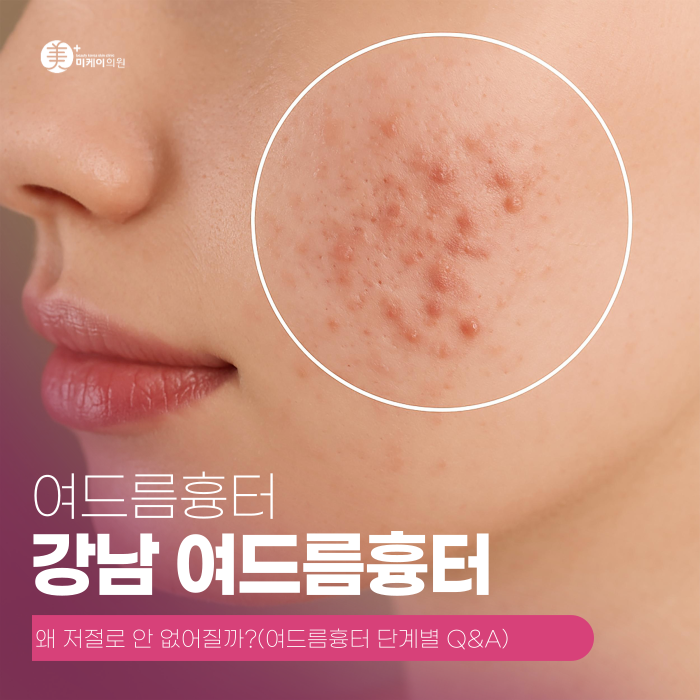
Even after acne subsides, reddish marks or indented scars may remain and become an even greater concern.
Why don’t acne scars disappear on their own?
Acne scars are the result of deep inflammation damaging the dermal layer of the skin, leaving behind indentations or pigmentation marks.
Once they develop, they are difficult to eliminate on their own, and the appropriate care varies depending on the type of scar.
If you are looking into acne scar treatment in Gangnam, the first step is to identify what type of scar you have.
Q1. Why do acne scars develop?
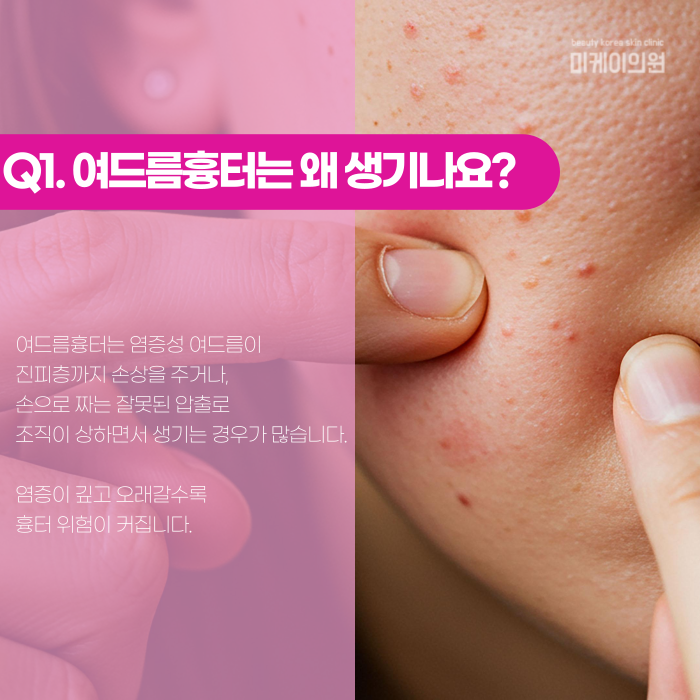
Acne scars often develop when inflammatory acne damages the dermal layer, or when improper extraction by hand damages the tissue.
The deeper and longer-lasting the inflammation, the greater the risk of scarring.
Because acne is such a common condition, many people experience it—the number of patients treated in 2022 reached 121,746.
That is why it is important to manage acne during the inflammation stage, before it becomes a scar. (Health Insurance Review & Assessment Service)
Q2. Are there different types of scars?
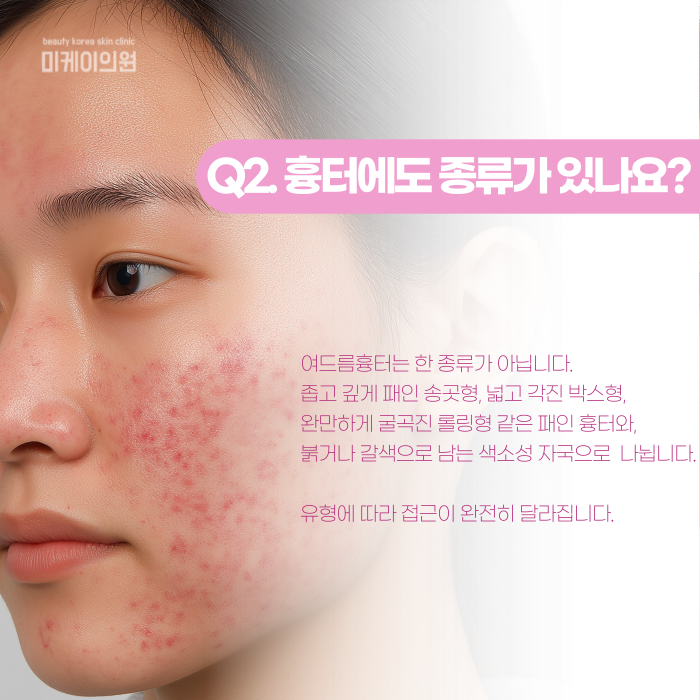
Acne scars are not all the same.
They can be divided into indented scars, such as narrow and deep ice-pick scars, wide and angular boxcar scars, and gently undulating rolling scars, as well as pigmented marks that remain red or brown.
The approach can vary completely depending on the type.
Therefore, even when referring to an “acne scar laser,” it is difficult to treat every type of scar with a single method.
Distinguishing the type of scar is the starting point for care.
Q3. Do they improve in a single treatment? How should they be managed?
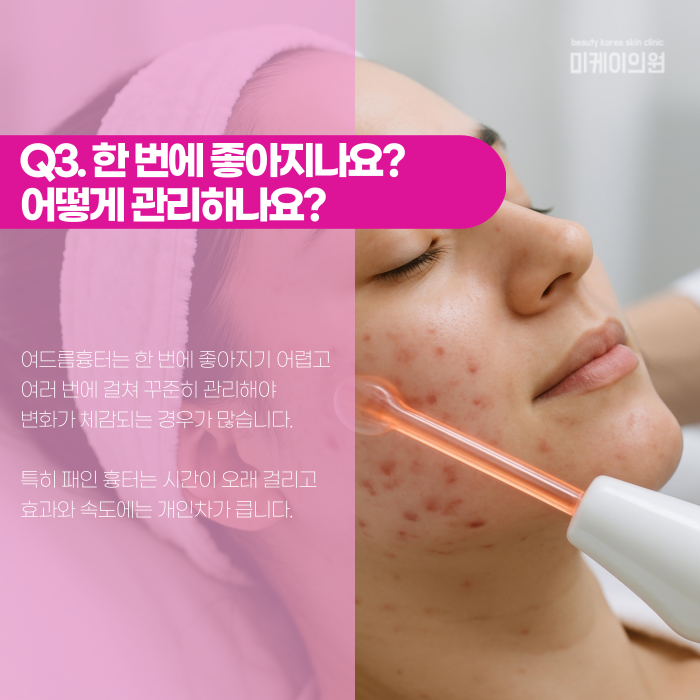
Acne scars are difficult to improve in a single treatment, and noticeable changes often require consistent care over multiple sessions.
Indented scars, in particular, can take a long time to improve, and results and the pace of change vary greatly from person to person.
Red marks are often addressed through soothing and pigmentation care, while indented scars are commonly approached according to their type using lasers or minimally invasive procedures.
Rather than treating every scar with one method, different approaches may be combined according to the type of scar.
People who may consider this care
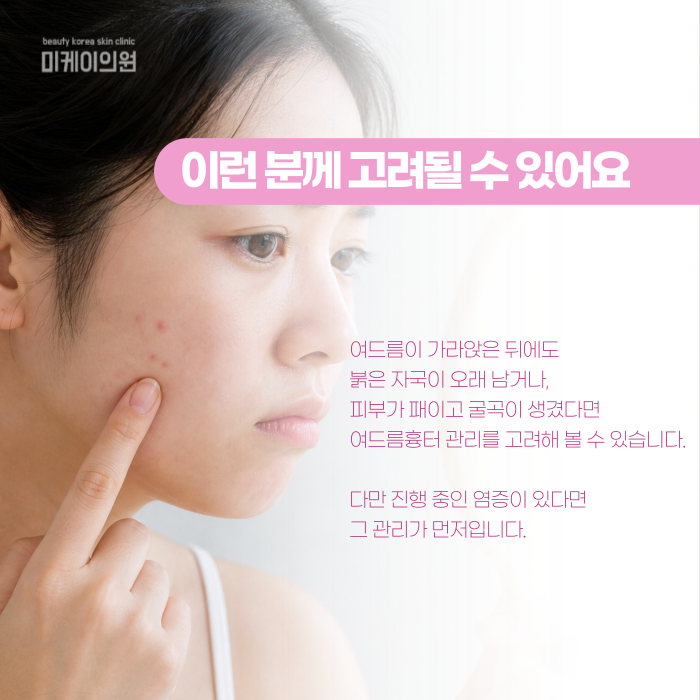
If red marks remain for a long time after your acne has subsided, or if indentations and unevenness have developed in the skin, you may consider acne scar care.
However, if there is ongoing inflammation, managing that should come first.
The appropriate approach for acne scars in Gangnam may vary depending on the type of scar and the condition of your skin.
Rather than undergoing an overly aggressive procedure in pursuit of quick results, it is safer to take a gradual approach.
Points to know before and after treatment

Temporary redness, scabbing, or changes in pigmentation may occur after scar treatment.
In particular, if you have active acne or inflammation, stabilizing it first is the priority, and it is advisable to inform your provider in advance about any medications you take and your skin condition.
During scar care, it is also important to prevent pigmentation by using sun protection and moisturizer.
Along with acne scar care in Gangnam, avoiding the habit of touching or squeezing your skin can help prevent new scars.
In closing
Acne scars come in many forms and do not disappear all at once, so consistent care suited to the type of scar is necessary.
Above all, managing inflammation before it develops into a scar is the best approach.
The most accurate way to determine what type of scar you have and which approach is appropriate is to consult a medical professional for a diagnosis during an acne scar consultation in Gangnam.
We recommend starting with an accurate diagnosis rather than attempting overly intensive self-care.
※ Treatment results and reactions may vary from person to person, and side effects may occur.