


Many people consider thread lifting because of reduced skin elasticity. In particular, people in their 50s often have a history of other procedures, so it is important to check the order and intervals between procedures in advance. Today, we will summarize the key points you should know before thread lifting.
Key Summary
✔ Swelling, bruising, soreness, and dimples may occur after thread lifting, and there may be individual differences.
✔ Avoid saunas, strenuous exercise, alcohol, and smoking for one week after the procedure.
✔ If you have received other procedures such as fillers, fat grafting, or Shurink, you must observe the recommended interval before undergoing thread lifting.
MI.K CLINIC · Seocho-gu, Seoul
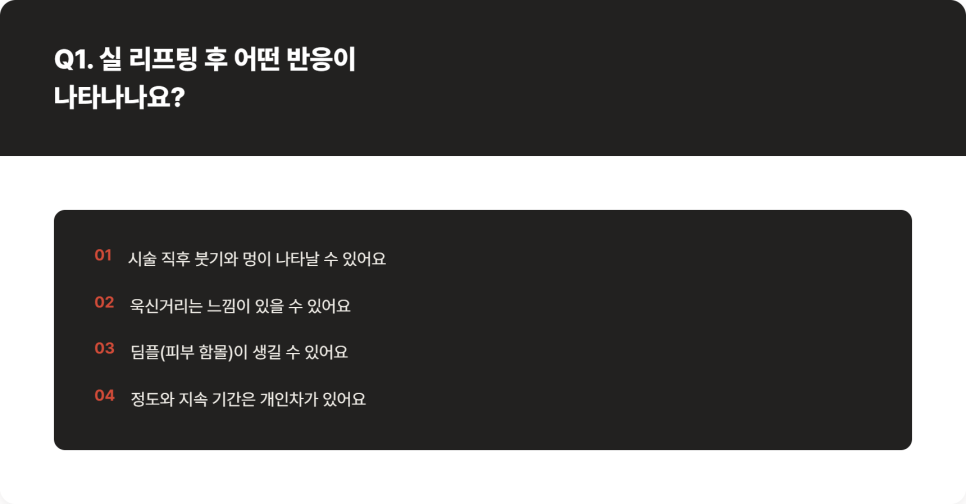
Reactions That May Occur After Thread Lifting
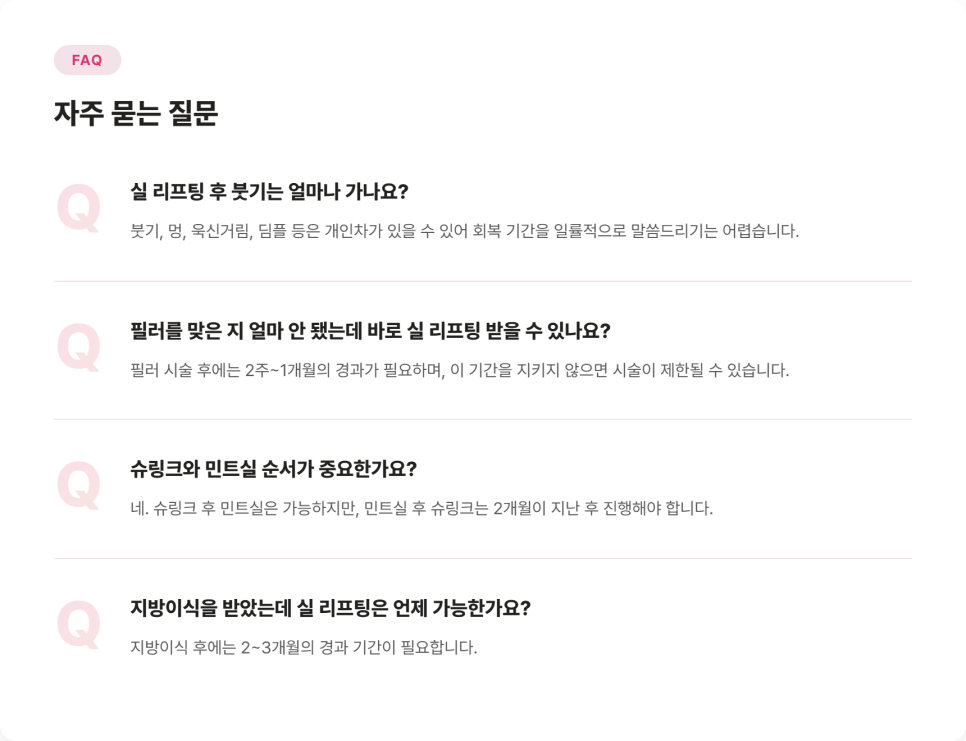
Thread lifting is a procedure in which medical threads are inserted to support sagging skin. Swelling, bruising, a sore or throbbing sensation, and dimples (skin depressions) may appear immediately after the procedure.
The severity and duration of these reactions may vary from person to person, and they may differ depending on the treatment area and the individual’s skin condition.
Before the procedure, it is important to receive sufficient information during your consultation about the reactions that may occur in your case.
Lifestyle Guidelines to Follow After the Procedure
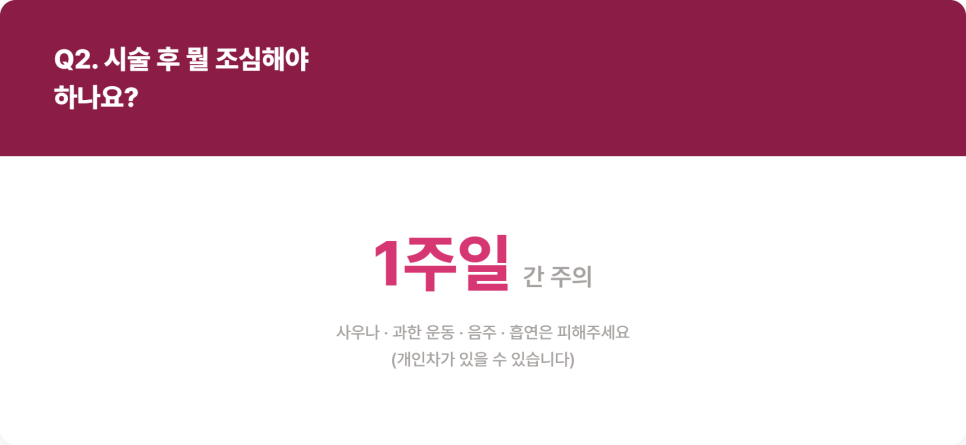
After thread lifting, avoid saunas, excessive exercise, alcohol, and smoking for at least one week.
These factors may worsen swelling and bruising or slow recovery.
While reactions such as swelling, bruising, soreness, and dimples that may occur immediately after the procedure are subsiding, following these guidelines may affect the recovery process.
Even everyday care can affect recovery, so it is important to follow the precautions provided after the procedure.
Why You Should Check the Order of Other Procedures
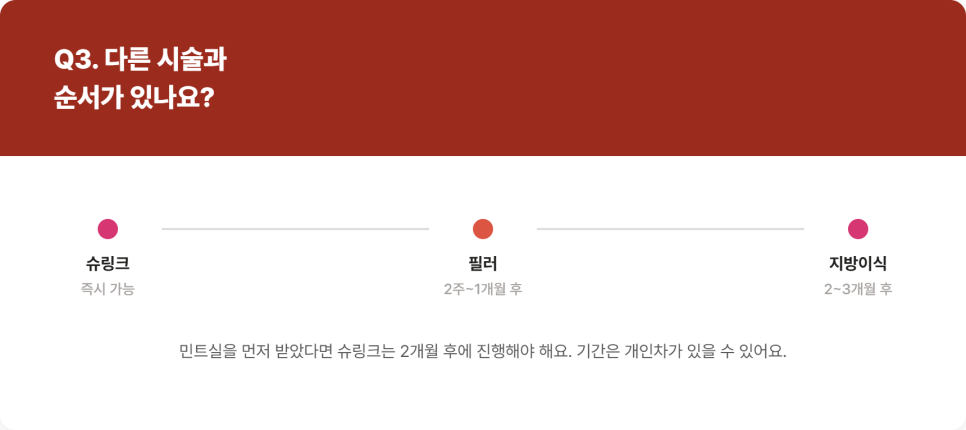
The timing of thread lifting depends on the type of procedure you have previously received.
If you have received Shurink, a Mint Thread procedure may be possible. Conversely, if you received Mint Threads first, you must wait two months before undergoing Shurink.
In addition, an interval of two weeks to one month is required after filler treatment, and two to three months after fat grafting.
If these intervals are not observed, the procedure itself may be restricted. Therefore, it is important to inform your provider of your recent procedure history during the consultation.
Who May Consider Thread Lifting?
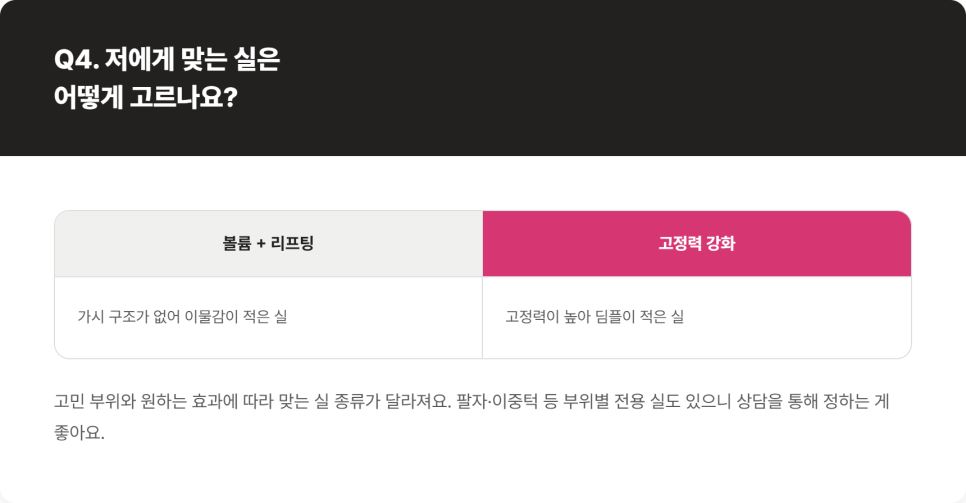
Thread lifting is a procedure that uses threads to support and improve sagging skin. It is mainly used in areas that are easily affected by gravity, such as the cheeks, jawline, and double chin, rather than the bridge of the nose or forehead.
The type of thread used may also vary depending on the area of concern and the degree of sagging.
For example, if nasolabial folds are a concern, a thread designed specifically for that area may be considered. If a double chin is a concern, a thread designed specifically for the double-chin area may be considered.
If you want to fill hollowed areas while also achieving a lifting effect, one option is to choose a type of thread without barbs, which may cause less of a foreign-body sensation. There are also separate thread types suited to those who want stronger fixation and reduced occurrence of dimples (skin depressions).
The effects of thread lifting are generally known to last approximately six months to one year, although there may be individual differences. It is best to decide on the type of thread suited to your skin condition and areas of concern through a consultation.
Therefore, if you are considering thread lifting, organizing in advance which areas concern you and what effects you want can make the consultation much easier.
Checking the precautions for thread lifting and the intervals between thread-lifting procedures in advance can help you prepare more safely for the procedure.
Why a Consultation Is Necessary
Even among people of the same age group, skin condition, procedure history, and recovery speed vary, making it difficult to apply a uniform standard.
If you are planning thread lifting, it is advisable to accurately provide information about your recent procedures and current skin condition. You should also receive sufficient information about which areas will be treated, whether the procedure can be performed, and what reactions can be expected before making a decision.
In particular, because various thread types can be selected depending on the area and degree of concern, it is necessary to work with your provider during the consultation to determine the option that best suits you.

Frequently Asked Questions
Q. When can I resume my daily activities after thread lifting?
A. Although there may be individual differences, avoiding saunas, excessive exercise, alcohol, and smoking for at least one week is recommended.
Q. Can I receive thread lifting if I have previously had fillers or Shurink?
A. Yes. However, an interval of two weeks to one month after filler treatment and two months after Shurink (based on after a Mint Thread procedure) is recommended. It is best to confirm the exact interval through a consultation based on your recent procedure history.

Thread lifting is a procedure in which care before and after the procedure, as well as confirming the interval between procedures, may affect the outcome. If you have recently undergone another procedure, first consult MI.K CLINIC to confirm whether thread lifting can be performed.
MI.K CLINIC | MI.K CLINIC / 4th Floor, 24 Seocho-daero 77-gil, Seocho-gu, Seoul / Inquiries: 1600-9083
#MIKCLINIC #ThreadLifting #MintLifting #Shurink #SeochoDermatology