
If you brush diligently but still experience unusual bad breath or frequently swollen gums, there is a good chance you are overlooking care between your teeth. The spaces between teeth that toothbrush bristles cannot reach and the areas along the gumline ultimately need to be cared for with auxiliary tools such as dental floss or interdental brushes. However, many people feel confused about whether to use floss or an interdental brush even after receiving a recommendation from their dentist. Today, we will compare the two tools carefully according to different situations.
First, let’s look at the basic differences between dental floss and interdental brushes. Dental floss is useful for cleaning the narrow spaces where teeth are tightly touching. It can carefully remove food debris or plaque lodged in areas with broad contact surfaces, such as the molars. Interdental brushes, on the other hand, are more efficient in wider spaces, such as areas where the spaces between teeth have opened somewhat, where the gums have receded, or around dental restorations. For adults whose spaces between their teeth have widened due to gum disease, an interdental brush often feels more suitable and easier to use.
Narrow spaces between teeth generally call for floss, while wider spaces call for an interdental brush
Let’s also divide dental floss into different types. Waxed floss is coated, so it slides between the teeth and is easy for beginners to handle. Unwaxed floss has a slightly rougher surface and is considered to offer good plaque-removal ability, but it can be inconvenient to handle if you do not have much strength in your fingertips. If string floss is difficult to wrap around your fingers and use, a floss holder with a handle can be an alternative. However, holders have the disadvantage of making it difficult to adjust the angle precisely between the teeth, so string floss is generally somewhat more advantageous for reaching every corner.
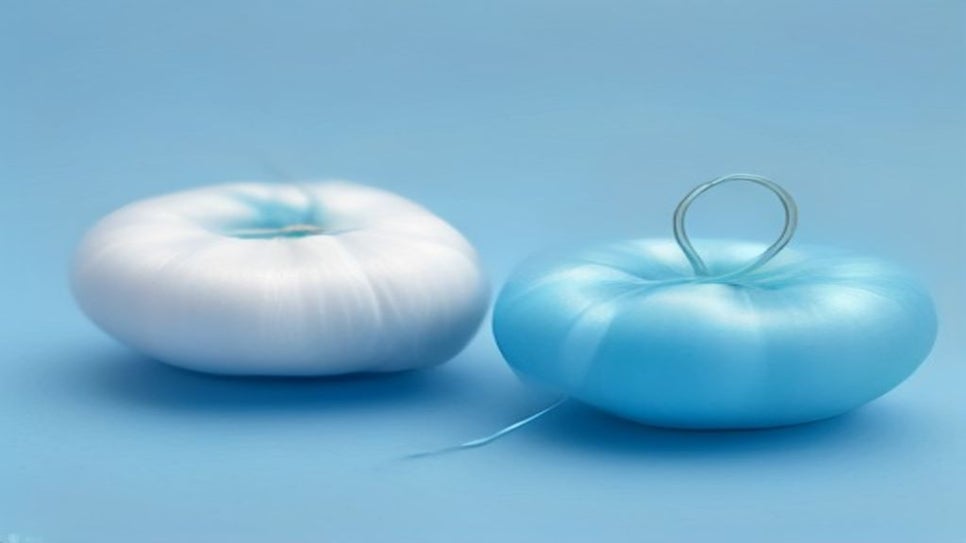
Interdental brushes come in different sizes and shapes. They are usually classified as SS, S, M, and L, and you need to choose a size that fits the spaces between your teeth to avoid injuring your gums. If the brush is too small, its cleaning effectiveness may decrease, while forcing one that is too large into the space can press against and irritate the gums. There are also straight and L-shaped designs. Straight brushes are convenient for the front teeth, while L-shaped brushes make it easier to adjust the angle around the back molars. If you are using one for the first time, we recommend buying one size, trying it, and then adding other sizes after checking whether it fits well.
With interdental brushes, bigger is not always better—the important thing is choosing a size that fits your spaces between teeth
Let’s organize some frequently asked questions about how to use them. Many people ask how often they should floss, and we generally recommend using it once a day, especially before bed, as this can help with gum care. If your gums bleed while flossing, you may be using too much force, or there may be inflammation in your gums. If the bleeding continues even after observing it for several days, we recommend seeking an examination. When using an interdental brush, do not force it into a tight space. Gently move it slightly from side to side as you pass it through; this is a way to protect your gums. Rather than repeatedly reusing the same section every day, pay attention to hygiene with both tools, as continued reuse can transfer bacteria.
Ultimately, dental floss and interdental brushes are not tools that replace each other; ideally, they should be used together depending on the area. For example, you can use floss between the front teeth and an interdental brush around areas where the gums have receded somewhat or around dental restorations. Since the tool that best suits your oral condition differs from person to person, the most accurate approach is to have your dentist check the condition between your teeth during regular examinations and provide guidance on the appropriate tool and technique. If any procedure or treatment is needed, we recommend making a decision after discussing it thoroughly with your medical professionals.
신촌다인치과병원 마포 offers a variety of dental services, including consultations on care between the teeth and gum health. Please refer to the information below for the exact location and office hours.
For people with special structures in their mouths, such as orthodontic appliances, implants, or bridges, the way dental floss and interdental brushes are used is somewhat different. If you are undergoing orthodontic treatment, regular floss can be difficult to insert because it catches on the wire. In this case, Super Floss, which has a pointed and firm end, or a floss threader makes it much easier to pass the floss under the wire. Many people divide their care by cleaning between the brackets with an interdental brush and finishing between the teeth with floss inserted using a threader. If you have a structure such as an implant or bridge that is connected like a bridge rather than having an open space between the teeth, floss with both thicker and thinner sections, such as Super Floss, can be helpful instead of regular floss. The thick sponge section cleans the open space beneath the bridge, while the thin section finishes the remaining spaces, making it particularly useful for caring for the area around dental restorations.
Many more people are also using oral irrigators such as Waterpik, and quite a few wonder whether they can completely replace floss or interdental brushes. Oral irrigators wash away food debris with a stream of water, so they do provide a refreshing and convenient sensation. However, dental floss and interdental brushes are stronger at physically scraping away plaque that is firmly attached to the tooth surface. Therefore, we recommend using an oral irrigator as an auxiliary tool about once a day while caring separately for your teeth with floss or an interdental brush. Especially when your gums are inflamed and bleed easily, it is safer to use the irrigator at a lower pressure. Since excessively high pressure can irritate the gums, beginners should start at a low setting.
Let’s also point out some common mistakes people make when using floss and interdental brushes. The first is the order of use. Many people brush first and floss afterward, but in fact, removing debris between the teeth first with floss or an interdental brush and then brushing allows the toothpaste ingredients to reach between the teeth more effectively, improving the result. The second is the habit of repeatedly cleaning only one area between the teeth and treating the rest casually. Areas that are difficult to reach, especially the inner sides of the molars, are easy to neglect if you do not pay attention to them. It can help to establish a routine of starting with the front teeth and moving toward the back in a set order without skipping any areas.
Storage is also more important than you might expect. If you leave an interdental brush in a humid bathroom, bacteria can easily grow on the brush portion, so it is best to rinse it with water after use and store it upright in a dry place. The basic rule for floss is also not to reuse a section that has already been used. With string floss, it is hygienic to cut off about 40 centimeters at a time, wrap it around your fingers, and continue rotating it so that a clean section is used each time. When traveling, packing compact floss picks or a floss holder can reduce the weight of your luggage. Many people also use a combination of floss picks for travel and string floss for thorough care at home.
Whatever tool you use, the habit of doing it consistently every day ultimately determines how effective your care is. It may take time at first because it feels unfamiliar and your hands may be awkward, but after repeating it for a few days, the method suited to the structure between your teeth will naturally become familiar. If swollen or bleeding gums continue to recur, it may be necessary to check the condition of your gums rather than focusing only on the tool. We recommend having the spaces between your teeth and your gum condition checked regularly at a dental clinic.

People also often ask when children should start developing a flossing habit. Once all the baby teeth have come in and the teeth are touching each other, it is a good idea for parents to help their children try flossing. Since wrapping floss around the fingers is difficult for children at first, we recommend starting with a handled floss holder. Children generally develop enough hand strength and coordination to handle floss themselves around the later years of elementary school, so until then, it is safer for a parent or guardian to insert it directly. If it is pushed in too forcefully, the child may experience pain and develop an aversion to flossing, so it is better to proceed gently and in several short passes to help the child become accustomed to it.
Conversely, some older adults may experience weakened finger strength or difficulty moving their wrists. In these cases, products with handles, such as interdental brushes or floss holders, are much more convenient than string floss. Choosing a product with a somewhat longer and thicker handle makes it easier to grip. For people with joint discomfort, using a pre-angled product that does not require much wrist bending is another option. People with dentures or implants also need consistent care between their teeth, so finding a tool suited to the condition of their hands is quite important regardless of age.
Handle-based tools are much more convenient than string floss if you have weak hand strength
Ingredients and flavor can also be surprisingly important when choosing a product. Strongly mint-flavored floss leaves a refreshing sensation, which many people enjoy, but those with sensitive gums or a low tolerance for irritation may instead experience a burning sensation. In this case, it may be better to switch to an unflavored product or one with a mild coating. Some interdental brushes also have fluoride or a special coating on the brush portion. Some people notice little difference, while others feel that their mouth is distinctly cleaner, so realistically, it is best to try several products yourself and find one that suits you. If the price difference is not significant, trying small quantities from several brands to find a product that feels comfortable in your hand is also a reasonable approach.
Ultimately, there is no single fixed answer when it comes to dental floss and interdental brushes. They are tools that should be adjusted according to your age, hand condition, and tooth structure. Rather than giving up after finding the first product uncomfortable, it is better to try several more times while changing the size or type. With consistent use, it will eventually become familiar and turn into a habit as natural as brushing your teeth.