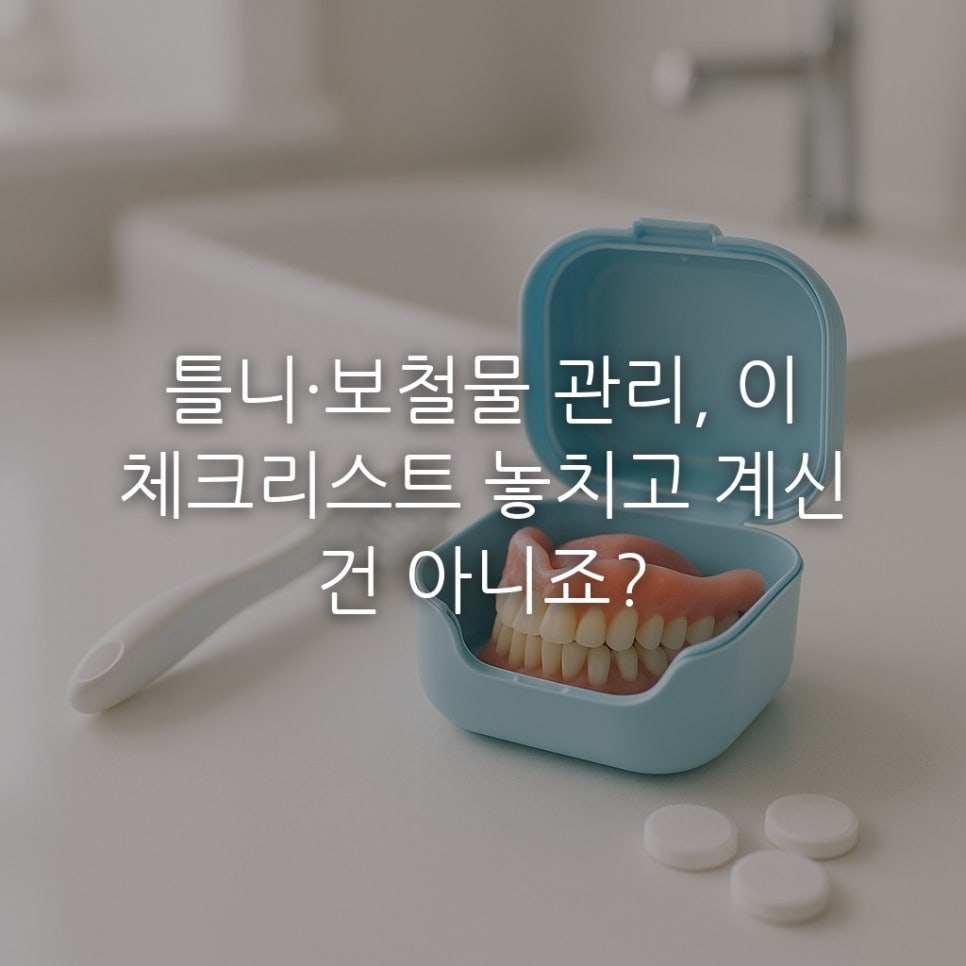
After getting new dentures or prosthetic restorations, many people take extra care of them for the first few days, but gradually become less diligent over time. Some simply scrub them roughly with a toothbrush and put them away, while others rinse them only with water without using a cleanser. The problem is that when these small habits accumulate, they can affect not only odors and staining but also the lifespan of the prosthesis. Today, let’s go through commonly overlooked care points one by one in checklist format. Comparing them with your own care routine may be helpful.
First, here is a checklist for cleaning habits. Are you rinsing them under running water at least twice a day and always after meals? Are you using a denture-specific cleanser or a soft brush instead of regular toothpaste? Start by checking these two points again. Regular toothpaste contains abrasives that can leave tiny scratches on the surface of a prosthesis, making it easier for bacteria and stains to adhere in those spaces. Some people also clean their dentures with hot water, but depending on the material, this can cause deformation, so lukewarm water is safer.
Cleaning with hot water and using regular toothpaste are common causes of prosthesis deformation and scratches.
The second checklist concerns storage and handling habits. Check whether you leave your dentures out to dry at night or keep them immersed in a dedicated solution or water. Leaving them dry for a long time can increase the risk of cracking or deformation. Dentures are also more often damaged than you might expect when dropped while being washed over a sink. When cleaning them, it is a good idea to do so over a sink filled with water or to place a towel underneath. Rinse the storage case every day as well to prevent bacteria from building up.
The third checklist covers fit and pain. Check for yourself whether you have recently felt pressure or pain on your gums, or whether the dentures feel looser or more unstable than before when chewing. Because each person’s jawbone condition gradually changes over time, prostheses that fit perfectly when first made can commonly become loose. Rather than continuing to wear them by force, this may be a time when adjustment is needed, so it is better to have the fit checked regularly at a dental clinic.
Changes in fit are natural, but leaving them unaddressed can lead to gum inflammation.
Fourth, let’s look at a checklist for lifestyle habits. Check whether you are being careful when eating hard or sticky foods, and whether you clean your dentures promptly after smoking or consuming dark-colored beverages. Hard foods such as squid or nuts can place stress on a prosthesis, while dark-colored foods and drinks such as coffee or red ginseng can accelerate staining. Removing your dentures before bed to let your gums rest is another habit that is easy to forget. The gums also need a break after being under pressure all day.
There are several questions that frequently come up when discussing care. One common question is whether a cleanser must be used every day. Daily use can help manage staining and bacteria. Another frequent question is whether it is okay to continue using dentures when they feel loose. If looseness is left unaddressed, the surrounding gums may be continually irritated, which can lead to inflammation, so the condition should be checked. People also sometimes ask whether a broken part can be fixed with super glue. Commercial adhesives often contain ingredients that have not been verified for use inside the mouth, so this is not recommended.
After going through the checklist point by point, you may have realized that you were overlooking more than expected. Care is an area where small daily habits build up to produce results, so rather than trying to do everything perfectly, it may feel less burdensome to start changing one thing at a time today. For aspects that are difficult to judge yourself, such as changes in fit or damage, it is best to consult a dental professional to check the condition.
Sinchon Dain Dental Hospital Mapo provides dental care related to dentures and prosthetic restorations, and offers consultations for those who need fit adjustments or condition checks.
Not all prostheses are made from the same material. There are various types, including partial dentures with metal frameworks, complete dentures made entirely of resin, and prosthetic restorations connected to implants, and their care methods differ somewhat as well. Metal frameworks are sensitive to corrosion, so soaking them for a long time in salt water or a strong cleanser can dull their shine and cause discoloration. Resin, on the other hand, is absorbent, so components from dark-colored foods can seep into the material, making stain management more important. Implant prostheses are secured with screws, so food can easily become trapped around the areas that meet the gums. These areas can be managed more effectively with auxiliary tools such as an interdental brush or Waterpik than with a regular toothbrush. If you are not sure exactly what material your prosthesis is made of, it is recommended that you review the information provided when it was first made. Caring for it without knowing the material can sometimes worsen damage during the cleaning process.
Choosing a cleanser can also be more confusing than expected. Since there are so many types in supermarkets and pharmacies, some people simply pick up any product, but it is a good idea to develop the habit of checking the ingredients. Products containing strong abrasives can create microscopic scratches that are not visible to the eye, making it easier for odor-causing bacteria to settle in those spaces. Foaming cleansers are convenient, but rather than using them every day, limiting them to about two or three times a week and combining them on other days with physical cleaning using lukewarm water and a soft brush places less strain on the material. Some people try to substitute a strongly scented product for cleaning, but it is worth remembering that fragrance only masks odors and is separate from actual bacterial removal.
Using cleansers with different ingredients and strengths in rotation, rather than the same product every day, can reduce material damage.
Lastly, let’s talk a little more about regular checkups. After having a prosthesis made, it is common for people to leave it unchecked for several years after the first one or two follow-up visits if they do not have any particular discomfort. However, the jawbone continues to change shape with age, and the rate of change differs from person to person. Even when there is no noticeable discomfort, small gaps may be gradually forming underneath. These gaps can become pathways for food to become trapped, and as bacteria settle in, they can easily lead to odors and inflammation. Checking the condition every six months to one year is generally recommended. For people with conditions that affect jawbone metabolism, such as diabetes or osteoporosis, it is safer to set shorter checkup intervals. A checkup does not necessarily mean that major treatment is needed every time; in many cases, the fit is checked and the visit ends with only minor adjustments. Rather, leaving the issue unaddressed is more likely to develop into a larger problem, such as gum inflammation or a broken prosthesis. Even without significant discomfort, regularly checking the condition can ultimately help extend the life of the prosthesis.

We often hear people say that their prosthesis smells, and when the causes are examined one by one, most are related to cleaning habits. Even when the outside appears clean, the inner surface that touches the gums has tiny irregularities that are difficult to see, and food particles and bacteria settle in between them. In particular, if the habit of doing a quick cleaning before bed and then falling asleep while still wearing the dentures is repeated, the odor may gradually become stronger. After cleaning, lightly shake off the excess water before placing them in the case, and periodically boil the case or rinse it with a cleanser as well to help prevent the odor from returning.
Care can become even more lax when going out or traveling. Even people who clean regularly at home may skip it in unfamiliar surroundings because water is not readily available or they did not bring a cleanser. It is a good idea to make a habit of packing a travel pouch with a mini cleanser and a soft brush. On days involving long periods of travel or strenuous activity, such as hiking, chewing for a long time with a loose prosthesis can cause irritation to build up in the gums, so even simply rinsing with water from time to time can reduce the burden. During flights or long-distance bus trips, some people may find their prosthesis feels stiffer because dry conditions reduce saliva production in the mouth. In such cases, drinking water frequently may help.
The more often you travel or spend time away from home, the more important it is to make a habit of packing your cleaning tools separately.
Many people naturally produce less saliva as they age, and this is more closely connected to prosthesis care than you might expect. Saliva helps inhibit the growth of bacteria in the mouth and wash away food particles. When saliva production decreases, bacterial film can form more quickly on the surface of a prosthesis, and it may also feel stiffer when worn. Some people taking certain medications experience dry mouth as a side effect. In this situation, drinking water frequently and chewing sugar-free gum to encourage saliva production may help. Wearing a prosthesis for a long time when the mouth is dry can easily irritate the gum tissue and cause sores, so it is safer to develop the habit of rinsing it a little more frequently than usual.
The more severe the dry mouth, the more attention should be paid to prosthesis comfort and bacterial management.
When discussing care habits, it becomes clear once again that the small actions repeated every day ultimately affect the lifespan of a prosthesis. Rather than leaving seemingly minor changes such as odor, fit, or dryness unaddressed, checking them as they arise is a much better way to maintain comfortable wear over the long term. If there is something you are unsure how to judge yourself, having the condition checked and reassessing your care routine is another option.