Hello, this is Greeny Dermatology!
When winter comes, the cold wind and dry indoor environment can easily cause the skin to lose elasticity.
In particular, as we age,
collagen and elastin decrease, making wrinkles
more pronounced and sagging more noticeable.
Because it is difficult to address these changes
with moisturizing alone,
more people are looking for a more fundamental way
to improve elasticity.
Let’s take a closer look at the details through a news article!
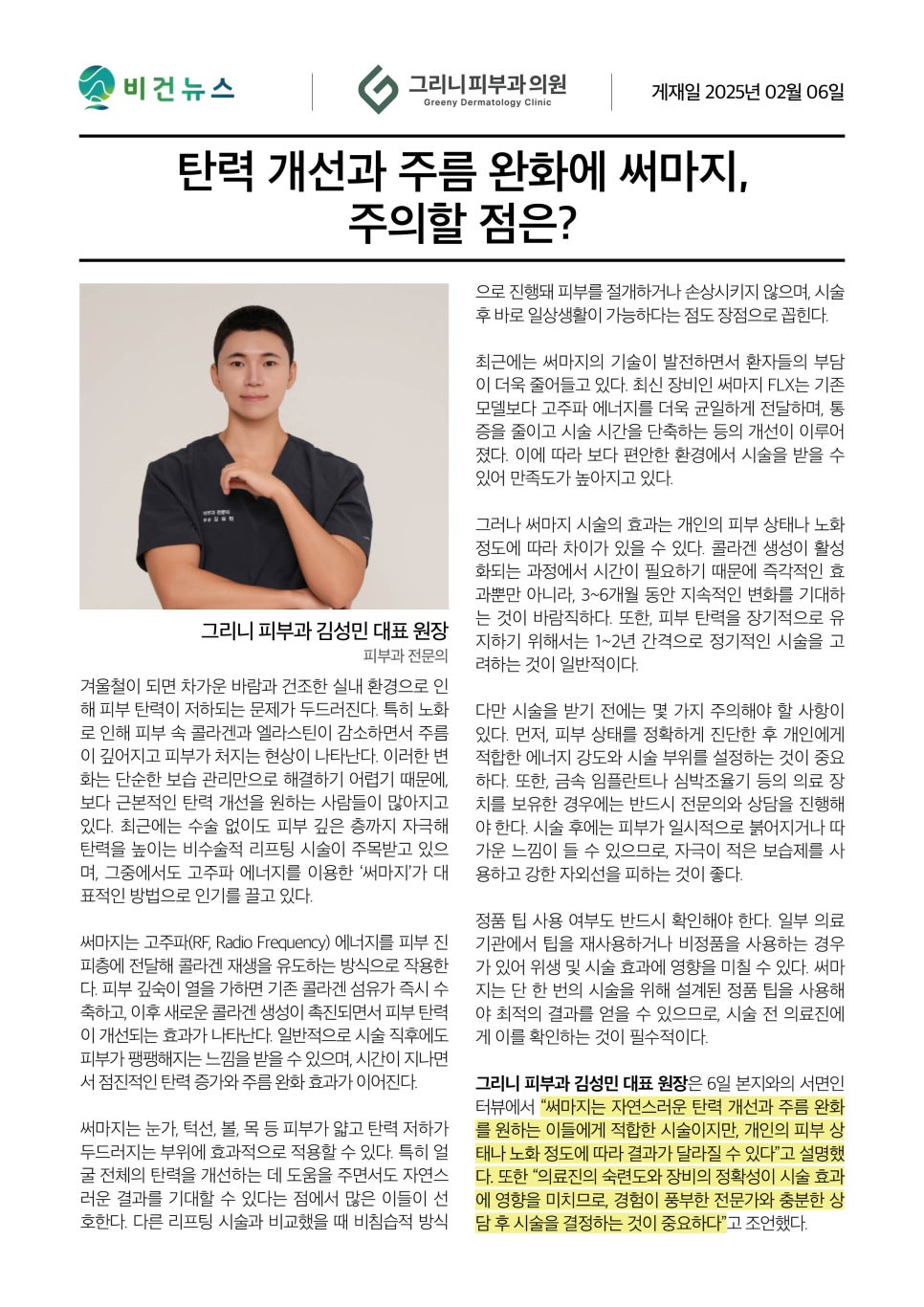
During winter, reduced skin elasticity becomes more noticeable due to cold winds and dry indoor environments. In particular, as aging reduces collagen and elastin in the skin, wrinkles become deeper and sagging occurs. Because these changes are difficult to resolve with moisturizing care alone, more people are seeking a more fundamental improvement in elasticity. Recently, non-surgical lifting procedures that stimulate the deeper layers of the skin without surgery have been drawing attention, and among them, “Thermage,” which uses radiofrequency energy, has become a popular representative option.
Thermage works by delivering radiofrequency (RF) energy to the dermal layer of the skin to induce collagen regeneration. When heat is applied deep within the skin, existing collagen fibers contract immediately, and as new collagen production is then stimulated, the skin’s elasticity improves. In general, patients may feel their skin become tighter right after the procedure, and over time, gradual improvements in elasticity and wrinkle reduction follow.
Thermage can be effectively applied to areas where the skin is thin and loss of elasticity is more noticeable, such as around the eyes, the jawline, the cheeks, and the neck. In particular, many people prefer it because it helps improve the overall elasticity of the face while still allowing for natural-looking results. Compared with other lifting procedures, it is performed in a non-invasive manner, without incisions or skin damage, and another advantage is that daily life can resume immediately after the procedure.
Recently, advances in Thermage technology have further reduced the burden on patients. The latest device, Thermage FLX, delivers radiofrequency energy more evenly than previous models, with improvements such as reduced pain and shorter procedure times. As a result, patients can undergo the procedure in a more comfortable environment, leading to higher satisfaction.
However, the effectiveness of Thermage treatment may vary depending on an individual’s skin condition and degree of aging. Because the process of collagen production takes time, it is advisable to expect not only immediate effects but also continued changes over 3 to 6 months. In addition, to maintain skin elasticity over the long term, it is generally common to consider regular treatments at 1- to 2-year intervals.
That said, there are several precautions to keep in mind before undergoing the procedure. First, it is important to accurately diagnose the skin condition and then set the appropriate energy level and treatment area for each individual. Also, if you have a medical device such as a metal implant or pacemaker, you must consult a specialist. After the procedure, the skin may temporarily become red or feel stinging, so it is advisable to use a low-irritation moisturizer and avoid strong UV exposure.
It is also essential to check whether genuine tips are used. Some medical institutions may reuse tips or use non-genuine ones, which can affect hygiene and treatment effectiveness. Since Thermage must use genuine tips designed for a single treatment to achieve optimal results, it is essential to confirm this with the medical staff before the procedure.
Kim Seong-min, CEO of Greeny Dermatology, explained in a written interview with this publication on the 6th, “Thermage is a suitable procedure for those who want natural improvement in elasticity and wrinkle reduction, but the results may vary depending on an individual’s skin condition and degree of aging.” He also advised, “Because the expertise of the medical staff and the accuracy of the equipment affect the treatment results, it is important to decide on the procedure only after sufficient consultation with an experienced specialist.”
▼ Go to the news article ▼