Hello, I’m Kim Tae-yoon, the chief director of Shinseong Dental Clinic.
Today, I’d like to talk about inlay treatment.
First, let me briefly explain what inlay treatment is.
When a tooth has a cavity,
the decayed area is removed,
and a filling is made in the same shape
as the portion of the tooth that was removed.
That filling is then fitted into the tooth.
This is a treatment procedure
that restores the tooth’s shape.
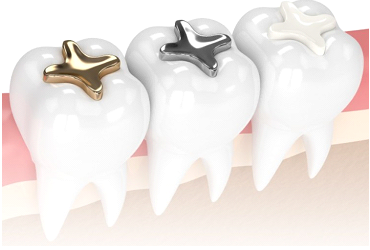
If you look at this image, it will be easy to understand.
The filling that is fitted into the tooth like this
is called an inlay.
As shown in the image, there are also various materials
used for inlays.
Gold, resin, ceramic, hybrid types, zirconia, and more.
They are all excellent materials.
However, among them, there is one material
that should not be used for inlays.
That is zirconia inlays.
Let me explain with a case.
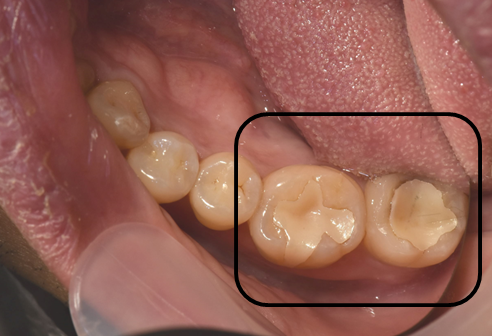
This patient visited the clinic recently because of discomfort while eating.
The black square is an inlay that had been treated a few years ago,
and it was a shocking inlay.
It was an inlay made of zirconia,
and the margins were all open.
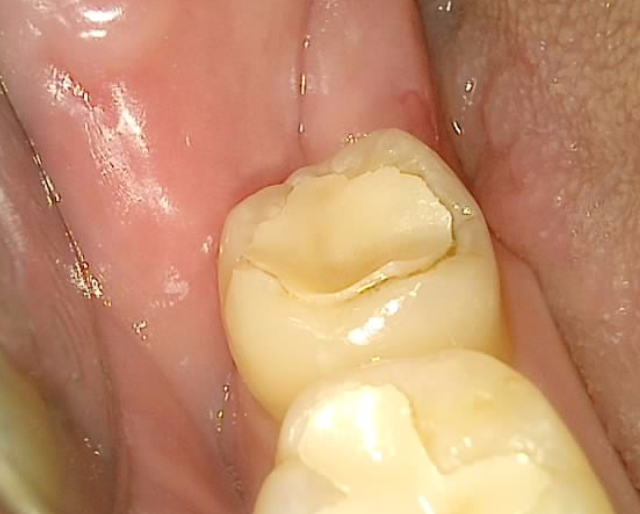
From the side, the open margins were even more obvious.
Both teeth had inlays that were not fitting properly,
but
the patient wanted treatment only for the backmost molar,
so we first proceeded with treatment on that tooth only.
(Leaving the inlay on the front tooth as it was
was honestly very uncomfortable for me...)
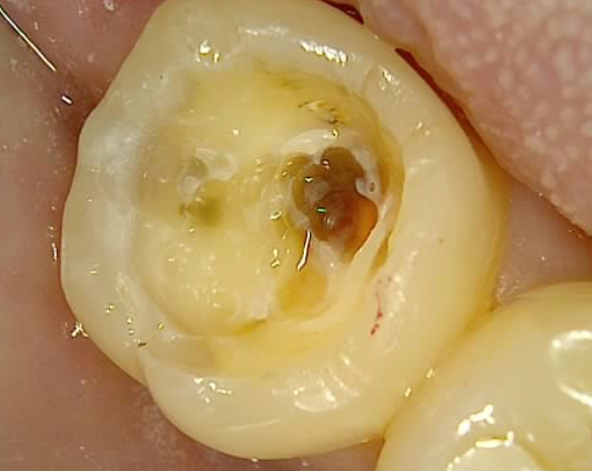
After removing the inlay,
as expected, there was significant decay inside the tooth.
Fortunately, the cavity had not reached the nerve,
but if it had been left a little longer,
root canal treatment would have been necessary.
This is why an inlay needs to fit the tooth well.
If the fit is poor,
food debris and bacteria can enter through the gap,
causing secondary decay.
In such cases, decay develops in the dentin inside the tooth,
and because dentin is vulnerable to decay,
the cavity progresses more extensively and rapidly.
Zirconia itself is such a strong material
that, at least for now, it is difficult to make fine adjustments
to achieve proper inlay fit.
And because of the material’s properties, it does not bond to the tooth,
so it cannot become a single unit with the tooth.
For an inlay, it is important that it becomes one piece with the tooth,
but if it cannot integrate completely with the tooth,
it may actually cause cracks in the tooth,
make secondary decay more likely,
and shorten the lifespan of the inlay.
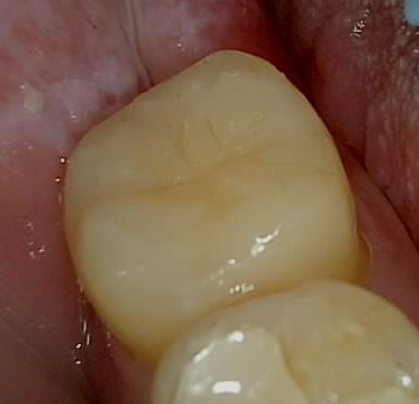
This is a photo after the treatment was completed.
You can see an inlay that has become completely one with the tooth.
At our clinic, we mostly use inlays made of a ceramic material called Lithium Disilicate,
which is the closest to natural teeth.
Zirconia is undoubtedly an excellent material
for crown prosthetic treatment.
I also make most crown restorations with zirconia.
However, it still seems like an unsuitable material
for inlay treatment.
That said, with recent digital equipment,
it can be fabricated in a short time,
so zirconia has been used for inlays more often.
If zirconia is listed among the material options for an inlay,
or if you are recommended a zirconia inlay,
please be sure to choose another option.
Thank you for reading this long post.
I hope this article was helpful! ^^