Nose surgery experience, revision rhinoplasty review
[Non-implant nasal bridge rhinoplasty + nasal tip alar cartilage correction
- Partial resection of the depressor septi nasi muscle]
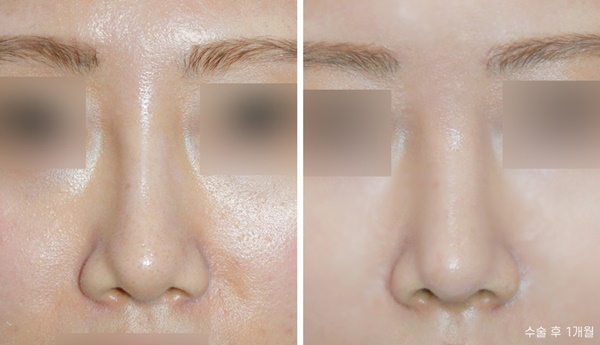
This patient was bothered by the fact that the nose looked pinched from the front
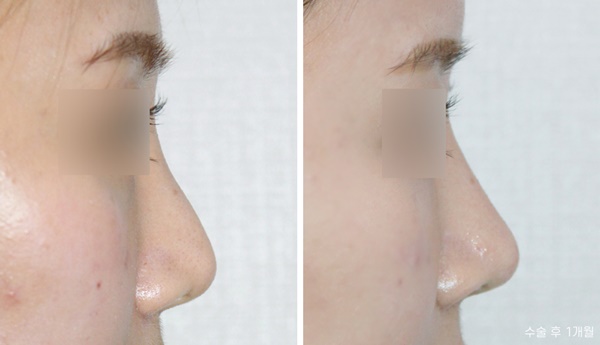
and that the nasal tip looked droopy,
so they wanted correction of these areas.
When the nose looks pinched from the front,
it is because the appearance of the front edge of the alar cartilage inside the nose
is visible through the skin.
In this case, the alar cartilage is repositioned
(at this time, it is moved toward the front or outward.)
Or, if the alar cartilage is weak,
a method of reinforcing it by adding ear cartilage on top of it
is used for correction.
In particular, in surgery to correct a bulbous nose,
if the lower alar cartilage is tightly sutured,
it can become an artificially pinched nose due to surgery,
as in the preoperative photo.
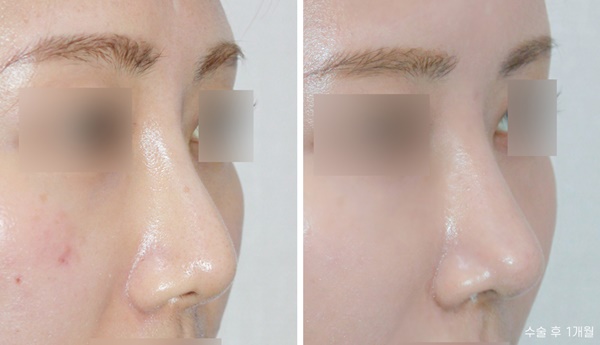
In this case as well, correction can be done using methods such as
repositioning the alar cartilage or reinforcing the cartilage.
A droopy nasal tip, when viewed from the side,
looks like the beak of a bird hanging downward;
if this becomes more severe, it can even resemble a congenital hump nose.
The method of correcting this is similar to correcting a congenital hump nose.
However, since this patient did not appear to have a pronounced hump,
the hump was not removed,
but some of the soft tissue under the thick skin above the nasal tip
was removed, and the weak columella was reinforced using septal cartilage or
autologous cartilage.
As in this revision rhinoplasty case,
when it is difficult to lift the nasal tip a lot,
non-implant rhinoplasty is recommended.
As expected, this patient had weak alar cartilage,
poor columellar support, and a strong depressor septi nasi muscle
(when the depressor septi nasi muscle is strong,
the nasal tip drops especially much when smiling),
so the alar cartilage and columellar support were operated on using autologous cartilage,
and part of the depressor septi nasi muscle was resected
to complete the revision rhinoplasty and correct the issue.
At this time, caution is needed when resecting the depressor septi nasi muscle.
If too much is removed,
the smile can look unnatural,
so the surgery must be performed carefully.
This has been a revision rhinoplasty review by Dr. Yoon Hyun-cheol of N+.