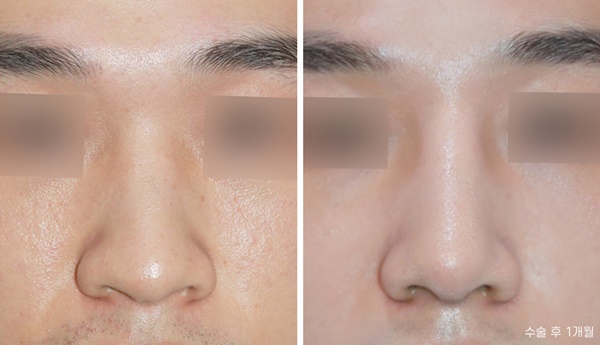
[Hump Nose Surgery: Osteotomy + Functional Rhinoplasty for Septal Deviation and Asymmetry Correction]
This patient had a hump on the nose and nasal congestion.
In the case of a hump nose, it is usually due to genetic factors
or a nose injury caused by trauma.
In hereditary cases, the columella is usually short,
and the hump is not severe,
with a somewhat gentle, rounded hump in many cases.
In traumatic cases, the columella is not short,
and the hump is relatively sharp,
with the external nose often deviated or accompanied by internal septal deviation.
In trauma patients, the injury often happened in childhood,
so facial asymmetry may also be present.
Most patients do not remember the accident,
because it happened when they were young.
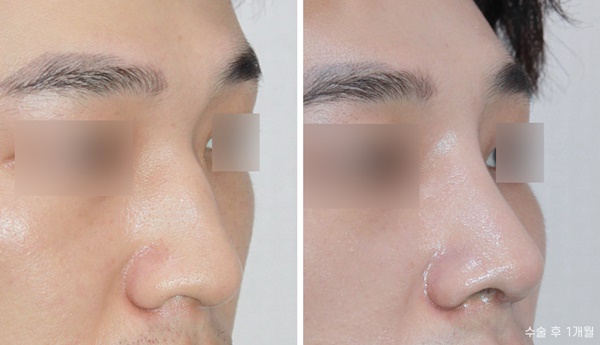
This patient also had no memory of trauma, but
had internal septal deviation,
which made breathing through the nose difficult,
and asymmetry of the external nose could be confirmed.
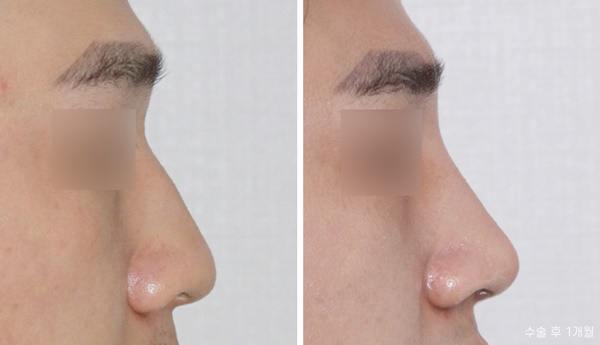
On the other hand, the columella was relatively short,
so it was thought that a combination of genetic factors and trauma
had caused the hump.
Septal deviation and nasal valve reconstruction were performed
to complete the functional rhinoplasty,
and using spare septal cartilage and ear cartilage,
the drooping nasal tip was lifted and hump removal osteotomy was performed
to complete correction of the hump nose and deviated nose.
To raise the bridge of the nose slightly, about 3 mm
of silicone was used to elevate the nasal bridge.
- A+ Dr. Yoon Hyun-cheol Hump Nose, Functional Rhinoplasty Review -