
It is said that it takes only 3 seconds
to decide a person’s first impression.
In particular, the nose is at the center of the face,
so it is one of the features that has a strong influence
on the overall image.
Many people look into reviews of tip surgery
because a person’s impression can change depending on
the shape or length of the nose.
In particular, when the tip droops and makes the nose look long,
it can make someone appear older,
so many people seem to want to escape the image of looking older than their age.
In such cases, improvement is possible through hooked nose correction,
and at N Plus, the procedure does not simply end with
correcting the length of the nose.
It is performed using N Plus’s own surgical method.
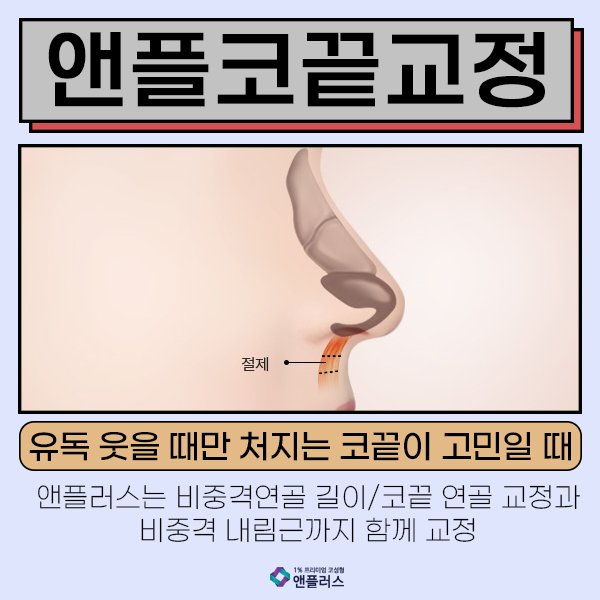
When the nasal tip droops, it is usually because the septal cartilage
has developed more than average, making the nose
longer overall, or because of the development of the lower lateral cartilage at the tip.
So at N Plus, when performing hooked nose correction,
we not only correct the length of the septal cartilage and the tip cartilage,
but also the depressor septi nasi muscle, which pulls
the tip downward.
For example, let me explain with the before-and-after photos below.
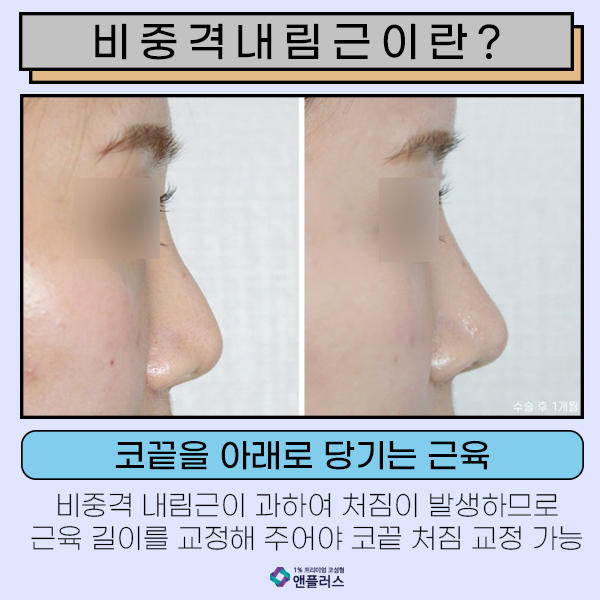
The photo above is a case in which the depressor septi nasi muscle was corrected.
If the tip drooping is not severe when the face is at rest,
but the tip drops a lot when smiling,
the depressor septi nasi correction should also be performed.
The depressor septi nasi refers to the muscle that pulls the tip downward,
and because drooping occurs due to excessive action of this muscle,
its length is also corrected.
After correcting the depressor septi nasi muscle,
it is possible to create a nasal tip that does not droop even when smiling.
Therefore, in the before-and-after case above as well,
the tip was corrected together with the depressor septi nasi muscle.
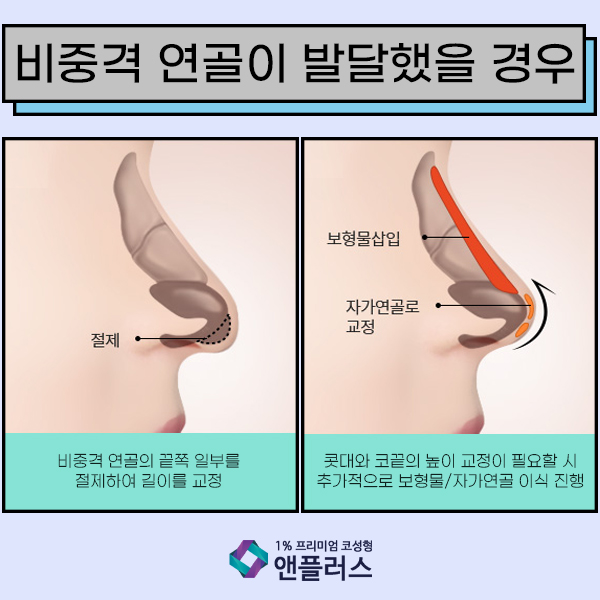
Also, in cases where the tip droops like a hooked nose,
the methods for hooked nose correction can be divided into three types.
First, after resecting part of the tip end of the septal cartilage
to correct the length, if additional correction of the bridge and tip height is needed,
an implant/autologous cartilage is grafted.
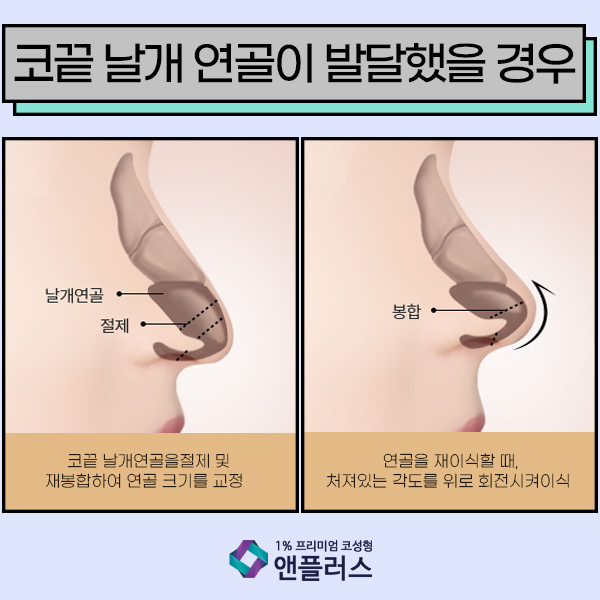
Second, if the lower lateral cartilage at the tip is developed,
the lower lateral cartilage is resected and sutured again to correct the size of the cartilage,
and when the cartilage is re-grafted, it is corrected by rotating the drooping angle upward before grafting.
At this time, if the lower lateral cartilage is tied too tightly,
the surgery may make the nose look artificially pinched,
so this part also needs to be handled carefully.
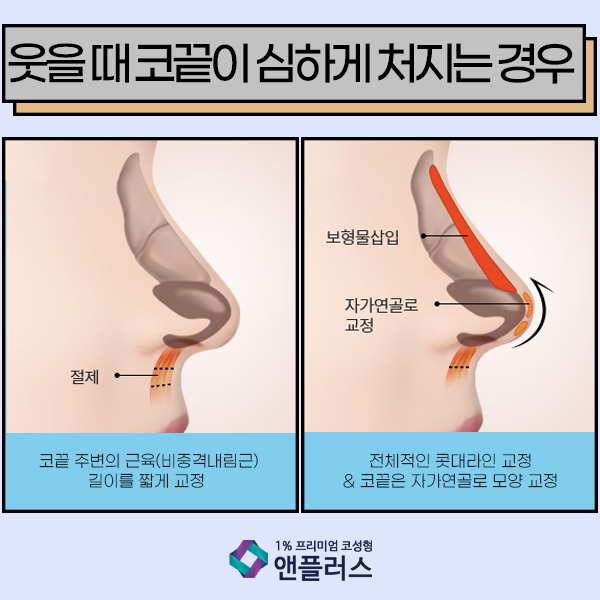
Third, when the tip droops severely while smiling,
the length of the muscles around the tip (the depressor septi nasi muscle) is shortened and corrected,
and the overall bridge line is corrected, or the tip shape is refined with autologous cartilage
to complete the hooked nose correction.
 Hooked nose correction varies depending on an individual’s nose length, height, and other factors,
and if the reason the nose looks long is that the midface itself is long,
we recommend visiting a clinic and deciding on a specific surgical method
through detailed examinations such as a CT scan.
Thank you.