Will It Be Restored If the Implant Is Removed After Nose Surgery?
Hello. For 15 years, OJIKO N Plus has been dedicated only to your beautiful and healthy nose.

Before surgery, you may finally make up your mind, go through a consultation, and have the procedure, and the result may not be bad either.
However, some people may not be able to adjust to their slightly changed appearance, or may think of cosmetic surgery too lightly and want to remove the implant.
So we brought up the topic: Can your nose go back to its original shape if the implant is removed after nose surgery?
Many people ask questions like, 'If the silicone is removed from the bridge implant, won't the skin become loose?'
But this is nothing to worry about.
Because skin is elastic, even if the volume decreases, the skin soon adheres again and
can remain in its original shape.
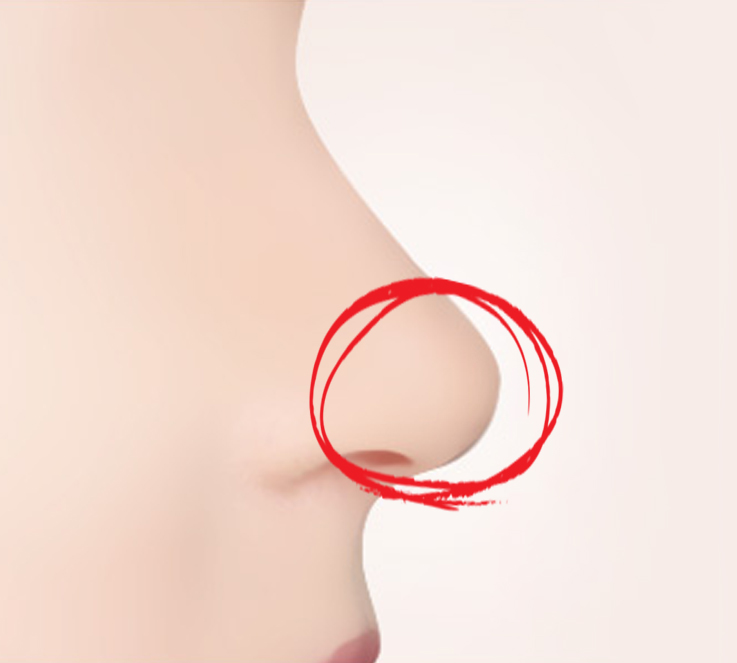
One issue, however, is the tissue at the nasal tip.
To shape the nose, the cartilage at the tip may be separated and refined,
and septal cartilage, ear cartilage, or autologous rib cartilage may be grafted inside the nose.
Sometimes people may feel discomfort because of the inherent hardness of the cartilage itself,
and for various reasons the implant may be removed.
In such cases, will it return to the way it was if the implant is removed?
To put it first, 100% restoration is difficult.
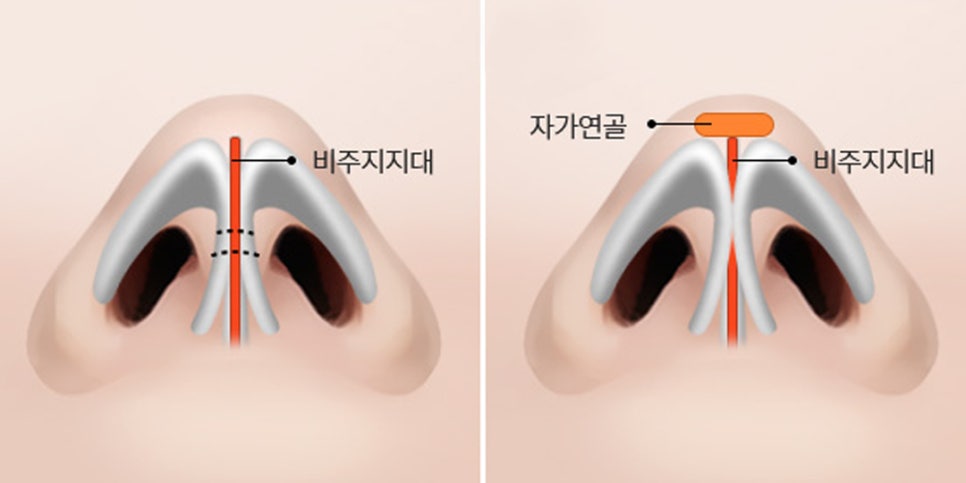
The image above explains the process of OJIKO N Plus nasal tip correction surgery.
During nasal tip surgery, the originally firm tissues are loosened, cartilage is grafted, and then brought back together,
so if that cartilage is removed, the tissue's supporting strength becomes weaker to some extent.
That is why we try to re-tie the cartilage, reposition it, and restore it as close to the original shape as possible, but there are limits.
Therefore, we explain to patients that only about 80% to 85% can be restored.
Then how will it differ from before surgery?
It may vary depending on the shape you had before surgery or the condition of your skin.
First, if the nose was small, short, and upturned, it may become a little shorter and smaller than before,
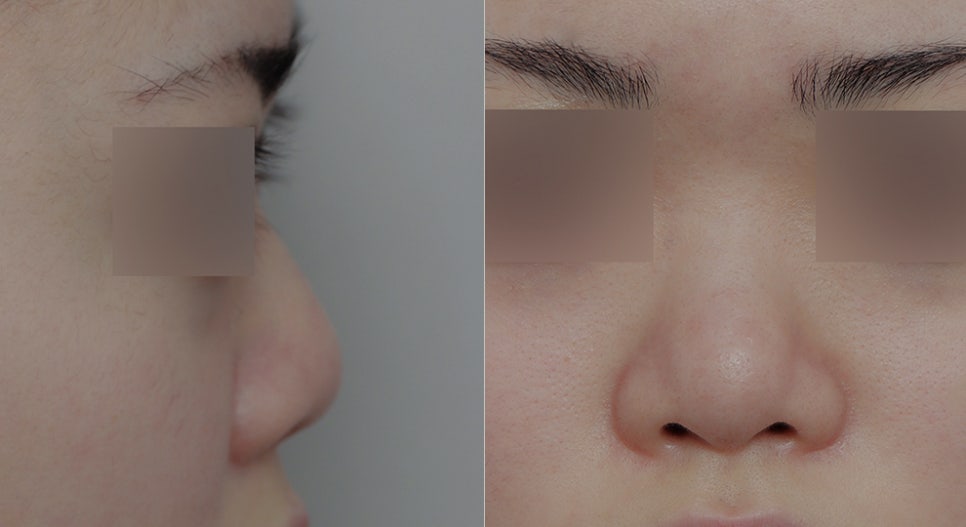
The image above shows a preoperative image of an actual patient who underwent upturned nose surgery at OJIKO N Plus.
Second, if the nasal tip is broad and thick, the supporting strength weakens, so it may become broader and wider than before.
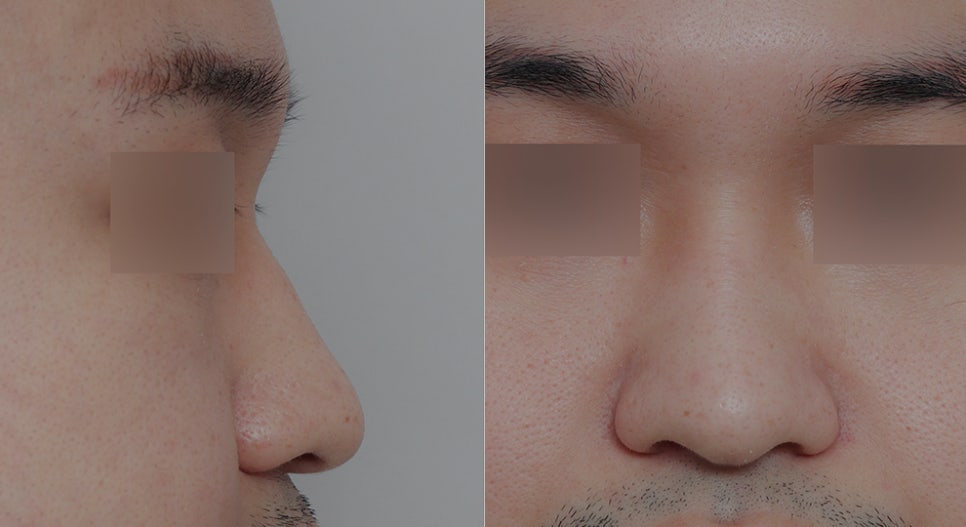
The image above shows a preoperative image of an actual patient who underwent bulbous nose surgery at OJIKO N Plus.
Of course, before that, cartilage repositioning is also performed to restore the shape as much as possible.
But it does not return to the original state.
That is why we recommend carefully considering cosmetic surgery as much as possible.
Also, after surgery, some people may have difficulty adjusting to the changed appearance.
After surgery, when your appearance changes, you may be startled every time you look in the mirror.
It usually takes about 3 to 4 months to adjust to the changed appearance.
Until that time, it can be very confusing, but before enough time has passed, it is not the final appearance.
Therefore, if there are 10 patients who have had surgery, more than 8 or 9 of them say they are glad they did not remove it at that time and waited.
Sometimes, there are people who request revision surgery, saying, "I heard it will be okay if I have reoperation within two weeks, so please do it quickly."
That '2 weeks' means that when you undergo surgery, normal tissue is injured.
For example, if you cut your hand with a knife, the wound swells. After a certain amount of time, only the line where it was injured remains faintly,
and the swelling during the middle process happens because scar tissue forms (a hard, swollen mass due to excessive tissue growth, etc.).
The process of scar tissue formation is generally seen from 2 weeks to 6 months.
So for revision surgery, we tell patients to do it before 2 weeks or after 6 months.
But does that mean it will always be fine? No, it does not.
Revision surgery means injuring again the area where normal tissue has already been injured once,
so more scar tissue forms at the surgical site and more damage occurs.
To be honest, the less revision surgery you do, the better.
If you cannot adjust to your appearance after surgery, do not take revision surgery lightly,
and it is important to make a careful decision.
Some people consider revision surgery because the nose shape is pretty and suits their face well, but they feel it is not the current trend.
Rather than copying a celebrity nose shape or a trendy nose shape,
the most important thing is a nose that suits your own face well.
The more revision surgeries you have, the more severe the tissue damage becomes, and later it will show on the surface and become noticeable.
To emphasize once again, it is important to make a careful decision about revision surgery.
What causes inflammation?
The causes of inflammation are truly diverse.
The most common case is when bacteria multiply and cause inflammation.
Next, for example, when we twist an ankle, it is called a sprain (when ligaments or muscles are stretched or partially torn due to external impact, etc.),
and even when bacteria are not infected, swelling and heat in that area are also called inflammation.
Such a reaction can also occur in the nose.
You can think of a case where there was no problem after surgery, but the bridge of the nose swells 1 to 2 years later.

Our nose normally has bacteria.
That is why, during surgery, we disinfect, receive preventive antibiotic injections,
and repeatedly rinse the nose during the procedure to reduce the number of normally present bacteria as much as possible.
Even so, in some cases bacteria may multiply significantly.
For example, inflammation can occur for various reasons such as blood collecting inside the nose or secretions inside the nose getting in.
If the inflammation is mild, it may disappear or improve with oral medication or injection treatment,
and if it is a little more severe, it may improve with irrigation in the operating room.
However, if the symptoms are severe, there are cases where only the inflamed area is removed and revision surgery is performed after allowing enough time.
Are there cases where the implant must definitely be removed?
There are cases where the implant must be removed after surgery.
That is when the inflammation mentioned above occurs.
As mentioned above, if the symptoms are mild, they may be relieved with medication, injections, or irrigation, but
if the symptoms do not improve even with the treatments above,
it is inflammation caused by the body recognizing the implant as a foreign body.
Usually, silicone used in nose surgery is recognized by the body as a foreign body,
and even when autologous materials are grafted, they may be recognized as foreign bodies unless vascular tissue grows in.
In these two cases, it is correct to remove the implant.
Also, in cases of excessive height or insufficient height due to cosmetic dissatisfaction, the implant may be replaced.
Up to here, we briefly introduced the topics of implant removal after nose surgery, revision surgery, and inflammation.
Thank you^^