Post-Nose Surgery Care
Complete Guide!

Hello. This is N+ Clinic, here only for your beautiful and healthy nose.
Today, we’ve prepared a list of precautions about what you must absolutely avoid after nose surgery.
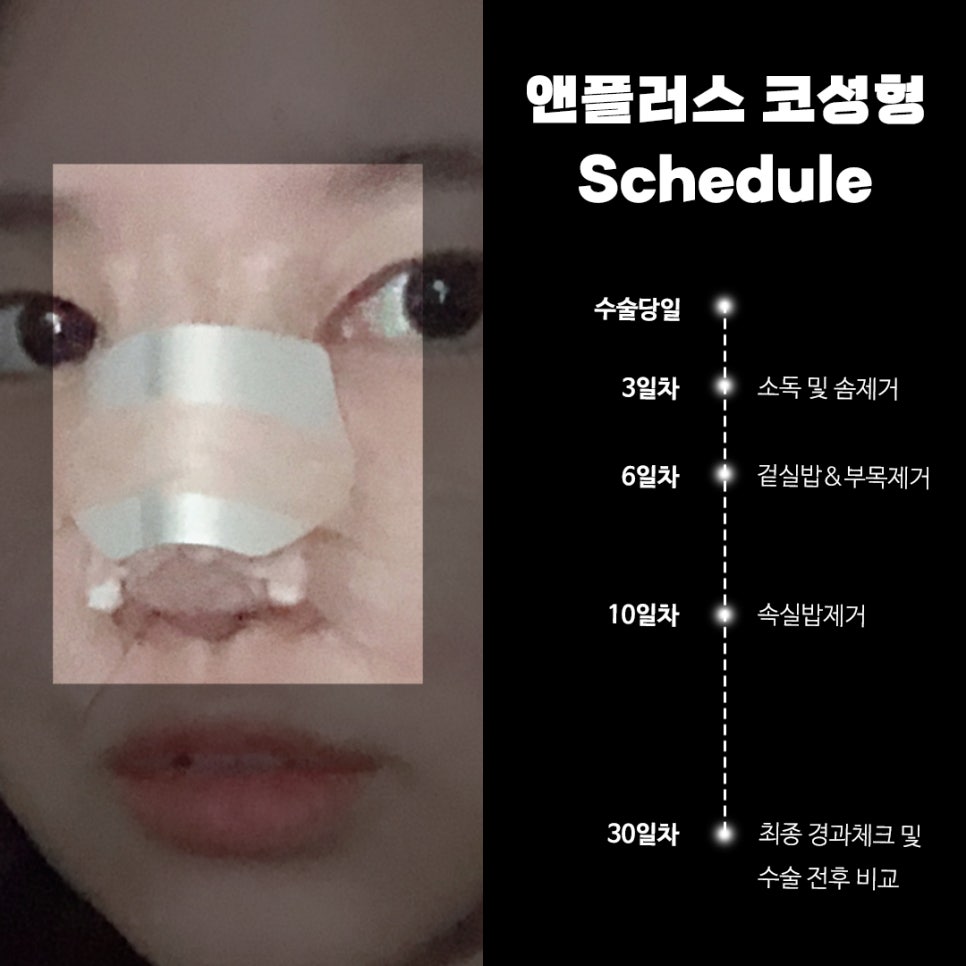
Cotton Removal After Nose Surgery
After nose surgery, cotton is placed inside the nose for about one, two, or three days to prevent bleeding.
Because you have cotton packed inside the nose, it feels very uncomfortable.
Since you have to switch from breathing through your nose to breathing through your mouth, your mouth becomes very dry, and some people also complain of a sore throat. If they cannot tolerate it, some people try to remove the cotton themselves.
The most important thing is that after nose surgery, you must not remove the cotton packed inside your nose on your own.
It must always be removed at the hospital where you had the surgery.
If you remove it carelessly, the surgical site may open, bleeding may occur inside, or inflammation may develop. So even if it feels uncomfortable, you should never remove it yourself.
Removing the Splint After Nose Surgery
Around the 6th day, the splint is removed and the stitches on the outside of the nose are taken out.
You should never remove it yourself.
A splint is used to help shape the nose, and if you remove it on your own, the implant may bend or blood may collect inside.
For people with dry skin, the adhesive part may naturally come off, and sometimes they remove it themselves because it feels bothersome.
In such cases, you should visit the clinic to check whether there is any problem, and then either have the splint reapplied or removed entirely. It is best to proceed only after the clinic has checked your condition.
After nose surgery, there may be bleeding and significant swelling, so the nose can feel very blocked.
Touching the inside of the nose to remove foreign material or blowing your nose are actions you should absolutely avoid.
Even after the stitches are removed, the incision area is still delicate, so doing so may cause the wound to reopen, the implant to bend, or the internal nasal cartilage to bend.
So if it feels really uncomfortable, the proper approach is to contact the clinic and visit the hospital so that the foreign material can be removed clearly and safely.

Exercise After Nose Surgery
Light walking is possible starting after the cotton has been removed from the nose following surgery.
However, for jogging, gym workouts, aerobics, and other strenuous activities involving movement, we recommend waiting one month before doing them.
Blowing your nose or removing foreign material is also something you can consider possible only after one month.
There is also something to be careful about even one month after nose surgery.
Skin care lasers, masks, scrubs, and peels can be done comfortably, but it is best to avoid any pressure on the nose or the area around the nose during acne extraction at a skin care clinic.
This is because excessive pressure on the cartilage supporting the tip of the nose may deform the shape of the tip.
Also, swimming is allowed, but you should be careful when using goggles.
Unlike sunglasses or regular glasses, goggles can place excessive pressure on the implant area, so we recommend wearing them only after at least 2 to 3 months.
For strenuous exercise, and activities such as jiu-jitsu or boxing that many women also do these days, we recommend avoiding them as much as possible because they may affect the surgical area of the nose.
Another frequently asked question is about dental treatment.
In the case of dental treatment, it is generally okay to proceed within 2 to 3 weeks after nose surgery, as long as it does not place a major burden on the nose.
After nose surgery, when you open your mouth wide or smile, you may feel a pulling sensation at the surgical site.
This is because the nose was lifted from a small/low position, which puts pressure on the columella of the nose (the pillar connecting the area from the philtrum to the tip of the nose).
Since skin has elasticity, over time it gradually stretches, and the discomfort or foreign-body sensation slowly goes away.
There is no need to worry too much about that.

Sleeping Position After Nose Surgery
After nose surgery, some people worry so much from the day of surgery that they sleep sitting up or try to keep their head fixed.
However, there is no need to do that at all.
You only need to avoid actions that cause blood to rush to the face to the point that it turns red.
When you sleep, it is of course fine to lie down comfortably.
Moving your head in the way you normally do in daily life is also not a problem.
For people who sleep on their side, you should sleep on your back for at least one week to 10 days after surgery.
This is because the implant has not yet settled and is still somewhat movable, so if you sleep on one side, the implant may shift.
Usually, a splint is kept on for about 6 days after surgery, so that period does not have much effect, but after the splint is removed, the implant may move.
Therefore, even after the splint is removed, it is best to maintain the correct sleeping position for another 5 to 7 days.

Precautions After Nose Surgery for Allergy Patients
People with severe allergies often have a habit of touching their nose without realizing it.
This habit is a very difficult issue, but to say the conclusion first, the answer is not to touch it.
If the surgical area is strongly irritated, the stitches may tear, bleeding may follow, and it can create an environment where bacteria infect the area.
In some cases, the cartilage may bend, the implant may bend, or various other problems may occur.
For allergy patients, not touching it is the correct answer, but for those who find that difficult, the only option is to keep a splint on up to the tip of the nose.
For at least 3 weeks to a month, you should be careful to avoid any stimulation from your hands.
After one month, some side-to-side movement or slight motion is not a problem.
Therefore, after nose surgery, I hope you will follow the above aftercare instructions well and achieve a safer and healthier nose shape.
That concludes my explanation of post-nose surgery care. I hope this article is very helpful for those who are curious about how to care for the nose after surgery. Thank you^^*