
Hello. We are Oji Go & Plus Clinic, thinking only about your beautiful and healthy nose for the past 16 years.
This time, we prepared information about cases where nose acne can appear after nose surgery, along with the causes of this nose acne and how to deal with it.

Why does nose acne appear after nose surgery?

After nose surgery, while the tape is still on, many people do not notice much, but after the tape is removed, many people suffer from nose acne or skin trouble for as short as one month and as long as about seven months.

The reason nose acne appears is that once surgery is performed, the nose area is naturally a place where people try not to touch it too carefully when squeezing sebum from the nose or performing skin care, so there may be areas that are not properly cared for,

and surgery can be seen as a form of tissue injury, during which the tissue becomes damaged.
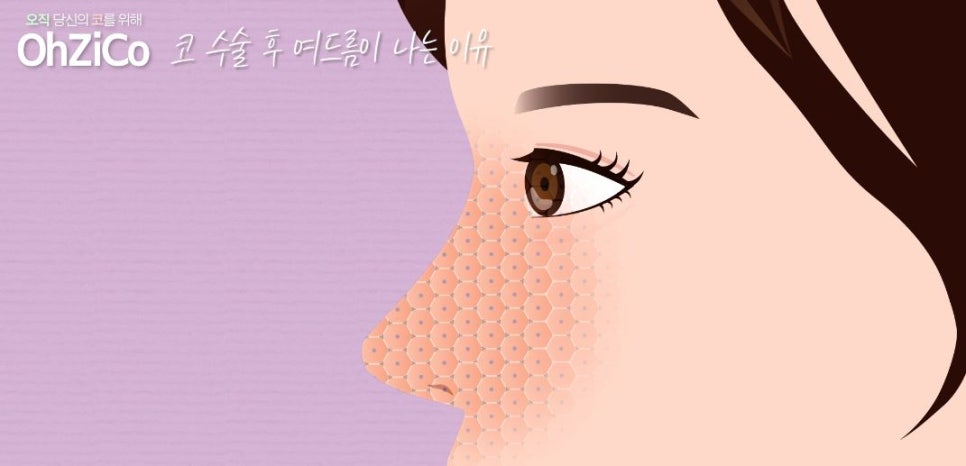
As a result, damaged cells regenerate more quickly and actively in order to return to their previous state. Because of this, the amount of oil produced by the skin increases significantly, and the peeling phenomenon called keratinization also becomes more frequent, so skin trouble or nose acne may become worse. This is also why you need to be careful with washing your face and skin care right after nose surgery.

So how should you deal with nose acne after nose surgery?

After nose surgery, the skin returns to its original condition in as little as one month and as long as three months, so having nose acne is not a problem.

However, in some cases, as part of the body's foreign-body reaction to implants or silicone,

the body tries to push out the implant or silicone.


In such cases, the skin tone may become red along the area where the silicone is inserted, and nose acne or skin trouble may appear especially often in that area.
In these cases, the implant or silicone must ultimately be removed.

After removing the implant or silicone and replacing it with materials such as dermis or autologous rib cartilage, the problem of side effects caused by foreign-body reactions after surgery can be resolved.

Therefore, I can say that a pimple or two on the nasal bridge is not a problem.
However, when acne appears on the tip of the nose, the problem can become larger than expected.
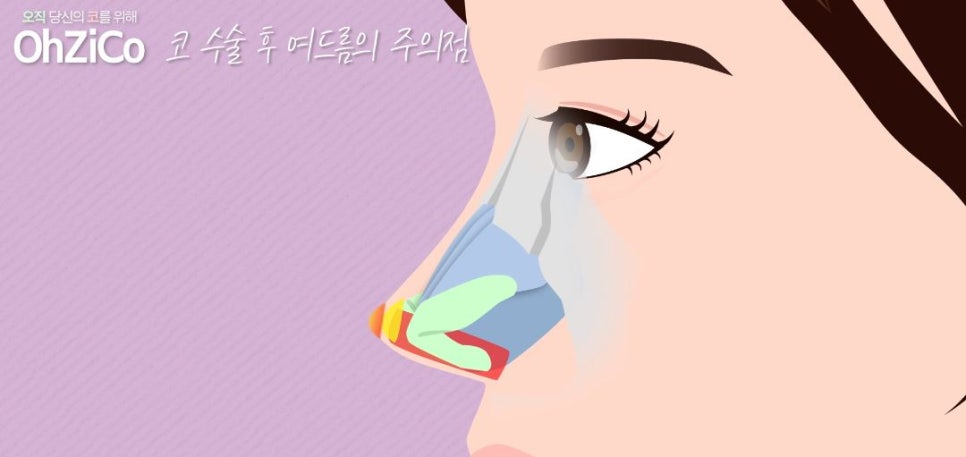
The tip of the nose is directly exposed to pressure, so if the nose acne is small and minor, it is not an issue. But if it is a little larger, it may come into contact with the cartilage support or the transplanted area.

Because nose acne contains bacteria, if those bacteria dig inward, they can cause inflammation.

Another possibility is that what you thought was acne is actually cartilage inside the tip of the nose, or the thread used to secure the cartilage. Although it is eventually absorbed by the body over time, it may irritate the delicate skin area and look like nose acne.

Therefore, if you see skin trouble or nose acne on the tip or bridge of the nose, do not assume it on your own and squeeze it or get treatment right away.

If possible, visit the hospital where you had the surgery, show your current condition to the doctor in charge, and check whether it is related to the surgical site or whether it is okay to treat it. Then receive the appropriate treatment for that situation.

Can squeezing nose acne cause the shape of the nose to become distorted?

To explain what you can do and what you must avoid about one month after nose surgery, from one month after surgery, activities such as exercise, somewhat intense exercise, wearing glasses and sunglasses, blowing or picking your nose, skin care, lasers, masks, scrubs, and peeling are allowed.

The first thing that is best to avoid after nose surgery is wearing swimming goggles. This is because swimming goggles apply excessive pressure to the nose. Therefore, we recommend trying them only after at least three months.

Second, many people visit a dermatology clinic to have acne on the tip of the nose extracted, but since pressure is applied to the nose during extraction, it is best to avoid doing so if possible.

The two reasons mentioned above for what should not be done after nose surgery have one thing in common: they apply pressure to the nose. When nose surgery is performed, the direction of the middle cartilage is changed, support is built, or height is added. If excessive pressure is applied to that area, the cartilage may be damaged, such as by breaking or bending.

Also, if nose acne or bacteria irritate the nose, they can dig inward and cause inflammation. So if acne appears on the nose, you should not squeeze or extract it. Instead, we recommend dealing with it as much as possible with scrubs or peeling.

That concludes our summary of the causes and solutions for how to deal with skin trouble or nose acne after nose surgery. I hope this article is helpful to many of you. Thank you.
https://youtu.be/x0Hnr_BelJk