
Hello. This is OJIKO & Plus Clinic, which thinks only of your beautiful and healthy nose.
This time, we will explain the causes and solutions for cases when a musty smell comes from the nose after nose surgery.

Many people say they notice a smell coming from the nose after nose surgery. After surgery, because they cannot touch their nose, the inside feels stuffy, crust-like secretions build up, it feels dirty, and they also notice an odor.

The reason for a nasal odor during the 1 to 2 weeks after surgery is mostly because crusts and secretions formed at the wound site after surgery stick together, causing the smell.
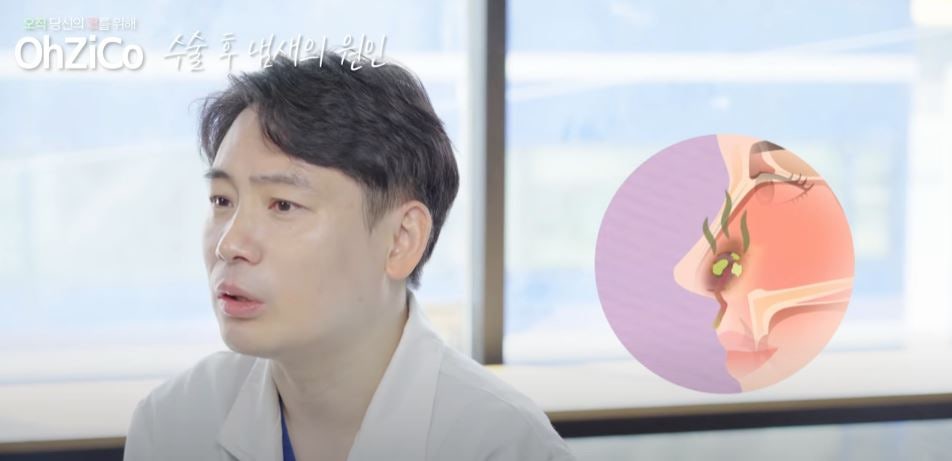
One more thing to mention is that during recovery, some people worry, “Could this be inflammation?” because of the smell. Of course, when secretions or pus-like discharge caused by inflammation are coming out from inside the nose, a smell can also occur.

So when you feel a nasal odor, it is best to receive a detailed examination from the doctor during the treatment process and hear whether it is a problem or a normal part of recovery.

Why does a smell still occur even after a considerable amount of time has passed after nose surgery?

There are cases where a smell comes from the nose not just 1 to 2 weeks after surgery, but even after a month or even 6 months to 1 year. In the first one to two months, when surgery is performed, the mucosa is damaged and injured,

The mucosa inside the nose is not just sitting still; it has tiny structures called “cilia.” These cilia constantly move secretions toward the back of the throat or push them outward for discharge.

However, when you undergo nose surgery, these functions can be damaged and temporarily stop for a fairly long period. When that happens, crusts and foreign substances can build up inside the nose, and secretions can stagnate, which can cause a smell.

In some cases, even after the cilia have recovered, a smell may still occur. In such cases, when the nose is low or short and the tip is raised or lengthened, the surgical method often involves using autologous cartilage and adding it beside the septal cartilage.

If that added cartilage is enlarged, you can see the septal cartilage here, and the added autologous cartilage beside it becomes thicker, creating a gap between them. Secretions and other material can accumulate in that gap. When such secretions build up, a smell can occur.

Therefore, if the surgical area has fully healed, washing it with a clean cotton swab or saline can greatly reduce the smell.

Also, if the step-off between the cartilages is too severe, causing ongoing nasal congestion and excessive buildup of secretions that lead to a strong odor, you may consider revision correction after consulting with the surgeon who performed the operation.

Then, when can nasal irrigation be done, and how long should it continue?

When you undergo nose surgery, both cosmetic and functional aspects are often addressed together. Because of this, people want the stuffiness and related discomfort to improve quickly. Usually, we recommend waiting until the wound area has completely healed, which means at least one month after nose surgery. After one month, we advise making nasal irrigation part of your routine. We explain that rinsing the nose can speed up recovery significantly and help resolve the smell.

Can foreign material in the nose be removed with tweezers?

Some people use tweezers to remove nasal crusts or pluck nose hairs for cosmetic care,

Although this is an extreme case, if inflammation occurs in the blood vessels around the nose in the so-called “Hazard Triangle,” that inflammation can spread directly to the brain.

If you pluck nose hairs with tweezers, wounds can be created in the process, and there is a fairly high chance that the normally present bacteria inside the nose can enter the brain through the bloodstream. Therefore, using tweezers to pluck nose hairs or remove foreign material does not seem advisable.

Today, we explained the causes and solutions for the discomfort caused by a nose odor that can be hard to talk about after nose surgery. I hope this article is very helpful for those who are worried about a nasal odor after surgery. Thank you.
https://youtu.be/GnUyzZwEl6E