
Hello. We are OJIKO Hospital and N Plus Clinic, dedicated only to your beautiful and healthy nose.
This time, we are preparing content about whether existing cartilage can be reused during revision rhinoplasty.

These days, many people undergo rhinoplasty, and many also undergo revision rhinoplasty.

When performing nose surgery, implants and silicone are commonly used for the bridge of the nose, while autologous tissue and autologous cartilage are often used for the tip.
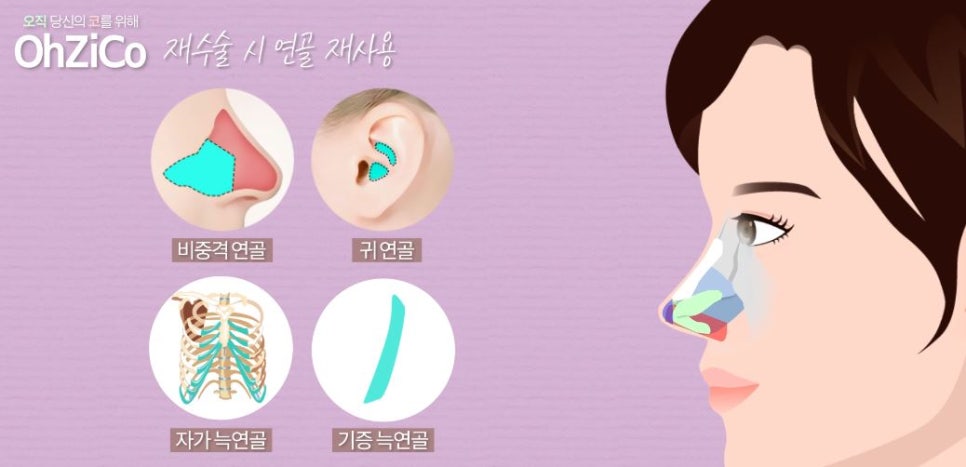
Autologous cartilage includes septal cartilage, ear cartilage, and autologous rib cartilage, and when using autologous cartilage is unavoidable, donated rib cartilage is used.

In general, when autologous tissue is used, there is one piece each of septal cartilage and ear cartilage.

Therefore, from the perspective of someone undergoing revision rhinoplasty, because septal cartilage was used in a previous surgery and cartilage is needed again, many people feel uneasy and ask whether the cartilage used before can be reused.

When it comes to reusing cartilage in revision rhinoplasty, we can say that it may be possible or it may be impossible.

First, the reason people consider revision rhinoplasty is usually to correct issues such as the nose being too high, too low, or upturned even after the first surgery. These issues can have various causes, such as mistakes during cartilage manipulation at the tip of the nose or insufficient cartilage remaining after surgery.

For that reason, when revision rhinoplasty is performed because of a problem, the cartilage that was already used is often difficult to reuse.

Also, even if the cartilage itself is large enough, the shape in which it was used can differ depending on the surgical method of the doctor who performed the procedure. Some may use it thickly, others thin and long, and so on, which can make reuse difficult.

So, for those considering revision rhinoplasty, we recommend consulting and undergoing surgery with the expectation that new cartilage harvest may be needed.

So in what cases can cartilage be reused?

The usual method of using tip cartilage involves using cartilage to build a support column, and then, to add a little more height when building that column, cartilage may be reused for what is called a "cap graft" on the nose, or for a "shield graft" that slightly projects the columella forward.

Cartilage used as a support column is often difficult to reuse. The reason is that it bears load and pressure, and during that process it may warp, be insufficient in size, or be shaped differently depending on the surgeon, making it difficult to reuse.

However, cartilage used as a supplement, such as in a "cap graft," "shield graft," or "cap graft," is often reusable.

To summarize cartilage reuse in revision rhinoplasty: cartilage that serves as a support column should be newly harvested, while cartilage that serves a supplemental role may be reusable.

Which type of cartilage has the highest reusability?


Among the types of cartilage, autologous rib cartilage has high reusability, and septal cartilage can also be reused if it remains relatively intact and large enough. However, ear cartilage is often difficult to reuse because it often crumbles during the dissection process.

At N Plus, when performing revision rhinoplasty, rather than simply reusing or discarding the existing cartilage, septal cartilage is usually placed back in its original position. This is because the septum is one of the main structures supporting the nose, and if it cannot be reused, putting it back in its original place helps restore its original function of supporting the nose.

How much higher can the nasal tip be made during revision rhinoplasty?

That varies greatly from person to person. The reason is that it depends on the condition of the nasal skin and on the current size of the nose.

Therefore, if the elasticity of the nasal skin is high and it can stretch sufficiently, and if the previous surgery did not raise the height enough using ear cartilage or septal cartilage, then revision rhinoplasty can use rib cartilage or donated rib cartilage to increase the height sufficiently.

However, if contracture has occurred, or if the skin itself is naturally very thick and does not stretch well, there are limits even if internal scar tissue is removed and the skin tissue is loosened. Therefore, the amount of height that can be added during revision rhinoplasty cannot be stated uniformly; it can only be estimated by directly examining the current nose and considering the condition and stretchability of the skin.

That concludes our explanation from OJIKO Hospital and N Plus Clinic about whether cartilage used in a previous surgery can be reused during revision rhinoplasty. We hope this article is very helpful for those who are considering revision rhinoplasty because they are not satisfied with the shape of their nose even after nose surgery. Thank you.


https://www.youtube.com/watch?v=wq0uEjBGoGg