Types and Features of Cartilage Used in Rhinoplasty

Hello. We are Ojik Plus Clinic, which cares only about your healthy and beautiful nose.
In this post, we have prepared an introduction to the types and features of cartilage materials used in rhinoplasty.

The types of cartilage used in rhinoplasty include septal cartilage, ear cartilage, and autologous rib cartilage. I would like to explain which type is suitable for which kind of nose.

In the past, a material widely used for rhinoplasty was silicone, which was used from start to finish.

However, because silicone caused many problems, ear cartilage was often used to lightly cover it with autologous tissue. This is called a CAP graft, and it was commonly used by placing it lightly over the nasal tip septum.

In the case of ear cartilage, which was often used in rhinoplasty before, the ear has curves and flaps, so it is soft. It can be used to raise the height of the nasal tip or to lower an upturned nasal tip, but it is somewhat insufficient for raising a small nose enough.

As a result, problems such as a drooping nasal tip arose, so septal cartilage, which is the hard cartilage in the center that divides the nose in half, was harvested and used to place a central support and add more height.
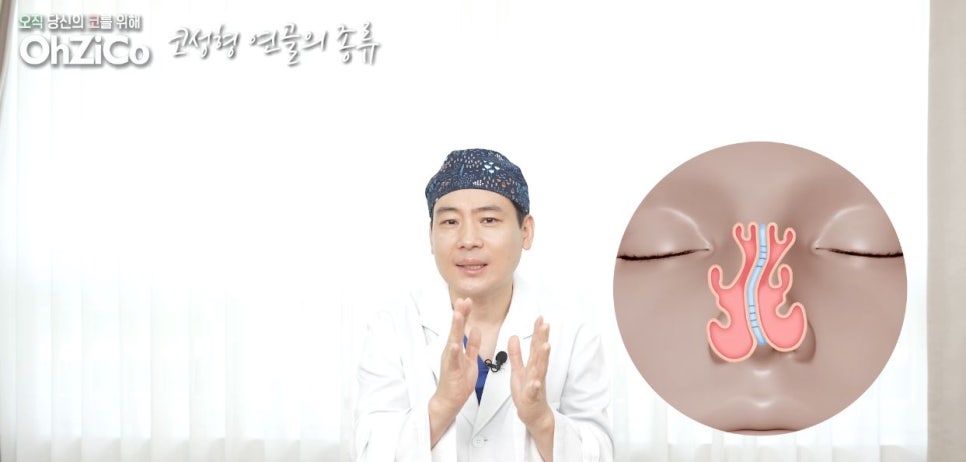
However, in some cases, septal cartilage is bent, and the size varies from person to person. Some cases are large, but in general, for East Asians, including Koreans, the size is small and thin. There are many cases where it is not enough to raise the nasal tip as much as desired.

Septal cartilage is a structure that supports the nose. If this septal cartilage is damaged, the nose can collapse and become upturned. Therefore, if septal cartilage was used before, it cannot be used again in revision surgery.

So the alternative that emerged was chest cartilage, or autologous rib cartilage. When we look at the ribs, the outside is made of hard bone, but closer to the center there is some flexibility. This part is the soft cartilage.

A section about the length of one finger joint is harvested and used for the nasal tip, and because the size is a bit larger, chest cartilage can also be used for the bridge of the nose.

As shown above, the cartilage materials used in rhinoplasty differ in shape and properties. The best material can be said to be chest cartilage, or autologous rib cartilage. Many people hesitate, wondering whether chest cartilage is really necessary for nose surgery, but recently autologous rib cartilage surgery has become quite common. Even in primary surgery, chest cartilage is often used. Because it is surprisingly firm and has a slightly larger volume, it allows you to aim for the nose shape you want and has the advantage of creating a beautiful line. However, if rhinoplasty is being done only to add a small amount of height, there is no need to use autologous rib cartilage; septal cartilage or ear cartilage can be sufficient for correction.

Also, if you previously had a double-jaw surgery, the part where the septal cartilage and the bottom of the nose are attached is cut and moved inward. Therefore, because there is no support, autologous rib cartilage is recommended in such cases. If the septal cartilage is very large and strong, surgery with septal cartilage is recommended. Septal cartilage can also be a good material. However, because septal cartilage is a structure that supports the nose, if inflammation occurs after septal surgery, there is a high possibility that the shape of the nose will change unfavorably.

The disadvantage of ear cartilage is that when cartilage is removed from the ear, the ear may become slightly smaller and the inner part of the ear may become thinner, so the overall shape of the ear can change somewhat. Also, there is a nerve behind the ear that is responsible for sensation, and since it passes through the area needed for rhinoplasty, the nerve may sometimes be cut. In such cases, there can be severe ear pain. This can last as little as 6 months and as long as 1 year and 6 months. These factors should be taken into consideration.

Therefore, when autologous rib cartilage is used, if the part that lifts the nasal tip is carefully and sufficiently refined, it can look softer, and even in the case of a thick, fleshy nose, adjusting the width and other factors can give it a sharper appearance. With septal cartilage, it is important not to harvest as much as possible, but to safely leave enough behind. At Plus Clinic, we often use a combination of septal cartilage and ear cartilage by harvesting only the amount needed to create proper support and then adding more height with ear cartilage. In the case of autologous rib cartilage, it can be fully effective on its own.

Up to this point, we have reviewed the septal cartilage, ear cartilage, and autologous rib cartilage used in rhinoplasty, including the properties and features of each and which cartilage is suitable for which type of nose. I hope this article has been very helpful for those who are currently considering rhinoplasty. Thank you.


https://tv.naver.com/v/30091978