Let’s take a look at the cases in which rhinoplasty for rhinitis is really necessary when you have rhinitis.

What is rhinitis?
Rhinitis can be broadly divided into two types:
allergic and non-allergic.
Rhinitis is inflammation inside the nose that causes nasal congestion, sneezing, itching, and discomfort.
Non-allergic rhinitis:
This is not caused by allergies, but by various factors, including viral infections, hormonal imbalance, or environmental factors such as exposure to extreme
temperature, humidity, or smoke.
Allergic rhinitis:
It occurs when the immune system reacts to allergens, causing cells to release chemicals that
make the inner lining of the nose swell and react.

Among these two, the type of rhinitis that can benefit from rhinoplasty for rhinitis is non-allergic rhinitis.
Allergic rhinitis does not benefit much from rhinoplasty for rhinitis.
So, if you have non-allergic rhinitis,
it is better to undergo surgery.
Then what types of rhinoplasty for rhinitis are there?
First, there is turbinate reduction surgery.
Turbinate reduction surgery is performed to make breathing easier in patients with chronic nasal congestion.
This surgery is also called turbinate reduction surgery or inferior turbinate reduction surgery.
(When both sides of the nose are operated on, it is called bilateral turbinate reduction surgery.)
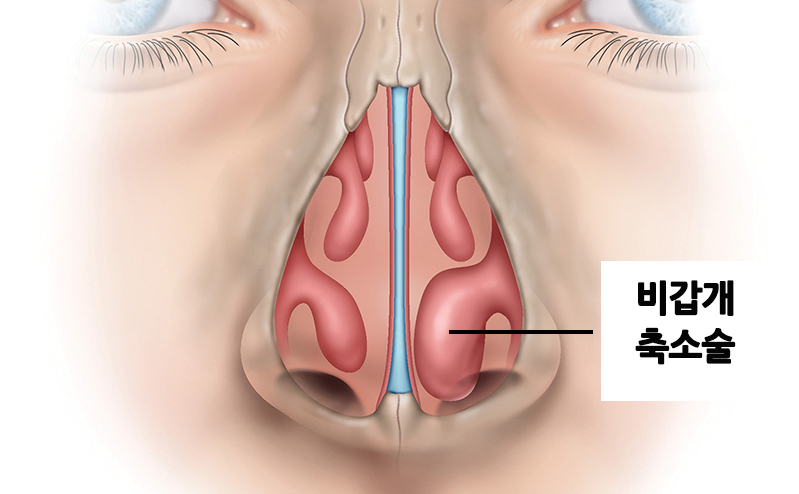
Turbinate reduction surgery removes excess tissue around the turbinate bone to make
breathing easier. Turbinates are small structures inside the nose.
As air passes through the nasal cavity and into the lungs, they filter,
warm, and humidify the air.
Turbinates can become inflamed and swollen as a result of irritation, allergies, or infection.
In most cases, this inflammation is temporary.
However, some people may develop chronic swelling of the turbinates.
Turbinate reduction is sometimes performed on its own, and sometimes together with
septoplasty.
The overall success rate of turbinate reduction is about 82%, and although the tissue around the turbinate can grow back, most patients
who have undergone turbinate reduction surgery are satisfied with the results.
Pros and cons of inferior turbinate reduction surgery for rhinitis?
Advantages:
Disadvantages:
How long is the recovery time after turbinate reduction?
You can return to daily life the day after turbinate reduction surgery,
but the recovery period for the turbinates takes at least 6 weeks.
The second case where rhinoplasty for rhinitis is performed is when there is a deviated septum.
A deviated septum occurs when the thin wall between the nostrils (the septum) is shifted to one side.
In many people, the septum is off-center or crooked, making one nasal passage smaller.
If the deviated septum is severe, one side of the nose becomes blocked, reducing airflow
and causing breathing difficulties.
When a crooked septum is exposed to the drying effect of airflow through the nose,
some people may occasionally develop crusting or
bleeding.
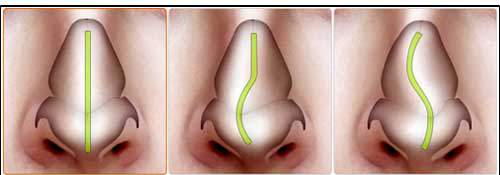
Nasal obstruction or stuffiness can occur when the septum is bent, the
tissue covering the nose is swollen, or both.
Symptoms of deviated septum in rhinoplasty for rhinitis?
-One or both nostrils blocked. Nasal congestion can make
it difficult to breathe through the nostrils.
People are prone to colds or allergies that cause swelling and narrowing of the nasal passages.
Nosebleeds. If the surface of the septum is dry, the risk of nosebleeds can increase.
Noisy breathing during sleep. A deviated septum or swollen nasal tissue may be
one of the many causes of breathing noise during sleep.
Preference for sleeping in a certain position. Some people, when their nasal passages are narrowed,
prefer to sleep in a certain position to optimize breathing through the nose at night.
Causes of a deviated septum?
A deviated septum occurs when the nasal septum (the thin wall that divides the nasal cavity left and right) is shifted to one side.
A deviated septum can be caused by:
-
Being born with a crooked septum from the time of fetal development
-
Nasal injury and a deviated septum due to various accidents in childhood or adulthood
-
The aging process affecting the nasal structure and causing the septum to deviate over time
Surgery for a deviated septum?
We accurately determine the degree of septal deviation and whether inferior turbinate hypertrophy is present.
An incision is made inside the nose, and the deviated septal cartilage is
corrected by minimally removing the affected area.
If the posterior ethmoid bone or vomer bone is deviated,
that area is also corrected for a complete correction.
If inferior turbinate hypertrophy is present,
inferior turbinate correction is performed at the same time using special equipment.
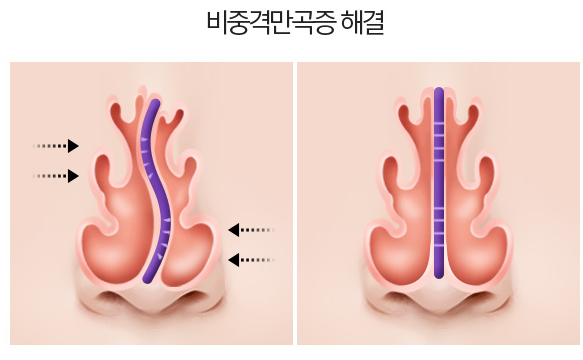
Finally, among rhinoplasty procedures for rhinitis, there is nasal valve reconstruction.
The nasal valve has internal and external valves on both sides of the nose.
It creates a relatively narrow airway in the middle and lower parts of the nose.
The valves often function to limit airflow.
Nasal resistance is important for creating the sensation of breathing.
It also slows the flow of air so that the air can be warmed, humidified, and filtered before entering the trachea and lungs.
These nasal valves can collapse when the cartilage becomes weak.
This often occurs after cosmetic rhinoplasty, where the valve cartilage has been narrowed for aesthetic reasons.
If the valve collapses during inhalation, air intake is restricted, causing snoring, mouth breathing, and
other problems.
How is nasal valve correction done in rhinoplasty for rhinitis?
Nasal valve correction is broadly divided into two cases: when the internal nasal valve is narrowed
and when the external nasal valve is narrowed.
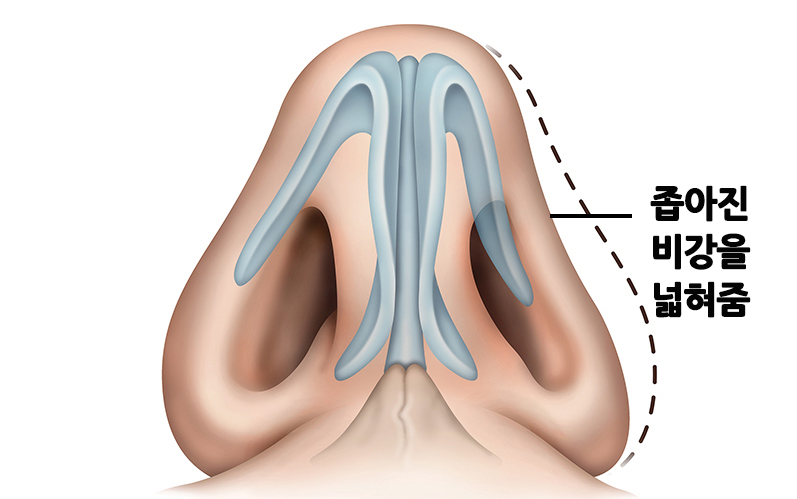
Internal nasal valve surgery
An appropriate amount of septal cartilage is harvested,
and cartilage is grafted to the roof area of the septum
to widen the nasal valve area.
External nasal valve surgery
If the alar cartilage, which is the outer part of the nasal valve, is weak,
the nasal valve becomes narrowed. In such cases,
the alar cartilage is reinforced through cartilage or skin grafting.
When undergoing rhinoplasty for rhinitis like this, it is important to
identify the cause accurately before surgery.